
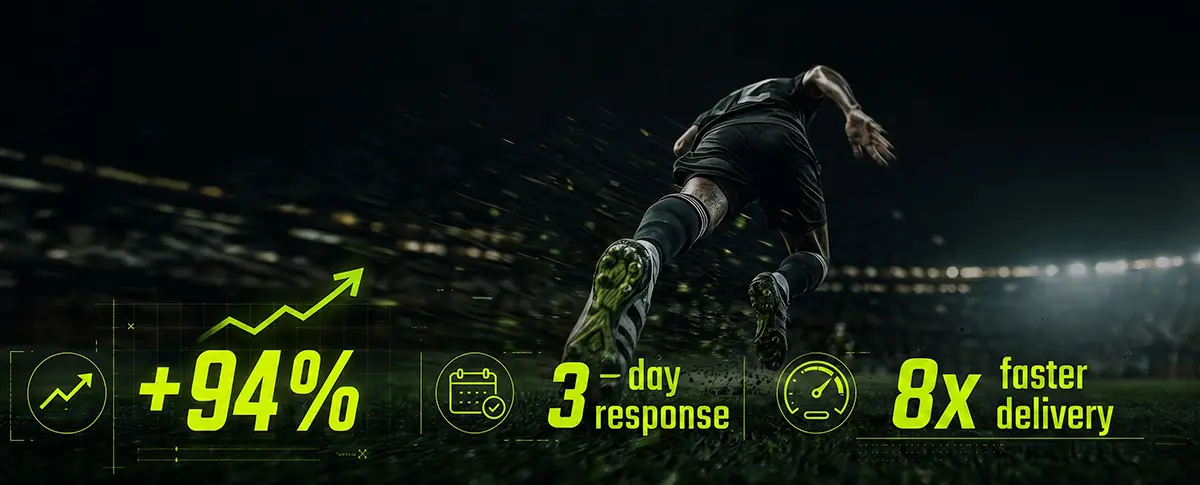

Year over year we have seen a 94% increase in feature requests from customers.
In Q1 2025, customers sent us 60 feature requests. In Q1 2026, they sent 161. That’s a 168% increase in the same quarter, one year apart.

Zoom out to full years, and the trend holds. Requests grew from 227 in 2024 to 441 in 2025, nearly doubling. In 2026 so far we’ve already logged 241, and we’re not yet halfway through the year.
More requests can be a warning sign. It means longer queues, slower replies, and a backlog that quietly grows. However, we found the exact opposite to be true.
When a customer submits a request, the first thing that matters is whether anyone is listening. So we measured time to first response: how long does it take until a real person on our team reply.
In Q1 2025, that took a median of 16.5 days. In Q1 2026, it took 3 days. An 82% reduction, even as request volume nearly tripled.

Approvals moved in the same direction. Time from submission to approval dropped from 5.6 days to 2.9 days, a 48% improvement.
A fast reply is worth little if the feature never ships. So we measured the number that’s hardest to fake: time from request to delivery.
At the start of 2025, it took us an average of 178 days to deliver on these requests. By Q1 2026, it was under 20.
Read that again. The wait between requesting a feature and its use in production fell from roughly six months to under three weeks.
And what we shipped to production speaks for itself:
And the small stuff too. Even something as simple as opening a link in a new tab was a customer request, because the details are what make a trading floor feel built for you.
Some requests are a single market. Others reshape the roadmap. One of the most in-demand capabilities operators were chasing was a bet builder. So we built our own same game parlay engine, Combo Builder, with our odds, our pricing, and full control for you to run your business.
That is what listening at scale looks like. When enough of you ask for the same thing, it stops being a feature request and becomes a priority.
Every number above started as someone like you typing a request into a box.
The roadmap that came out of it wasn’t written in a boardroom. It was written by the people who use LSports every day.
So if there’s coverage you need, a market you’re missing, or a capability that would make your operation sharper, tell us. We read every request, respond within days, and, increasingly, ship.




“LSports가 데이터를 빠르게 취합하여 우리가 명성을 얻은 통찰력과 분석을 제공할 수 있게 하는 속도와 방식이 중요해요.”

“LSports는 다른 어떤 제공업체도 제공할 수 없는 마켓을 제공하며, LSports의 도움으로 우리는 주요 이벤트 및 리그의 선수 소품에 대한 빠른 서비스를 제공해요.”

“LSports는 업계에서 가장 빠른 데이터 수집 업체야. 다양한 소스에서 데이터를 가져와 실시간으로 제공하는 데 탁월해.”

“BOOST를 사용해본 후 솔직히 말해서, 이것은 제가 우리 플랫폼에 구현한 최고의 고급 AI 참여 도구 중 하나라고 할 수 있어요.”



