


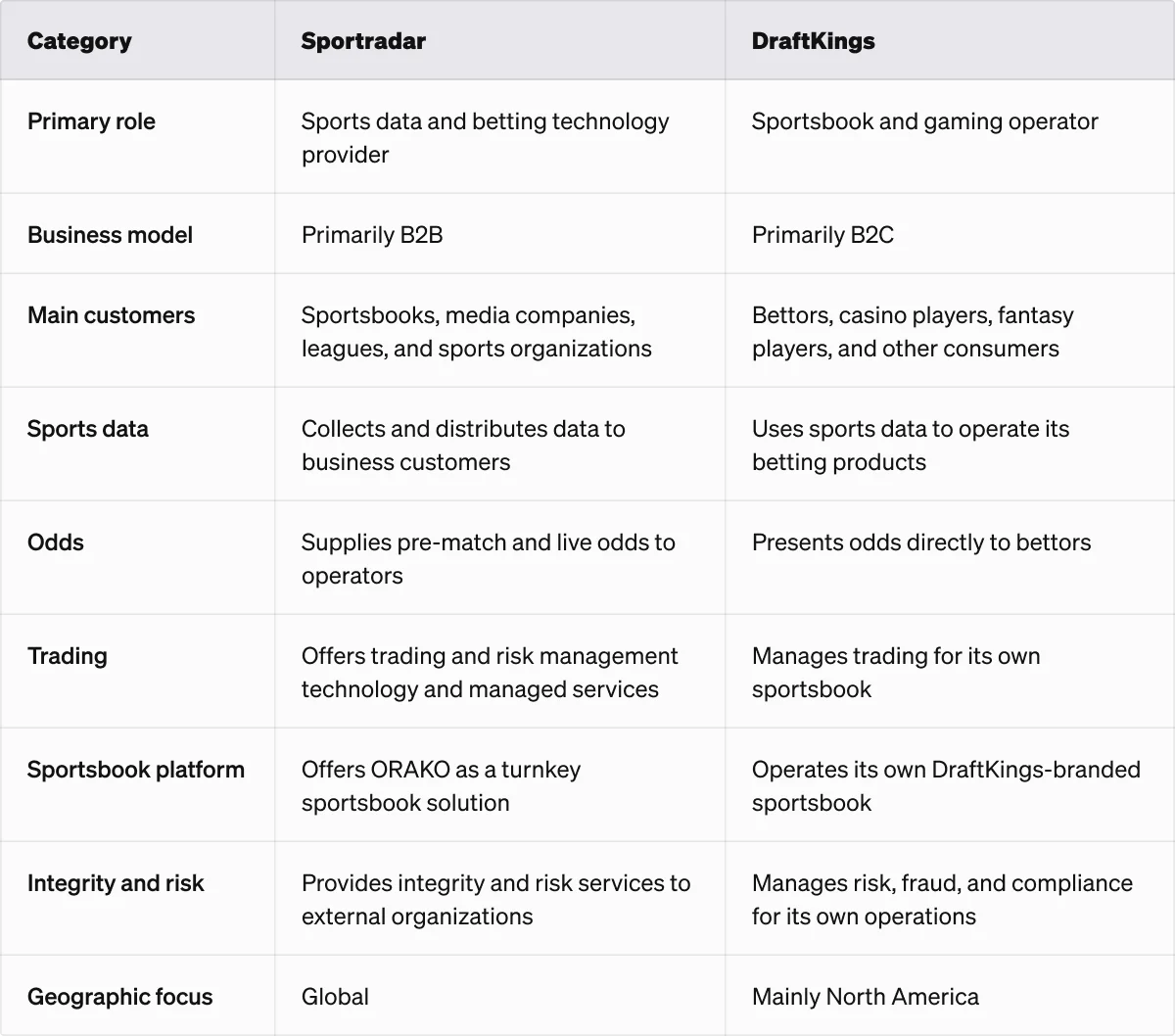

Sportradar is a sports technology company that provides data, betting technology, media solutions, and other services to sportsbooks, sports organizations, and media companies. For betting operators, its services cover much of the sportsbook operation, from collecting sports data and creating odds to managing risk and engaging players.
Sportradar states its sports data API covers 80+ sports, 500+ leagues, and more than 750,000 events annually, with data available through JSON and XML feeds. Sportradar also offers a turnkey sportsbook platform for operators that want more than standalone feeds or individual tools.
Some of Sportradar’s main products and capabilities include:

DraftKings is a digital sports entertainment and gaming company best known for its consumer-facing sportsbook. It operates its own betting and gaming products and accepts wagers directly from customers.
The company started with daily fantasy sports and later expanded heavily into regulated sports betting and online casino gaming. As of 2026, DraftKings has also expanded into prediction markets, while its broader portfolio includes lottery and media products.
Its main offerings include:
Sportradar is primarily a B2B sports technology provider, meaning it supplies data, technology, and other services to sportsbooks rather than taking bets directly from customers. You can use its sports data, odds, trading, risk management, and sportsbook technology to power different parts of your betting platforms.
DraftKings operates mainly as a B2C betting and gaming company. Bettors create accounts directly with DraftKings, deposit money, place bets, and receive their winnings through the DraftKings platform.
Sportradar’s technology and sports content are designed to support you across numerous countries and betting markets. Its data coverage also extends across international sports, leagues, and competitions.
The DraftKings Sportsbook expansion is tied directly to where it is legally permitted to accept bets. As of February 2026, DraftKings Sportsbook operates mobile and/or retail betting in 29 US states, Washington, D.C., Puerto Rico, and Ontario, with additional expansion depending on licensing and local regulation.
Sportradar earns revenue by selling data, content, technology, and managed services to business customers. You may pay for a particular data feed, odds service, trading solution, sportsbook platform, or combination of products.
DraftKings primarily makes money from customers using its gaming products. In sports betting, revenue comes from the difference between customer wagers and payouts, after accounting for incentives and other adjustments. In 2025, DraftKings reported $53.55 billion in sportsbook handle and $3.83 billion in sportsbook revenue.
Sportradar and DraftKings are not direct competitors in the traditional sense. Both companies develop sports betting technology and operate in many of the same industry areas, but they occupy different positions in the market.
The companies have a supplier-customer relationship. Sportradar’s 2025 filing identifies DraftKings as one of the largest sports betting operators using its services.
Sportsbook technology is where the two companies come closest. Both have built the systems that run a betting product, but DraftKings built its stack for itself, while Sportradar packages ORAKO and sells the capability to operators.
Sportradar can be a strong choice for sportsbooks that want an established provider with a broad range of products. Its partnerships with major leagues and sports organizations benefit operators that prioritize official data and access to high-profile competitions.
However, that model can come at a high cost. Securing official and exclusive data rights for major competitions is expensive, and those costs affect the contracts offered to sportsbooks. As a result, you may pay a premium for access to official data, particularly when major leagues are a central part of your offering.
Sportradar’s product ecosystem may also be larger than some sportsbooks need. Its packages can be tailored, but access still runs through enterprise agreements with a high entry point and long commitment.
Compared to Sportradar, LSports offers a more flexible, cost-efficient approach to sports data.
Instead of relying only on exclusive data rights, LSports collects data through AI, computer vision, in-venue scouts, and 100+ live sources, helping you access extensive coverage at a reasonable price.
Its Sports API covers 100+ sports, 15,000+ leagues, and over 3 million fixtures annually, spanning major competitions as well as lower-tier leagues and niche sports.
The data is delivered in a standardized format, allowing you to integrate a wide range of sports and competitions through a single API rather than handling different formats for each.
The table below shows how Sportradar and LSports compare across the factors that matter most when choosing a sports data provider for your sportsbook:

ARENA360 is an integrated ecosystem that gives you tools for trading, risk management, performance analysis, and bettor engagement. It consists of four main solutions:
Request a demo today and see how LSports can help you expand your betting coverage, reduce data costs, and build a stronger sportsbook offering.
DraftKings competes with other major sportsbooks, including FanDuel, BetMGM, Fanatics Sportsbook, Caesars Sportsbook, and bet365, though the competitive landscape varies by market.
Yes. You can use multiple data providers at the same time. For example, you may have one provider for major competitions and another for additional sports, leagues, or markets. Multiple feeds also provide a backup if a primary feed becomes unavailable.
Yes. Sportradar has official data partnerships with numerous sports leagues and organizations, which give it authorized access to their data. These partnerships cover major properties across sports such as basketball, tennis, baseball, and ice hockey.
You should compare sports and league coverage, data speed and accuracy, pricing, API integration, reliability, and customer support. The right provider should match the competitions and betting markets you want to offer without making you pay for data or services you do not need.
Yes. Sportradar offers ORAKO, a turnkey sportsbook platform that provides much of the technology needed to operate a sportsbook. Operators can combine it with Sportradar’s player account management (PAM) technology or integrate it with a third-party PAM.
A sports data provider supplies information such as scores, match events, statistics, and results, while a sportsbook platform provider supplies the technology used to operate the betting product. Some companies offer both.
Yes. Betradar was Sportradar’s betting-focused brand, offering services such as sports data, odds, and betting solutions to operators. Sportradar phased out the Betradar brand and now offers these services under the name Sportradar.






"É a velocidade e a rapidez com que a LSports pode reunir conjuntos de dados para que possamos usá-los para fornecer o insight e a análise pelos quais somos reconhecidos."

"A LSports está fornecendo mercados que nenhum outro provedor pode oferecer, e com a ajuda da LSports, temos uma oferta rápida de apostas em jogadores em eventos e ligas importantes."

"A LSports é a coletora de dados mais rápida do setor. Eles são excelentes em obter dados de diferentes fontes e entregá-los em tempo real."

"Depois de usar o BOOST, posso dizer honestamente que esta é uma das melhores e mais avançadas ferramentas de engajamento com IA que implementei em nossa plataforma."



