2026年10月7日
电子竞技投注赔率是如何计算的?[详解]
了解电子竞技博彩赔率的计算方法,并学习如何为市场定价、考虑游戏相关因素以及持续更新赔率。

在本文中
订阅
保持领先地位
获取有关体育数据、博彩趋势和行业新闻的最新见解——直接发送到您的收件箱。
这是一个标题
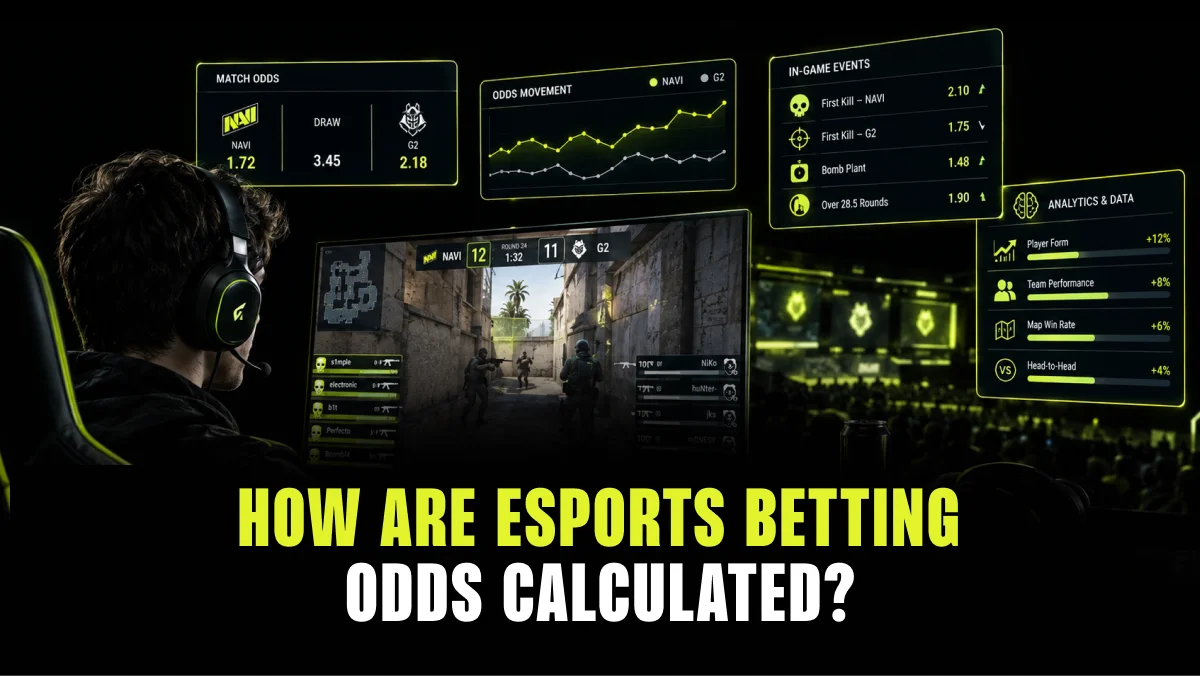
eSports betting allows participants to wager on the outcomes and in-game events of competitive video game matches.
According to Esports Charts, live eSports competitions generated a record 3.3 billion hours watched in 2025 worldwide, excluding mainland China. Younger generations are more likely to bet on these competitions. In 2023, YouGov reported that 12% of users aged 18–34 had bet on eSports in the previous 12 months, compared with just 2% of those aged 55+.
As eSports attracts more bettors, you need to offer a strong selection of markets while ensuring odds are priced accurately and updated as matches unfold.
In this guide, you will learn how eSports betting odds are calculated and which factors you need to consider when setting your prices.
Key Takeaways
- Start by estimating the probability of each outcome
You need to assess how likely each result is, convert those probabilities into odds, and then add your sportsbook margin.
- Look beyond basic wins and losses when setting your odds
Consider opponent strength, current form, maps, drafts, game patches, match format, and situational factors to build more accurate prices.
- Update your odds continuously during live matches
Use game-specific data such as round scores, team economy, kills, objectives, gold, and map position to recalculate probabilities as the match develops.
- Offer a mix of core and game-specific eSports markets
You can cover match winners, handicaps, totals, correct scores, player props, first objectives, and tournament markets to give bettors more ways to engage.
- Use LSports to automate and scale your eSports betting offering
LSports gives you the data needed to power eSports markets, while its ARENA360 offering helps you automate trading, manage risk, optimize performance, and improve bettor engagement.
What are eSports?
eSports are organized video game competitions where professional players and teams compete against each other. They can range from smaller online tournaments and regional leagues to major international events held in large arenas. Popular eSports include:
- Shooter games
- Multiplayer online battle arena (MOBA) games
- Sports games
- Battle royale titles
- Real-time strategy games
Most popular eSports
eSports has grown into a major global entertainment industry, with top tournaments drawing millions of viewers. Some of the most popular competitive titles include:
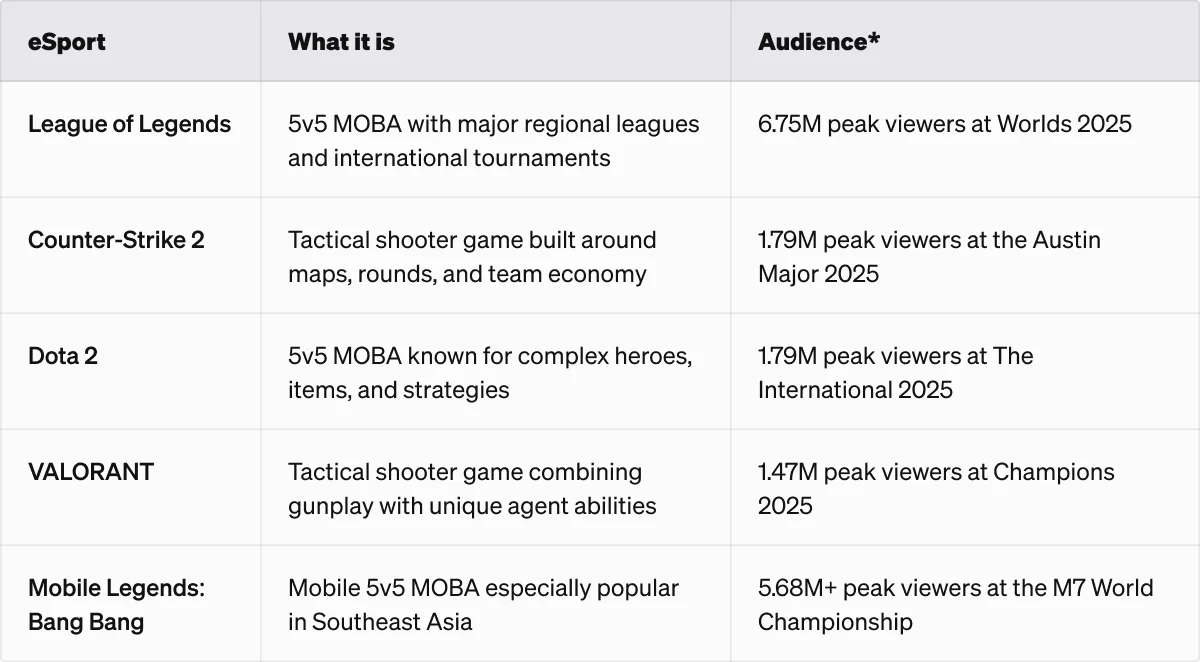
*Audience data is based on peak viewership figures reported by Esports Charts for League of Legends, Dota 2, VALORANT, and Mobile Legends: Bang Bang, and by BLAST.tv for Counter-Strike 2.
Types of odds for eSports betting
eSports betting uses the same odds formats as regular sports betting. The main ones include:
- American (moneyline) odds: Mainly used in the US, American odds display prices as positive or negative numbers. Negative odds generally indicate the favorite, while positive odds indicate the underdog. For example, a favorite may be priced at -150, while an underdog may be offered at +130.
- Decimal odds: Common across Europe, Canada, Australia, and many international betting markets, decimal odds show the total return for each unit staked. For example, odds of 2.50 mean a $10 winning bet returns $25 in total, including the original $10 stake.
- Fractional odds: Most common in the UK and Ireland, fractional odds show potential profit relative to the stake. For example, odds of 5/2 mean a $10 winning bet generates $25 in profit, with the original $10 stake also returned.
- Hong Kong, Indonesian, and Malaysian odds: These formats are primarily used across Asian betting markets. Hong Kong odds use positive decimal-style values, while Indonesian and Malaysian odds use combinations of positive and negative numbers to represent the price.
How eSports betting odds are calculated
eSports odds can depend on a wide range of game-specific factors that change quickly, making pricing more complex. Here is how you can account for these factors and calculate accurate eSports betting odds:
1. Define the event and settlement rules
Before calculating odds, you need to define exactly what the bettor is betting on. For example, does the market cover a single map, the entire best-of-three match, or a team’s advancement to the next tournament round?
Make sure your data feed, trading system, bet slip, and house rules all use the same team names, map numbers, start times, and settlement conditions. This helps you price markets correctly and prevents confusion when it is time to settle bets.
2. Build a baseline team or player rating
Next, you need to estimate how strong each team or player is based on past performance. You can start with a rating system such as Elo, then improve it by weighting recent results more heavily and accounting for factors such as opponent strength, maps, sides, regions, and tournament level.
Do not rely only on wins and losses. A team that wins eight of its last ten matches against weaker opponents is not necessarily stronger than a team that wins five out of ten against top-ranked competition.
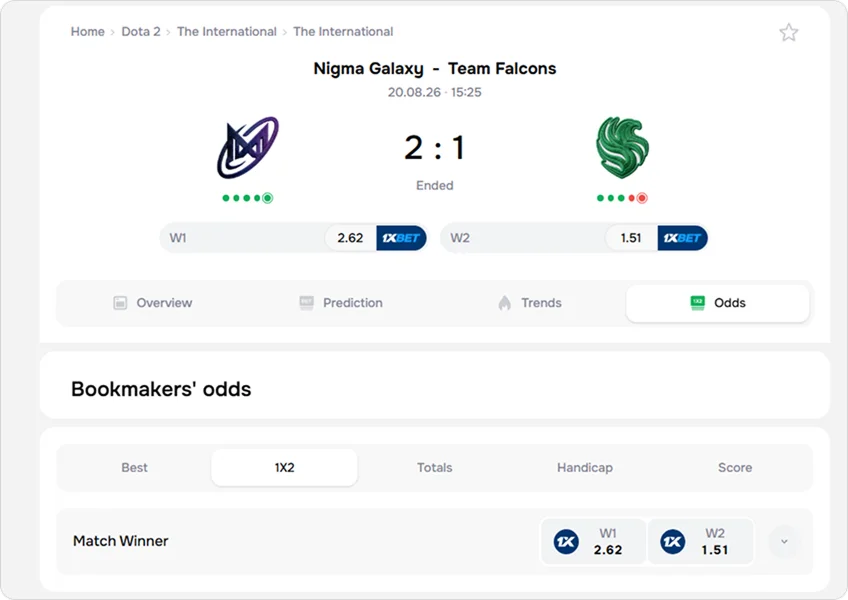
For example, look at Nigma Galaxy and Team Falcons at The International 2026. Nigma finished the group stage with an impressive 4–1 record, while Falcons went 3–2 and had to play an elimination match to reach the playoffs.
However, Nigma had faced a relatively easier set of opponents, while Falcons had played stronger competition. So, when the two teams eventually met in the playoffs, sportsbooks still considered Falcons the much stronger team and priced them as clear favorites at 1.51.
3. Account for maps, drafts, and the game version
You also need to consider the conditions under which the match is being played. eSports games change regularly through patches that can strengthen or weaken characters, adjust items, modify maps, and shift which strategies are most effective. After a major update, older results may be less useful for predicting how a team will perform.
Maps and drafts can also significantly change the odds. In Counter-Strike 2 or VALORANT, a team that is the overall underdog may be much stronger on a particular map. In Dota 2 or League of Legends, the draft can give one team better lane matchups, stronger late-game potential, or a more effective team-fight composition.
For this reason, you may pause certain markets while the map veto or draft takes place. Once the selections are confirmed, traders can use this new information to recalculate the odds before reopening the market.
4. Model the match format
You also need to consider how many maps or games a team must win to take the series. A best-of-one is generally less predictable than a best-of-five because a favorite has fewer chances to recover from one poor map. The format also affects markets such as correct score, map handicaps, and total maps played.
When modeling the series, account for:
- Series length: Best-of-one, best-of-three, and best-of-five formats produce different probabilities.
- Map win probability: A team’s estimated chance of winning each individual map affects its overall chance of taking the series.
- Map selection: Teams may be much stronger or weaker on specific maps, making the draft or veto process important.
- Side choice: Starting on a preferred side can influence a team’s chances on certain maps.
- Fatigue and adaptation: Longer series give teams more time to adjust their strategy, but they can also increase fatigue.
5. Include situational factors
You should also consider the circumstances surrounding the match, as two teams with similar statistics may perform very differently depending on the conditions. These factors should not outweigh stronger performance data, but they can help make the odds more accurate.
Consider situational factors like:
- Travel and time zones: Long journeys and major time differences can affect preparation and player performance.
- Tournament schedule: Teams playing several matches in a short period may have less time to rest and prepare.
- Online vs. LAN play: Some teams perform differently when competing remotely than at an in-person event.
- Server location: In online competitions, server location can affect latency and potentially give one team better playing conditions.
- Competition stage: A group-stage match may matter less than an elimination or championship match.
- Head-to-head history: Previous meetings can provide useful context, particularly when the teams have faced each other recently.
However, use historical head-to-head results carefully. A team may have beaten the same opponent several times, but those matches become less relevant if the rosters, maps, game version, or competitive conditions have changed significantly.
6. Recalculate odds during live play
Once the match starts, you need to continually update the odds as the game develops. Your in-play model can start with the pre-match assessment and then incorporate live match data.
The exact data depends on the eSport:
- CS2 and VALORANT: Map and round score, team economy, available weapons, surviving players, side selection, and likely purchases for the next round
- League of Legends, Dota 2, and MLBB: Kills, gold or net worth, destroyed structures, neutral objectives, map position, game time, draft scaling, and important ability or buyback availability
Your model can use this information to estimate the probability of each remaining outcome and update the odds accordingly. Markets may also need to be temporarily suspended during decisive moments, such as a bomb plant, major team fight, objective contest, or interruption to the live data feed.
eSports betting markets you need to offer
Here are the main eSports betting markets you should consider offering on your sportsbook:
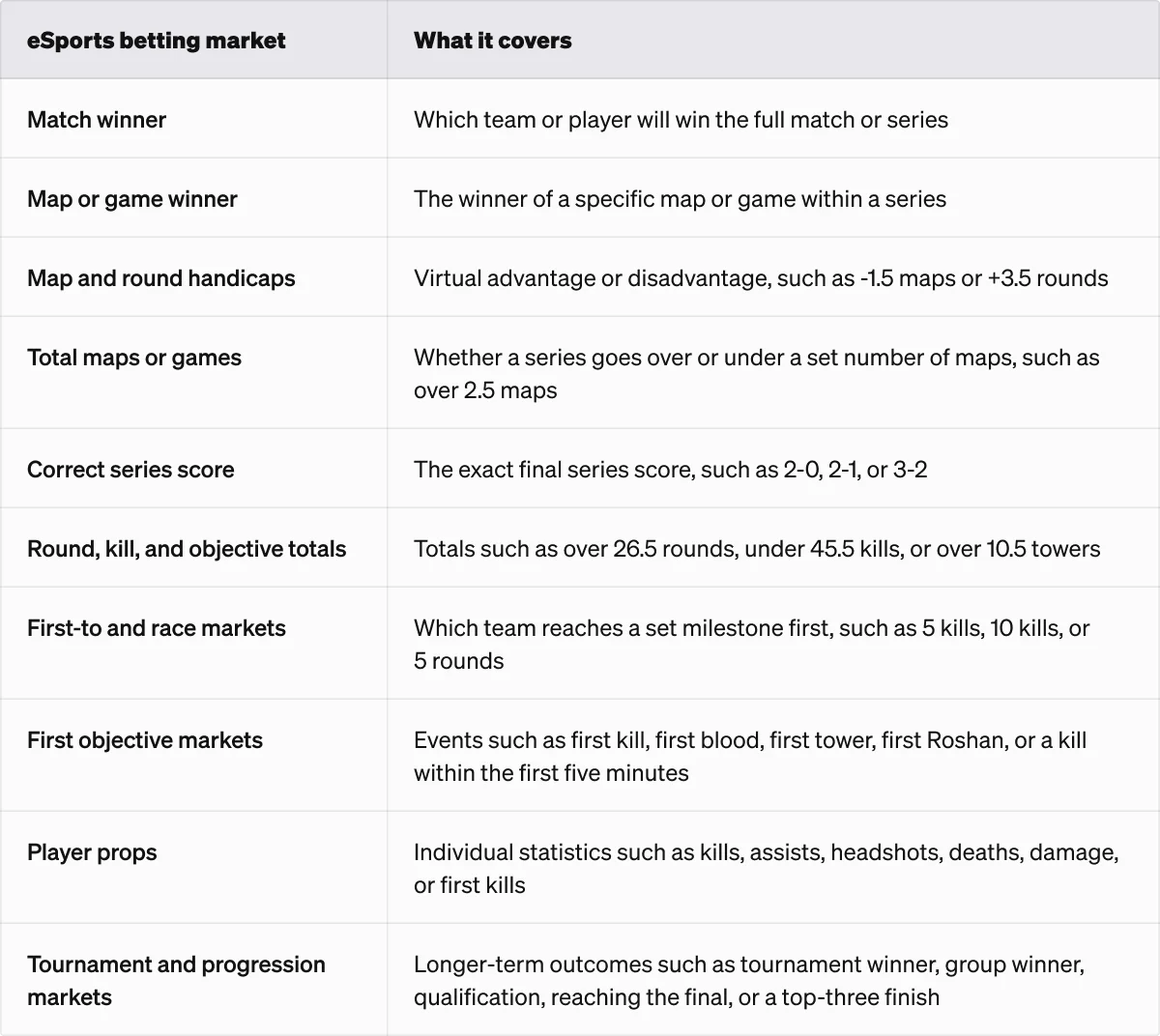
Expand your eSports betting offering with LSports
LSports provides an eSports API that combines simulated sports with popular competitive gaming titles, covering 23 sports and 950,000 fixtures.
To help turn this data into betting markets, TRADE automates key parts of the trading process, including odds creation, market management, live updates, and settlement. This helps you keep pre-match and in-play eSports markets accurate as rounds, kills, objectives, and match scores change.
LSports also provides additional tools to support every part of your sportsbook offering:
- DEFEND helps you monitor betting activity, manage exposure, and identify suspicious patterns across your markets.
- BOOST gives you insight into market performance, uptime, margins, and data quality.
- ENGAGE adds visualizations and interactive features that create a more engaging betting experience.
Request a demo to see how LSports can help you broaden your eSports coverage, automate trading, manage risk, and improve the betting experience.
常见问题解答:
1. Is eSports betting legal?
Yes, eSports betting is legal in many jurisdictions, but the rules depend on where you operate. In the US, sports betting is regulated primarily at the state level, and individual states determine whether licensed sportsbooks may offer eSports markets and under what conditions.
2. What are the most popular eSports bets?
Some of the most popular eSports bets include match winner, map winner, handicaps, total maps, correct series score, kill totals, first kill or first blood, and player props. The markets that attract the most interest can vary considerably between games because titles such as Counter-Strike 2, League of Legends, Dota 2, and VALORANT have different competitive structures and statistics.
3. How do eSports sportsbooks get live match data?
Sportsbooks typically receive live eSports data through specialized data feeds that collect and distribute match events, such as scores, rounds, kills, objectives, and player statistics. Your trading system can then use this information to update markets and odds as the match develops.
4. What makes eSports betting difficult for sportsbooks?
Frequent game patches, roster changes, map selections, drafts, different tournament formats, and rapidly changing live match conditions can all make eSports markets challenging to price. You also need reliable, low-latency data because key events can change an outcome’s probability within seconds.