28 de outubro de 2026
Como as casas de apostas detectam e evitam o abuso de bônus em 2027
Saiba como as casas de apostas detectam e evitam o abuso de bônus, desde a criação de múltiplas contas e a arbitragem até a identificação de dispositivos e a avaliação de risco em tempo real.

Neste artigo
Inscreva-se
Fique à frente do jogo
Receba as últimas análises sobre dados esportivos, tendências de apostas e notícias do setor — diretamente na sua caixa de entrada.
Este é um título
Bonus abuse occurs when bettors exploit sportsbook promotions to gain rewards or value beyond what an offer was designed to provide. In a March 2026 LexisNexis Risk Solutions survey of 993 North American online gaming decision-makers, 78% cited bonus abuse as a top fraud threat.
Preventing this activity helps protect your promotional budget and your margins while ensuring legitimate customers can still benefit from your offers.
In this guide, you’ll learn how to detect and prevent bonus abuse in sports betting, along with how it happens in the first place.
Principais conclusões
- Bonus abuse takes several forms
Bettors can exploit promotions through duplicate accounts, referral manipulation, matched betting, low-risk wagering, and promotion-related arbitrage. Some of these behaviors only become abuse when they violate your terms or involve deception.
- Clear promotion rules are your first line of defense
Define who qualifies, how often an offer can be claimed, what wagering requirements apply, and which markets or jurisdictions are eligible so customers and your risk team know the boundaries.
- Detecting abuse requires connecting multiple signals
Similar bets or quick withdrawals are not proof of abuse on their own. Proper investigation should combine betting behavior with signals such as shared identities, devices, payment methods, IP addresses, account links, and repeated bonus claims.
- Your bonus engine also needs safeguards against duplicate rewards
Configure each qualifying action to trigger a reward only once and test how your system handles repeated events, voided wagers, partial cash-outs, and settlement corrections before a promotion goes live.
- LSports helps you detect and control suspicious betting activity
LSports’ DEFEND helps your team spot suspicious promotional betting as it happens and take proportionate action against higher-risk accounts while allowing legitimate customers to continue betting.
What is bonus abuse in sports betting?
Bonus abuse in sports betting happens when a bettor exploits sportsbook promotions in ways that violate the offer’s terms or uses deception to claim rewards they are not eligible for. Common examples include:
- Creating multiple betting accounts to repeatedly claim welcome offers
- Using fake or borrowed identities
- Abusing referral programs
- Coordinating accounts to bypass promotional limits
Which sportsbook promotions are most exposed to bonus abuse?
The table below shows common sportsbook promotions that can be targeted for bonus abuse and how they may be exploited.
Welcome bonus
- How it works: Rewards new bettors for registering, depositing, or placing their first qualifying wager
- Why it’s targeted: High one-time value
- How it’s abused: Opening multiple accounts or using fake identities to claim the bonus repeatedly
No-deposit bonus
- How it works: Gives new bettors bonus funds or betting credit without requiring an initial deposit
- Why it’s targeted: No upfront cost to the bettor
- How it’s abused: Registering several accounts to collect funds without risking any money
Free bet
- How it works: Provides betting credit that can be used on eligible sports markets
- Why it’s targeted: Credit that can be converted into cash through hedging
- How it’s abused: Claiming free bets through linked accounts and covering the opposite outcome on an exchange or at another sportsbook
Referral bonus
- How it works: Rewards existing customers for referring new bettors who meet qualifying requirements
- Why it’s targeted: A reward for every qualifying sign-up
- How it’s abused: Referring secondary accounts or coordinating with others to generate fake referrals
Reload bonus
- How it works: Adds bonus funds or credit when an existing bettor makes a qualifying deposit
- Why it’s targeted: Repeatable rewards for existing customers
- How it’s abused: Cycling funds between linked accounts to trigger more reloads than the terms allow
Cashback
- How it works: Returns part of qualifying betting losses as cash or bonus funds
- Why it’s targeted: Partial refunds on losing bets, which reduce the cost of hedging
- How it’s abused: Placing offsetting bets across linked accounts so one side wins and the losing side qualifies for cashback
Odds boosts
- How it works: Increases the price or potential return on selected bets
- Why it’s targeted: Prices above your standard odds, usually with per-customer stake limits
- How it’s abused: Using multiple accounts to stake more than the per-customer limit allows
Bet-and-get offers
- How it works: Awards a free bet or bonus after a bettor places a qualifying wager
- Why it’s targeted: A low qualifying requirement
- How it’s abused: Triggering the reward repeatedly through multiple accounts, often with low-risk qualifying bets
Common methods of bonus abuse
Here are the most common methods bettors use to take advantage of sportsbook promotions and extract their value:
1. Multiple accounts
Multi-accounting is when one person creates or controls several betting accounts to claim a promotion more than once. Players may use different email addresses, phone numbers, payment methods, devices, or even other people’s identities to make the accounts appear unrelated.
For example, a player might claim your welcome bonus, then open a second account using a partner’s identity, a new email address and phone number, and a different debit card to claim it again.
2. Bonus hunting and bonus bagging
Bonus hunting or bonus bagging involves actively searching for sportsbook promotions and using them primarily to extract promotional value. A player may sign up, complete the minimum requirements needed to receive or withdraw the bonus, and then stop betting with the sportsbook.
This behavior is not automatically abuse, since players can choose sportsbooks based on their promotions. It becomes an abuse issue when players break eligibility rules, use multiple accounts, provide false information, or use other prohibited methods to repeatedly access offers.
3. Matched betting
Matched betting is when a bettor uses a sportsbook’s free bet or bonus credit and covers the opposite outcome with a lay bet on a betting exchange, where users can bet against a result. This reduces their exposure to the event outcome and helps convert promotional credit into withdrawable cash. It is commonly used with welcome bonuses, free bets, and bet-and-get offers.
Most sportsbooks don’t prohibit matched betting, but using multiple accounts or someone else’s identity to collect extra free bets can violate promotional terms.
4. Low-risk wagering
Low-risk wagering involves placing bets designed to minimize the chance of losing funds while completing a promotion’s wagering requirements. Players may choose short-priced selections or other wagers they consider relatively safe to meet turnover requirements and unlock bonus funds.
Choosing low-odds bets isn’t abuse per se, but it becomes a concern when players use prohibited betting patterns, coordinated accounts, or other methods your promotional terms specifically exclude.
5. Referral abuse
Referral abuse occurs when players manipulate refer-a-friend promotions to collect rewards without bringing genuine new customers to your sportsbook. A player might create additional accounts, refer themselves, or coordinate with others to generate referral rewards while hiding the connection between accounts.
6. Promotion-related arbitrage betting
Promotion-related arbitrage betting is when a bettor combines a bonus or boosted odds at your sportsbook with bets at other bookmakers to cover every possible outcome of an event.
Instead of using an exchange, they take advantage of price differences between sportsbooks, with the promotion helping create a profitable opportunity. It can occur with promotions such as odds boosts and reload bonuses.
Arbitrage betting isn’t automatically bonus abuse either. It becomes abuse when bettors use promotions for arbitrage in violation of your terms or use linked accounts to claim offers they’re not eligible for.
How can you detect and prevent bonus abuse in online gambling?
Preventing bonus abuse requires identifying where your promotions can be exploited and putting the right safeguards in place before abuse occurs.
1. Set clear eligibility rules for every promotion
Before launching a promotion, define exactly who can claim it, how often they can claim it, and what they must do to receive the reward. Clear rules make it easier for customers to understand the offer and for your team to identify attempts to bypass restrictions.
For example, a welcome bonus might be:
- Available only to customers opening their first account with your sportsbook
- Limited to one bonus per person, household, device, or payment method, where appropriate
- Available only to customers in specified countries or jurisdictions
- Triggered by a minimum qualifying deposit or bet
- Subject to specific wagering requirements, minimum odds, or eligible markets
- Valid for a defined period after registration or activation
- Unavailable to customers who have already claimed the same offer through another brand, if your terms and operating model allow such a restriction
2. Verify identity and check for duplicate eligibility early
To reduce multi-accounting abuse, verify that each customer is who they claim to be and check whether they are already associated with another account.
Depending on your verification process, this can include validating an identity document, matching the customer’s face to the document photo, and using liveness detection to confirm that a real person is completing the check.
Verification alone, however, is not enough. Compare the verified identity and other account signals against your existing customer base to identify potential duplicate accounts.
Look for connections such as:
- The same verified identity or identity document
- Matching phone numbers, addresses, or payment methods
- Shared devices or IP addresses
- Previous accounts associated with the same customer
- Previous claims of the same welcome or one-time promotion
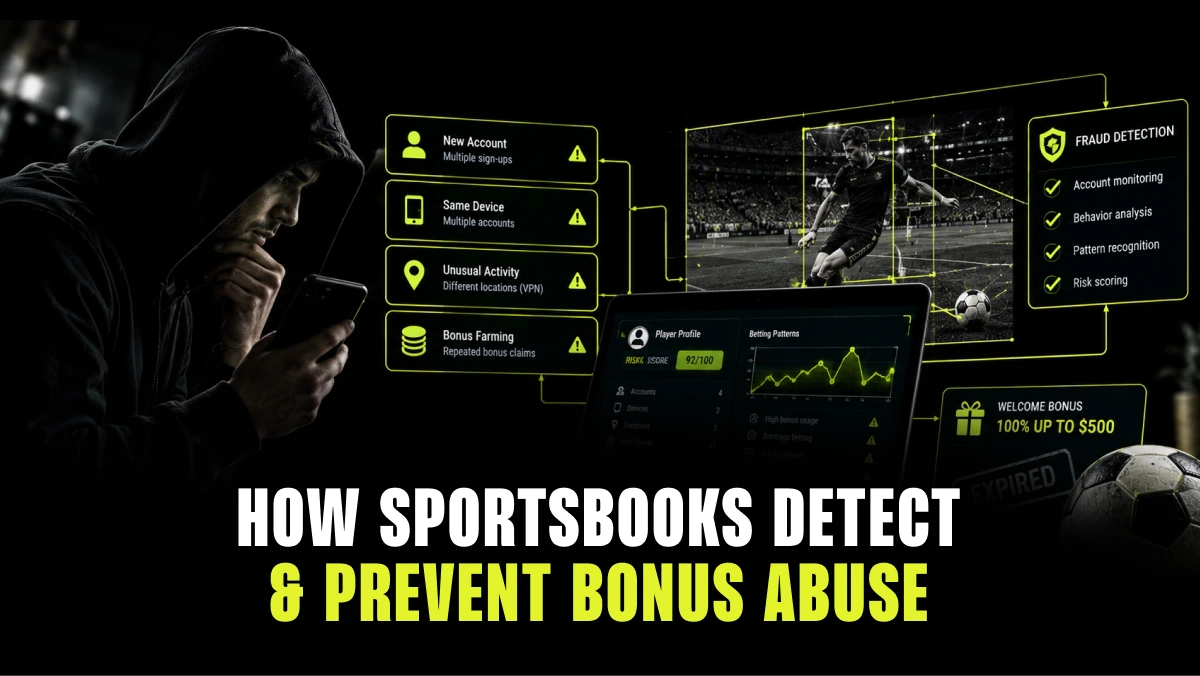
3. Monitor betting patterns for signs of coordinated abuse
Review how customers use promotional funds and look for betting patterns that may indicate the same person or group is controlling or coordinating accounts. Instead of treating a single unusual bet as proof of abuse, look for combinations of signals and repeated behavior.
For example, watch for groups of accounts that:
- Place the same or very similar bets within a short period
- Deposit similar amounts and follow the same sequence of qualifying bets
- Repeatedly claim the same promotions and use them in nearly identical ways
- Consistently place bets that appear designed primarily to satisfy wagering requirements
However, these patterns do not necessarily mean customers are abusing a promotion. For example, if you offer an odds boost on a major football match, many unrelated customers may naturally place the same bet within a short period.
Similarly, a customer may focus on promotional bets, win consistently, or withdraw soon after meeting the offer requirements while still following your rules.
Consider using a risk scoring system that assigns higher scores to accounts showing multiple suspicious behaviors. This helps your team prioritize accounts for manual review without restricting legitimate customers.
4. Prevent your system from issuing the same bonus twice
Some bettors exploit technical errors in your bonus system to claim the same reward more than once. For example, they may submit the same request multiple times or partially cash out a qualifying bet to trigger another bonus.
Configure your bonus engine so each qualifying action triggers a reward only once. For example, if the same qualifying deposit or bet is processed twice because of a delayed or repeated system event, the second event should not generate another bonus.
Before launching a promotion, test what happens when the original qualifying activity changes. This includes situations where:
- A qualifying bet is voided
- A customer partially cashes out a bet
- A result is corrected after settlement
- A transaction or system event is processed more than once
How LSports helps sportsbooks reduce bonus abuse
LSports helps you reduce bonus abuse with DEFEND, its risk management system for detecting suspicious betting behavior and controlling higher-risk activity. It monitors customer activity in real time, flags unusual or repetitive patterns, and gives you the tools to investigate potentially problematic accounts and apply targeted limits or restrictions.
With DEFEND, you can:
- Detect suspicious betting activity in real time: Monitor anomalies, sharp activity, customer behavior, and other risk signals as bets are placed, with automated alerts helping your team identify activity that requires attention.
- Monitor individual customer risk: Use the Live User Dashboard to view customer activity and risk levels, then segment players by risk level and type, including new, VIP, and sharp customers.
- Identify repetitive or high-risk betting behavior: Automatically flag or restrict repetitive and higher-risk betting patterns, such as unusual activity involving promotional bets, that may warrant investigation.
- Refer high-risk bets for manual review: Send bets that exceed predefined limits to the Live Bet Queue, where your team can review the customer’s risk flags, referral reason, odds, stake, and notes before making a decision.
- Review betting patterns retrospectively: Use Event Reports and customer histories to analyze previous bet slips and activity, and determine whether suspicious behavior is isolated or part of a recurring pattern.
- Maintain an audit trail: Keep records of customer histories, notes, actions, decisions, and timestamps so your team has additional context when investigating suspected bonus abuse.
Request a demo today to see how DEFEND can help you reduce losses from bonus abuse without disrupting the experience for legitimate bettors.
Perguntas frequentes:
1. Does a bonus bet turn into real money?
A bonus bet itself typically cannot be withdrawn as cash, but the winnings may be withdrawable depending on your promotion terms. Make it clear to customers whether the bonus stake is included in the return and whether they need to meet any additional wagering requirements.
2. Is promo abuse illegal?
Promo abuse usually counts as a breach of a sportsbook’s promotional terms, but some methods may also violate applicable fraud or other laws. The legal position depends on your jurisdiction and whether the activity involves conduct such as identity theft or deliberate misrepresentation.
3. What are bonus bets in sports betting?
Bonus bets are promotional credits you give customers to place eligible wagers without using the equivalent amount from their cash balance. You should define how the credit is used, when it expires, which markets qualify, and how you pay any resulting winnings.
4. How can you distinguish bonus abuse from legitimate promotional betting?
Focus on whether the customer has violated your promotional terms. Winning consistently or taking advantage of promotions isn’t abuse by itself, but evidence of intentional rule violations, such as claiming the same bonus through multiple accounts, can justify taking action.
5. How can bonus abuse affect your sportsbook?
Bonus abuse wastes your promotional budget on bettors who exploit offers without becoming long-term customers. It can also distort campaign results, making it harder to measure how effectively your promotions attract and retain genuine customers.
6. Can KYC prevent sportsbook bonus abuse?
KYC can help you prevent bonus abuse by verifying customer identities and making some forms of multi-accounting harder. However, it cannot catch every case, so you still need to monitor account connections and betting behavior after verification to identify abuse that only becomes visible later.