20 de maio de 2026
Integração da API de apostas esportivas: guia passo a passo completo
Uma API de apostas esportivas é uma interface tecnológica que permite que as plataformas acessem dados esportivos em tempo real, cotações e funcionalidades de apostas de provedores externos. À medida que cresce a demanda por experiências de apostas rápidas, precisas e envolventes, essas APIs desempenham um papel crucial no funcionamento das plataformas modernas de apostas esportivas. Neste artigo, vamos explicar como funciona a integração de uma API de apostas esportivas e o que você precisa levar em consideração ao implementá-la.


Neste artigo
Inscreva-se
Fique à frente do jogo
Receba as últimas análises sobre dados esportivos, tendências de apostas e notícias do setor — diretamente na sua caixa de entrada.
Este é um título
Principais conclusões
- APIs are the backbone of modern sportsbooks
A sports betting API handles real-time data like odds, scores, and bets, so platforms don’t have to build everything from scratch. This lets operators focus on the user experience while relying on accurate, automated data in the background.
- Different APIs work together to run the entire system
From data feeds and odds management to payments, KYC, CRM, and communication tools, each API has a specific role. Together, they create a complete ecosystem that keeps betting platforms secure, compliant, and engaging.
- Successful integration starts with planning, not coding
Before touching any code, you need clear goals, regulatory awareness, and the right provider. Choosing a reliable API with strong uptime, good documentation, and scalability is one of the biggest factors in long-term success.
- Integration is a full-stack process, not a quick plug-in
It involves backend setup, frontend connections, payment systems, and continuous testing. You also need to handle real-world complexity, such as time zones, live odds changes, and edge cases, to ensure a smooth user experience.
- The right provider can give you a major competitive edge
Instead of piecing together multiple tools, solutions like LSports offer a full ecosystem with ultra-low-latency data, built-in risk management, and user-engagement features. This makes it much easier to launch faster, scale confidently, and stay competitive in a fast-moving betting market.
What is a sports betting API?
A sports betting API (Application Programming Interface) is a digital tool that lets software applications easily access and manage real-time betting data, such as odds, scores, and betting markets, in a clear, structured format, such as JSON or XML. By integrating an API, a platform can connect to trusted data providers and automatically receive real-time updates without building everything from scratch.
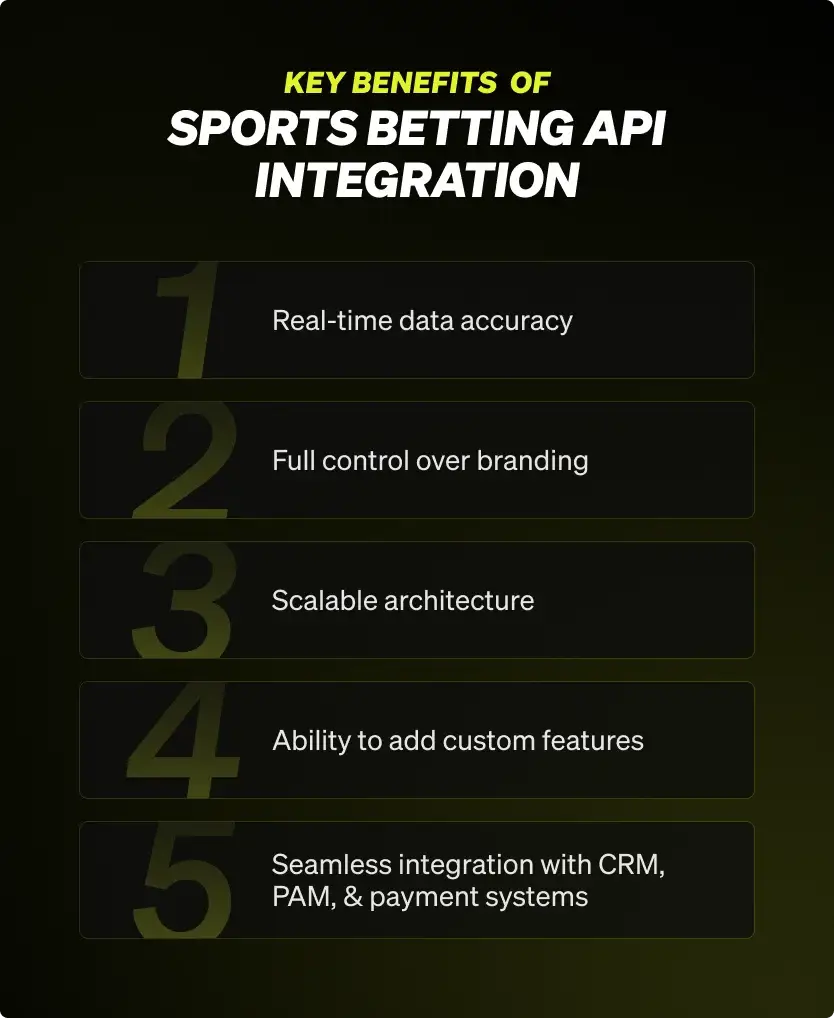
These APIs handle the heavy lifting behind the scenes, such as collecting and standardizing data, processing requests, and even enabling actions like placing bets or verifying users. As a result, sportsbooks can focus more on creating a smooth user experience while relying on the API for accurate, up-to-date information.
Types of APIs in sports betting
Sports betting uses many different APIs. Each serves a distinct function, and together they form the backbone of modern sportsbook operations. Below is an overview of the primary categories:
- Sports Data APIs provide real-time information such as live scores, match schedules, and team line-ups. This data is essential for calculating accurate odds. Low-latency, reliable feeds allow bettors to make informed decisions while helping platforms stay competitive.
🏆 Check out our article on the best sports data APIs for a detailed comparison and recommendations.
- Odds & Risk Management APIs automate the process of adjusting odds based on market activity and overall risk exposure. They can also identify arbitrage opportunities and enforce stake limits, helping operators maintain balance and profitability.
- Payment APIs enable secure deposits, withdrawals, and settlements. Common integrations include PayPal, Skrill, and cryptocurrency gateways. These systems support multiple currencies and use encryption and tokenization to ensure transactions meet financial compliance standards.
- CRM & Personalization APIs help platforms understand and engage their users. By analyzing behavior and segmenting audiences, they enable targeted promotions and tailored experiences, boosting user retention and satisfaction.
- KYC (Know Your Customer) APIs are used to verify player identities, prevent fraud, and comply with anti-money-laundering regulations. They work by cross-checking user data against global databases and automating identity verification processes.
- Communication APIs facilitate timely interactions with users through email and SMS. They are used for sending bet confirmations, odds updates, and promotional messages.
How to integrate sports betting APIs: A step-by-step guide
Integrating a sports betting API involves far more than simply calling endpoints. It requires thoughtful planning, careful selection of the right vendor, adherence to regulatory requirements, and thorough testing at every stage. Here is how the process works:
1. Define your goals and compliance requirements
Identify which sports, markets, and bet types you plan to offer, as well as the regions you want to target. At the same time, consider the legal and regulatory requirements. This includes licensing, data retention rules, and responsible gambling policies. Having a clear scope from the outset will help you select the right API and ensure you stay compliant at every step.
2. Choose and vet the right API provider
Not all API providers are the same, so it’s important to evaluate them carefully. Look at factors like:
- Reliability
- Uptime
- Security
- The range of sports and markets they cover
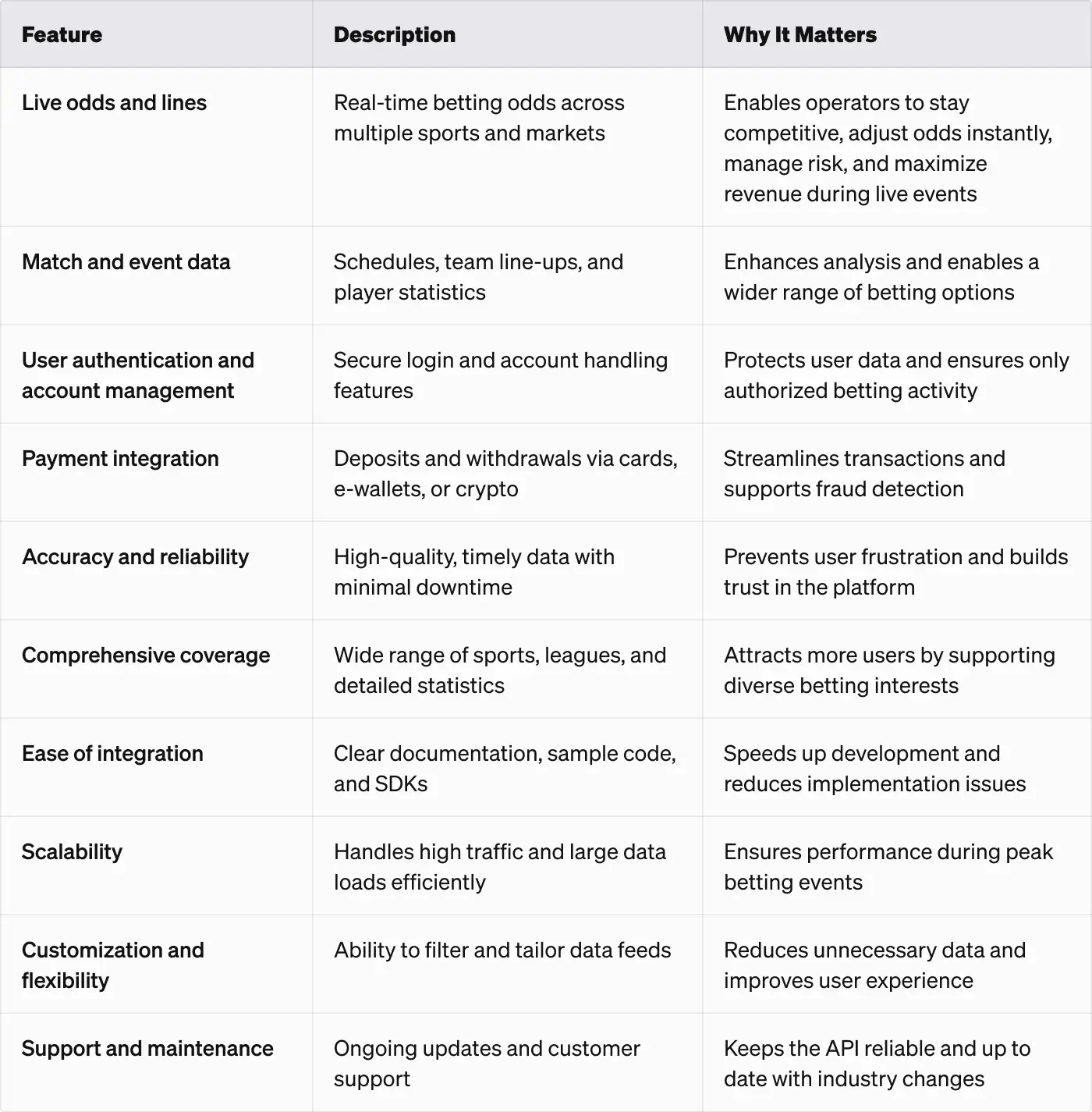
Check how frequently odds are updated, especially for live betting. Also review pricing, service level agreements (SLAs), and compliance standards. If you need broader coverage or greater reliability, consider using multiple providers.
In the table below, you can find the key features to look for when evaluating a sports betting API provider:
3. Get documentation and test access early
Start by requesting full API documentation, including:
- Details on endpoints
- Authentication methods
- Rate limits
- Error handling
Make sure you also have access to a sandbox environment so your team can test and experiment without impacting live data. Taking this step early can help you avoid costly mistakes later on.
4. Set up your development foundation
Choose a tech stack that fits your needs, such as:
- Node.js for real-time applications
- Python for data-focused tasks
- Java for larger enterprise systems
Set up secure storage for your API keys and ensure all communication is protected with HTTPS. Finally, ensure your system is set up to work with the API’s data formats (such as JSON or XML) and authentication methods, so you can avoid problems during integration.
5. Build the backend integration layer
Start by setting up the backend to handle sports data, odds, and related functionality. Map external data into your internal system, while properly managing time zones and regional differences. Follow the API’s requirements for bet placement and settlement, and make sure all requests and responses are logged with trace IDs to support debugging and auditing.
6. Connect the frontend user interface
Link the API to key parts of your interface, including:
- The sports list
- Event pages
- Bet slip
- Live betting views
Add clear notifications for odds changes and design straightforward re-acceptance flows so users aren’t confused. Also, ensure that elements such as currency, language, and time formats are displayed correctly across different regions.
7. Implement bet placement and management
Integrate features for bet placement, confirmation, and settlement. Make sure user authentication and session management are secure, and account for edge cases like void bets or partial settlements. It’s also important to record transaction IDs to support accurate tracking and reconciliation.
8. Integrate payment processing
Connect payment gateways, such as cards, digital wallets, or crypto options, to enable deposits and withdrawals. Ensure your setup complies with local financial regulations and includes strong anti-fraud measures. While many payment providers handle encryption and tokenization, you should also implement safeguards such as multi-factor authentication to protect user accounts.
9. Test, launch, and monitor continuously
Start by thoroughly testing your system in a sandbox environment. Check data accuracy, performance under load, and how it handles edge cases like postponed matches or sudden odds changes.
When you’re ready to go live, roll out gradually and keep a close eye on key metrics such as latency and error rates. Continue to meet regulatory requirements and maintain strong security practices as you scale.
Finally, make sure your team is well prepared, and stay in close contact with your API provider for updates, support, and ongoing improvements.
Challenges of sports betting API integration and how to address them
Here are the main obstacles developers face when integrating sports betting APIs, along with practical ways to overcome them:
- Data latency – In live betting, even tiny delays can make a big difference, as players may take advantage of outdated odds and create losses. To stay competitive, use fast data providers, optimize caching, and keep a close eye on performance during high-traffic moments.
- Data standardization – Each provider delivers data in its own format, which can easily lead to errors if not handled properly. By normalizing data with mapping systems and testing tricky scenarios like postponed matches, you can ensure everything stays accurate and consistent.
- Managing multiple providers – Integrating several APIs can quickly become complicated, with different rules, limits, and update schedules to manage. A modular setup makes things easier to control, while backup providers help keep your platform running smoothly if one fails.
- Scalability and peak demand – Big sporting events bring huge spikes in traffic that can strain your system if you’re not prepared. Building scalable infrastructure and working with high-capacity API providers ensures your platform stays fast and reliable when it matters most.
Meet LSports: A standout sports betting API provider
Choosing the right API provider ultimately determines how well your sportsbook performs in real-world conditions, especially in terms of data accuracy, speed, scalability, and long-term flexibility. This is exactly why you should consider LSports.

LSports is a global sports data solutions provider that equips sportsbooks with the tools and insights needed to optimize profitability, enhance player engagement, and stay competitive in a fast-moving betting landscape. Rather than offering just a single API, LSports combines a powerful odds feed with a full operational ecosystem through its ARENA360 platform.
At the core of its offering is a highly advanced odds API designed to deliver flexibility, transparency, and real-time performance
- OddService – Delivers raw bookmaker odds from over 100 global operators, providing full transparency into market-wide pricing and giving trading teams greater control.
- TRADE – Generates customizable average odds based on operator-defined preferences, with built-in margin control, automated suspensions triggered by real-time conditions, and integrated settlement capabilities.
- Ultra-low latency performance – Both solutions are delivered within a single feed, with 0–1 second latency for live (in-play) events, ensuring fast and reliable updates.
Beyond odds, LSports supports the entire sportsbook lifecycle through ARENA360 modules:
- DEFEND – Provides configurable risk management tools, combining automated safeguards with manual controls to help operators effectively manage exposure.
- BOOST – Delivers real-time benchmarking insights, enabling operators to quickly identify margin gaps and optimize trading performance.
- ENGAGE – Enhances the user experience with frontend features such as live scoreframes, match trackers, and an AI-powered betting assistant.
In addition, LSports independently collects data from over 100 live sources using AI-driven technologies, delivering extensive coverage that includes:
- Mais de 100 esportes
- Mais de 15.000 léguas
- 2.500 mercados
- Mais de 175.000 eventos pré-jogo por mês
Start your free trial today and see how the LSports API can power your sportsbook with real-time odds, ultra-low latency, and seamless end-to-end integration.
FAQs:
1. How much does it cost to integrate a sports betting API?
The cost of integrating a sports betting API can vary widely depending on several factors, including API pricing, development resources, infrastructure, and regulatory compliance. A basic integration may cost just a few thousand dollars, while building a full-featured sportsbook platform can range from tens to hundreds of thousands.
2. How long does it take to integrate a sports betting API?
The timeline for integration depends largely on the complexity of your project. A simple setup can be completed in a few weeks, whereas a fully developed sportsbook platform may take several months. Factors such as the number of APIs used, compliance requirements, and the experience of your development team all play a role.
3. Can you build a sportsbook using multiple API providers instead of just one?
Yes, it’s possible to use multiple API providers when building a sportsbook. This approach can enhance reliability, expand market coverage, and offer greater flexibility. However, it also introduces additional complexity, as it requires careful data standardization and a more advanced system architecture.