
It’s about adapting the entire experience to local culture, including sports preferences, design choices, language nuances, and even how users interact with the platform. A one-size-fits-all sportsbook will struggle to engage or retain users in different regions.
Betting behavior varies widely by region, from preferred sports to betting styles like in-play wagering. Platforms that tailor content feeds, bet types, and features to local demand see stronger engagement and lower churn.
Users expect familiar payment methods, local currencies, and fast, transparent withdrawals. If deposits or payouts feel unreliable or confusing, users leave. Strong fraud prevention and seamless verification also play a key role in building long-term trust.
Regulations, odds formats, and interface expectations differ across markets. From geolocation rules to how odds are displayed, failing to align with local standards can cause confusion, legal issues, or lost users.
Even with great UX and localization efforts, success depends on delivering accurate, real-time, and region-specific sports data. Solutions like LSports provide the infrastructure needed to localize effectively at scale, with massive sports coverage, real-time feeds, and tools that help operators tailor experiences, manage risk, and boost engagement.
Localization in sports betting is about adapting an entire platform to feel natural and relevant to a specific audience. It involves aligning language, symbols, and overall user experience with local culture, including meaningful translations, culturally appropriate design choices, and sensitivity to regional preferences. It also requires compliance with local regulations and the integration of familiar currencies, payment methods, and social features.

Below are six key challenges you’re likely to face when localizing sports betting software, along with practical tips to overcome them.
Sports that drive betting volume vary widely across markets, so you need to align with local demand rather than applying a one-size-fits-all approach. For example, soccer dominates betting activity across most of Europe and Latin America, basketball is highly popular in the United States, while cricket leads in countries like India and Pakistan.
Latin American markets are also shifting from bonus-led strategies toward in-play betting and richer content experiences, making cultural adaptation essential to avoid low engagement and high churn.

Here are some tips to help you solve this challenge:
To effectively localize your sportsbook and meet diverse market preferences, you need a data provider that covers all relevant sports and delivers fast, reliable, and accurate feeds for each.
Providers like LSports offer extensive sports data feeds designed to support global operators. LSports coverage spans over 100 sports and esports, including both major international competitions and niche local events. With access to more than 15,000 leagues, 3 million fixtures, and over 2,500 betting markets, such as outrights and player props, you can confidently tailor your offerings to different regions.
For instance, in cricket alone, LSports provides APIs covering around 45,000 fixtures annually across 550+ leagues, ensuring comprehensive coverage of both high-profile tournaments and smaller competitions.
Get a demo today and discover how LSports can power your sportsbook with reliable, real-time data across every market you want to reach.
Literal translation can result in awkward or even unintentionally offensive phrasing, which quickly undermines user trust. That’s why cultural nuance is essential. Expressions that feel natural in one region may seem confusing or out of place in another. For instance, Western idioms used in a Japanese context can feel unnatural or jarring.
This challenge extends to betting terminology as well. Odds formats, bet names, and promotional language differ significantly across markets, and without proper localization, users may misinterpret key information. The result is both confusion and a perception that the platform lacks professionalism.
Here are some tips to help you solve this challenge:
Payments are one of the most important touchpoints for bettors, directly influencing trust and retention. Paysafe’s 2025 “All the Ways Players Pay” report shows that:
These insights show that while trust is improving, payment experience and security remain decisive factors. At the same time, player preferences vary significantly across regions, adding another layer of complexity for operators. For example, mobile money is common across Africa, while Brazil relies heavily on PIX transfers, and offering only global payment options can exclude users or make the platform feel unreliable. Regulations add another layer of complexity, as some markets restrict certain payment methods or require partnerships with local financial providers.

Here are some tips to help you solve this challenge:
Sports betting operates within a complex web of laws that vary widely by region. Requirements range from strict data-privacy rules in Europe to state-by-state gambling regulations in the US, where each state sets its own rules on:
Some states, like Massachusetts, impose strict rules on how promotions are presented, banning terms such as “free” or “risk-free.” Failing to comply with these regulatory requirements can lead to significant financial and reputational consequences.

Here are some tips to help you solve this challenge:
🏆 Worth knowing: If you’re considering entering the US market, it’s worth reading our article on key factors to evaluate beforehand.
Different regions use different formats to present odds, and understanding these variations is key to creating a user-friendly experience:

If users are presented with a format they don’t recognize, it can quickly lead to confusion and even discourage them from placing bets. The same applies to the broader user interface. Details such as date formats, time displays, currencies, and even color choices can vary significantly across cultures, and overlooking these differences can harm the overall user experience.
Here are some tips to help you solve this challenge:
Localized customer support is closely tied to both language and cultural understanding. Players expect quick, helpful responses in their native language, and when support teams use familiar terms and regional expressions, it creates a stronger sense of trust and connection.
On the other hand, without local support teams, operators risk misinterpreting customer concerns or overlooking region-specific issues, such as payment delays or confusion around certain bet types.
Here are some tips to help you solve this challenge:
To successfully overcome the common challenges of localizing sports betting software, you need more than adapting language or payments. You need accurate, real-time data, deep market coverage, and tools that align with regional behaviors. Without the right technology partner, even well-localized platforms can struggle to deliver relevant content, competitive odds, and engaging user experiences.
That’s where LSports can help you!
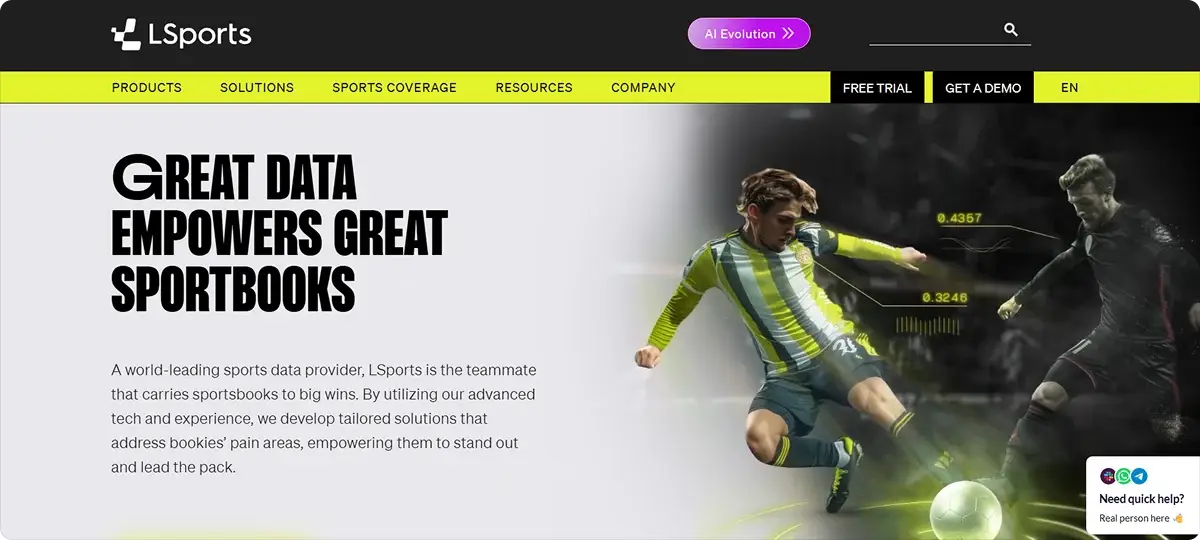
As a global leader in sports data solutions, LSports empowers operators to tackle localization challenges at scale. With coverage spanning 100+ sports, 15,000+ leagues, 2,500 markets, and over 3 million fixtures, it enables sportsbooks to tailor offerings to any market, whether focusing on mainstream competitions or niche regional events. Its near-zero latency data, sourced from over 100 live feeds, ensures users always receive fast, accurate, and reliable information.
At the core of its offering is the ARENA360 platform, an all-in-one ecosystem combining real-time data, AI-driven tools, and advanced analytics. Its key capabilities include:
Start your free trial today and discover how LSports helps you localize smarter, deliver real-time sports data, and create tailored betting experiences that truly resonate in every market.
The timeline depends on market complexity, regulations, and the level of customization required. Basic localization may take a few weeks, while full-scale adaptation can take several months.
Success is measured by KPIs such as user acquisition, retention, and betting activity across markets. Tracking engagement, conversion rates, and payment success helps refine and improve localization efforts over time.