
Before diving into each provider, here’s a high-level comparison to orient your evaluation:
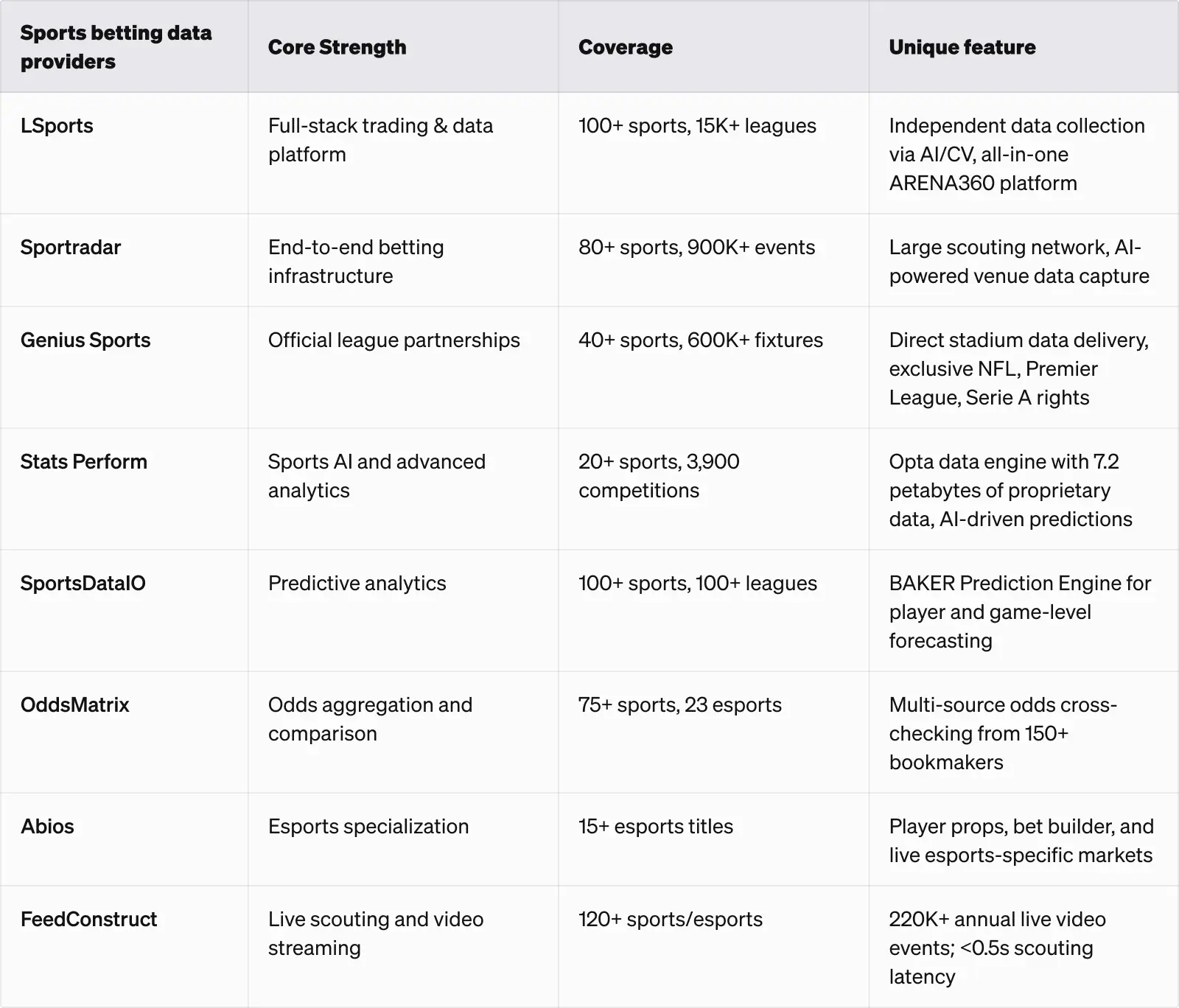

LSports is a world-leading sports data provider built to fight data monopolies. While major leagues continue selling exclusive rights to a handful of dominant companies at premium prices, LSports offers an independent alternative.
Using AI and computer vision to collect data from publicly available broadcasts, and a scouting network to report from live events, the company delivers high-quality, real-time feeds at a fraction of the cost. The coverage is deep:
All data is delivered at close-to-zero latency from 100+ live sources, and includes lower-tier and regional competitions that most providers don’t cover.
LSports offers much more than raw data delivery. With ARENA360, you get access to the full stack of features to make the most of your data.
These include automated odds generation, visualization tools, dynamic risk management with manual override capability, and live benchmarking intelligence that feeds directly into trading workflows. Engagement tools and a Managed Trade Service round out the offering for operators who want a complete infrastructure without the operational overhead.
For sportsbooks locked into a Tier 1 contract, LSports can work as a complementary service and fill coverage and latency gaps rather than replacing the regulatory backbone.

Sportradar is one of the largest independent providers in the space. Its scale is hard to overlook, with a scouting network of over 12,600 data collectors across 80+ sports and 900,000+ events annually. That scale, combined with official partnerships across major leagues, gives Sportradar broad access to both venue-level and broadcast-derived data.
Besides raw feeds, the platform offers odds services, trading and risk management, and live video streaming. Sportradar has also invested in AI-powered venue capture to reduce reliance on manual scouting and improve data consistency.
Still, consider that the platform’s dominant market position and exclusive rights are reflected in its pricing. Additionally, bundled pricing can limit how selectively operators optimize their data spend, and coverage depth tends to thin out outside the leagues where Sportradar holds official rights.

Genius Sports is known for its 400+ official league partnerships, which offer rights to the NFL, Premier League, and Serie A. Its core advantage is the ability to deliver data directly from the stadium in real time. This provides security of supply and regulatory confidence in markets that mandate official feeds.
The platform’s data and odds APIs cover 600,000+ fixtures across 40+ sports, with predictive pricing models that simulate millions of outcomes for odds generation. It emphasizes low-latency delivery and high uptime, offering faster bet settlement and longer market availability.
Genius Sports’ clear compliance pathway is beneficial if you operate in heavily regulated jurisdictions. On the downside, this rights-heavy model concentrates coverage on premium leagues, which can be problematic if you need data on lower-tier or niche competitions. Expanding into new markets under this model also tends to be slow and expensive, since each addition depends on securing or licensing additional rights.

Stats Perform occupies a distinct position in the market, leading with sports AI and deep analytics rather than competing primarily on trading infrastructure. The company’s Opta data engine is powerful. It features 7.2 petabytes of proprietary sports data, which powers 8 foundation AI models across 200+ software modules.
Opta covers 500,000+ matches annually and 3,900+ global competitions, with granular event-level detail. This makes it a strong fit for operators building advanced player prop markets, editorial content, or engagement features that demand statistical richness. Access options range from raw data feeds and APIs to research platforms, embeddable widgets, and a dedicated editorial team.
The limitation is that Opta’s strength in analytics doesn’t extend into trade execution. Insights and benchmarks live in a separate workflow from the systems that actually move odds, which can create friction when speed matters.
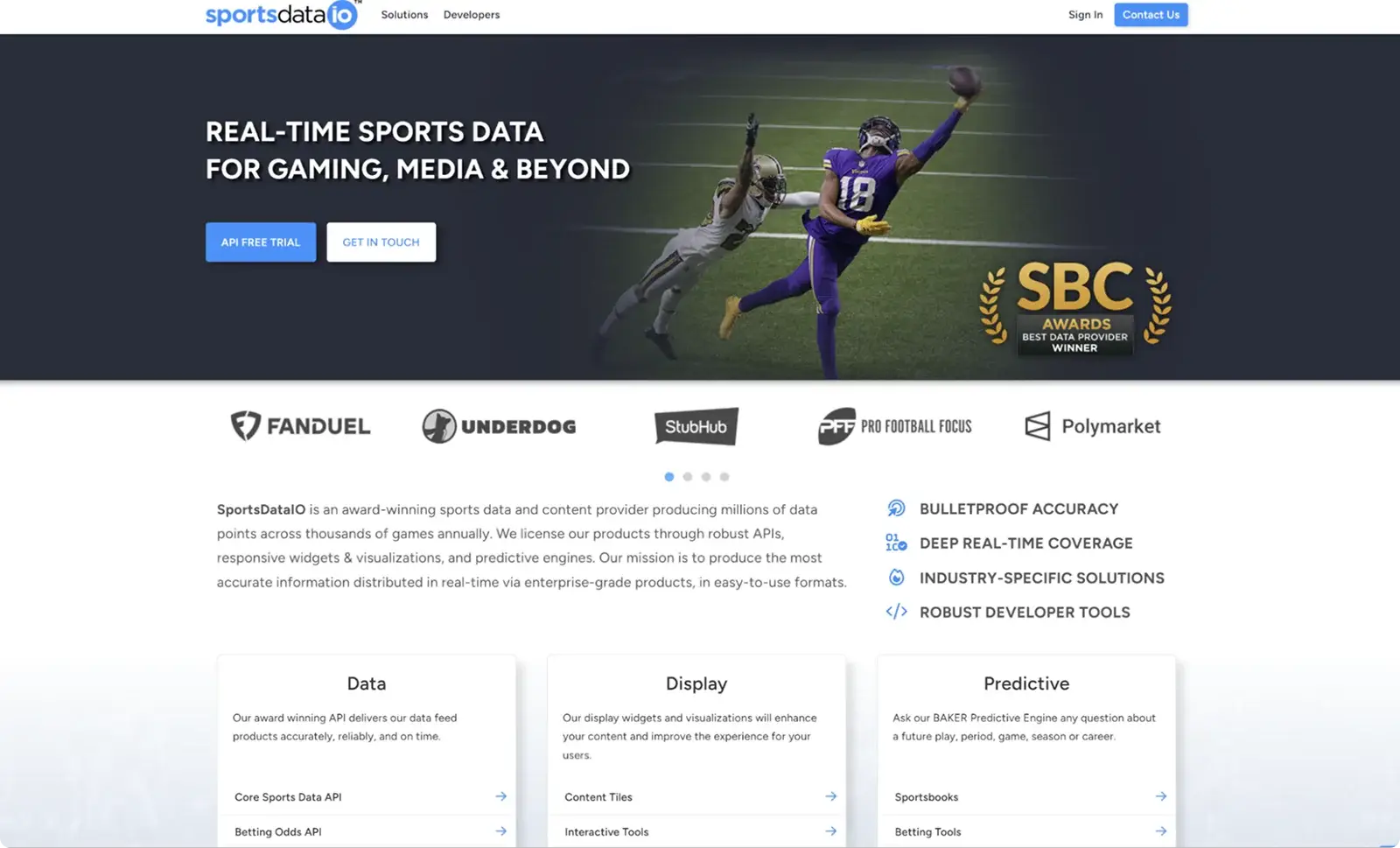
SportsDataIO focuses primarily on the U.S.-regulated market, producing millions of data points across major American leagues. What sets it apart is the BAKER Prediction Engine, a proprietary forecasting tool that handles predictive queries at the play, period, game, season, and career level. That prediction layer sits atop standard data feeds, which gives sportsbooks and betting brands an edge in content differentiation.
The practical applications lean toward engagement and conversion. For example:
The company also offers plug-and-play widgets with affiliate tracking, designed to reduce development time while driving on-site retention.
SportsDataIO’s coverage is narrower than that of global providers. The strength here is depth within US sports, backed by 15 years of data accuracy and reliability.
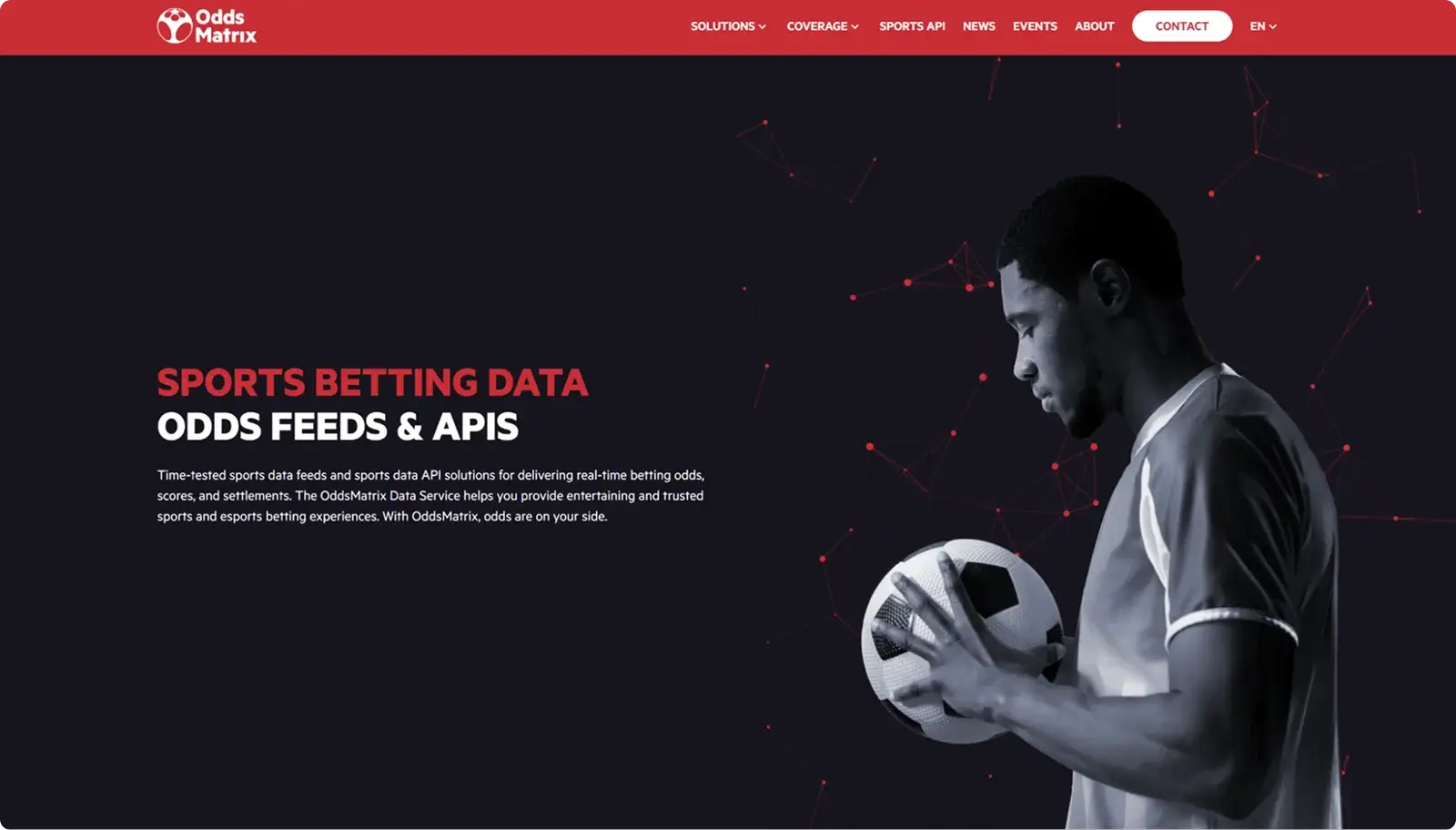
OddsMatrix, powered by EveryMatrix, takes a different approach from most providers on this list. Rather than relying on a single proprietary source, it aggregates odds from 150+ bookmakers and cross-checks them against 92 pre-live and 43 live odds providers, plus 39 score sources. This multi-source verification model catches discrepancies that single-feed setups might miss.
The platform covers 75+ traditional sports and 23 esports titles, and processes over 170,000 live and 150,000 pre-match events monthly. Operators get a back-office application for customizing payouts, tracking competitor odds, and adjusting prices at any level from sport down to individual markets.
With automatic settlement for 99% of markets, OddsMatrix is a practical choice for mid-size books that need depth without building their own aggregation layer. However, testing under peak load is necessary as aggregated feeds that pull from many sources can introduce latency spikes when event volume surges.

Abios focuses on esports, covering 15+ titles with 50 billion structured data points. While traditional sports data providers treat esports as an add-on vertical, Abios has spent over 12 years building infrastructure specifically for competitive gaming.
The odds feed supports 60+ market types, including player props and a bet builder. These features mirror how esports fans actually engage with competition. Market uptime sits at 83% with sub-4-second bet delay, and the feed is powered by real-time data from select rights-holder partnerships.
Coverage spans 6,000+ monthly matches across all tiers of play, which serve 40+ operators in regulated markets globally. As esports betting volumes grow and Gen Z audiences become a larger share of the market, Abios offers the kind of title-specific depth that generalist providers typically lack.

FeedConstruct specializes in live scouting data and video streaming, a niche that other providers often source externally. Alongside its data feeds, the company delivers over 220,000 exclusive live video events annually across 120+ sports, racing, and esports disciplines.
Its live scouting model covers 5,500+ monthly matches for 60+ exclusive leagues with alleged sub-0.5-second latency. This preposition is strong when the in-play offering depends on content that’s hard to source elsewhere.
FeedConstruct also offers an aggregator platform that consolidates content from multiple providers through a single integration, which simplifies vendor management. BetGuard combines odds feeds and risk management into a single service, and 700+ experienced traders provide an additional managed layer that can absorb operational load during scaling.
Keep in mind that in-play data consistency can become a pressure point as volume and concurrency increase. The operational model leans on manual processes that may not scale as smoothly as automated alternatives.
Selecting a data provider requires looking past marketing claims and pressure-testing where performance actually matters for your operation. Here are some guidelines to help you:
Each provider on this list brings something different, and the right choice depends on your operational priorities, regulatory environment, and growth plans.
LSports tops our list of sports betting data providers due to its strong balance of capability and value. The platform offers comprehensive coverage, close-to-zero latency, automated trading, and integrated risk management without the financial burden of exclusive data contracts. Additionally, LSports is modular and adaptable, acting as either your primary data engine or a strategic complement to existing feeds.
Ready to see how it fits your operation? Talk to an LSports data expert and get the full game plan.