HOME / BLOG

What Is Sports Data Analytics? [A Guide for Bookmakers]

sports-data-analytics-cover

Sports data has reshaped how sports organizations and fans interact with sports. Over 75% of professional sports teams today use real-time analytics to enhance their strategy during games. 

While sportsbooks use different types of data, it matters every bit as much. Data is the foundation powering every feature and decision, from market pricing to risk mitigation tactics. Understanding how to extract value from data is essential to navigate increasingly tight margins, fast markets, and sharp bettors.

This guide explains the basics of sports data analytics, the metrics that matter, and the role of technology in this field.

Yoav ziv 
Subscribe To Our Blog

Key takeaways

  • Sports data analytics turns raw information into operational decisions. 

By capturing, structuring, and interpreting event data, sportsbooks can accurately price markets, manage exposure, and react to live action.

  • For sportsbooks, the benefits are direct and measurable. 

Accurate in-play pricing, sharper risk detection, bettor personalization, responsible gaming compliance, and live performance benchmarking all stem from strong analytics foundations.

  • The metrics that matter are the ones that move odds.

Estimation models, efficiency ratings, momentum indicators, and player-level prop data each serve different markets, and their relevance varies by sport, format, and game state.

  • AI and machine learning are now core infrastructure. 

Automated models process variables more quickly than any manual trading desk can. They power in-play pricing, anomaly detection, and bettor behavior analysis at scale.

  • LSports provides the data and tools to address these challenges. 

ARENA360 delivers automated trading, risk management, and player engagement tools built for the speed and coverage modern markets demand.

Sports data analytics 101

Sports data analytics is the process of collecting, structuring, and interpreting information from sporting events. Data may include player statistics, match outcomes, performance metrics, in-game events, or historical records.

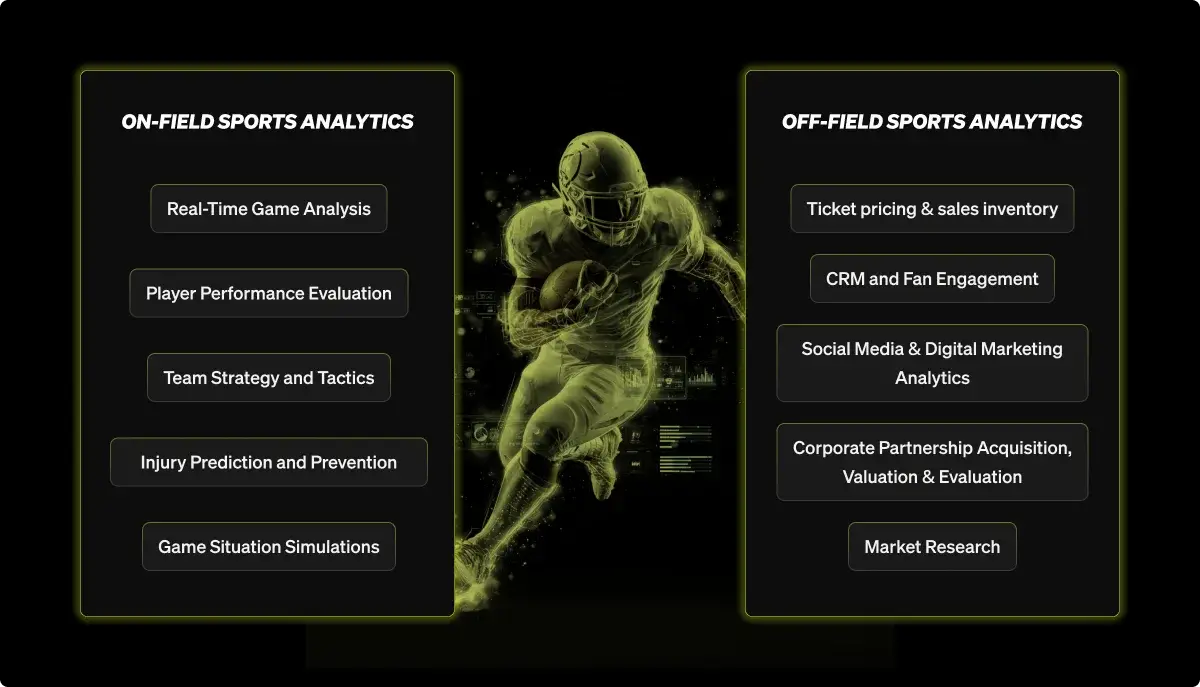
The raw inputs come from a range of sources before, during, and after games, both on and off the field. Statistical models and artificial intelligence help turn numbers into insights, which then have broad applications and benefits for coaches, teams, and sportsbooks alike.

For a coach, data analytics can help identify fatigue patterns to prevent injury or scout underestimated talent. For a sportsbook, the data may determine pre-match odds, drive real-time price adjustments, and inform how the betting product is structured.
sports-analytics


Why sports data analytics matters in betting

The use cases of sports data analytics are many, and the benefits for betting operators are direct and measurable:

  • Odds accuracy and in-play pricing: Operators use analytics to determine outcome probabilities and translate them into odds. With in-play betting surging across nearly every sport over the last decade, bookmakers must adjust odds continuously during competition. Quality data and fast delivery are non-negotiable.
  • Risk detection and management: Analytics models identify unusual betting patterns, correlated exposure, and sharp action. This allows trading desks to adjust limits and prices before losses materialize.
  • Bettor behavior analysis and personalization: Operators analyze punter habits to enhance the betting experience. This allows them to tailor suggestions based on preferred sports, market types, odds ranges, session timing, and pre-match vs. in-play preferences.
  • Responsible gaming: As regulatory pressure increases, behavioral data helps operators implement effective safeguards. Models flag at-risk patterns like unusual bet sizing, loss chasing, or extended sessions, which supports self-exclusion options and spending limits.
  • Performance benchmarking: Many operators monitor performance manually or through static reports. Analytics enables live benchmarking against the broader market and surfaces gaps in coverage, pricing, or margin.

Ultimately, accurate, fast-processed data leads to smarter decisions and stronger margins.

Key metrics to know

Not all data points carry equal weight for a trading desk. The metrics that matter most depend on the sport, market type, and whether you’re pricing pre-match or in-play. Here are some examples:

  • Estimation metrics like expected goals (xG) predict the likely outcome of an action based on historical context. These allow you to assess whether live match events are running above or below expectation, which directly informs whether odds should shift and by how much.
  • Efficiency and output metrics measure how effectively a team or player converts opportunities. They feed into totals pricing and handicap markets, and are especially useful for in-play adjustments when the pace of scoring deviates from pre-match models.
  • Momentum and form indicators like win streaks track recent performance trends. They help calibrate pre-match odds and inform how aggressively models should react to early in-play developments.
  • Serve and set-piece metrics are critical in sports where individual actions carry outsized weight and can significantly move odds during key game states.
  • Player-level prop data like pitcher spin rates feed the fastest-growing market segments. Accuracy here is especially important because prop markets are where sharp bettors tend to find the most pricing inefficiency.
  • Contextual and situational data like weather and referee tendencies influence outcome probabilities that pure performance metrics often miss.

Data use across sports

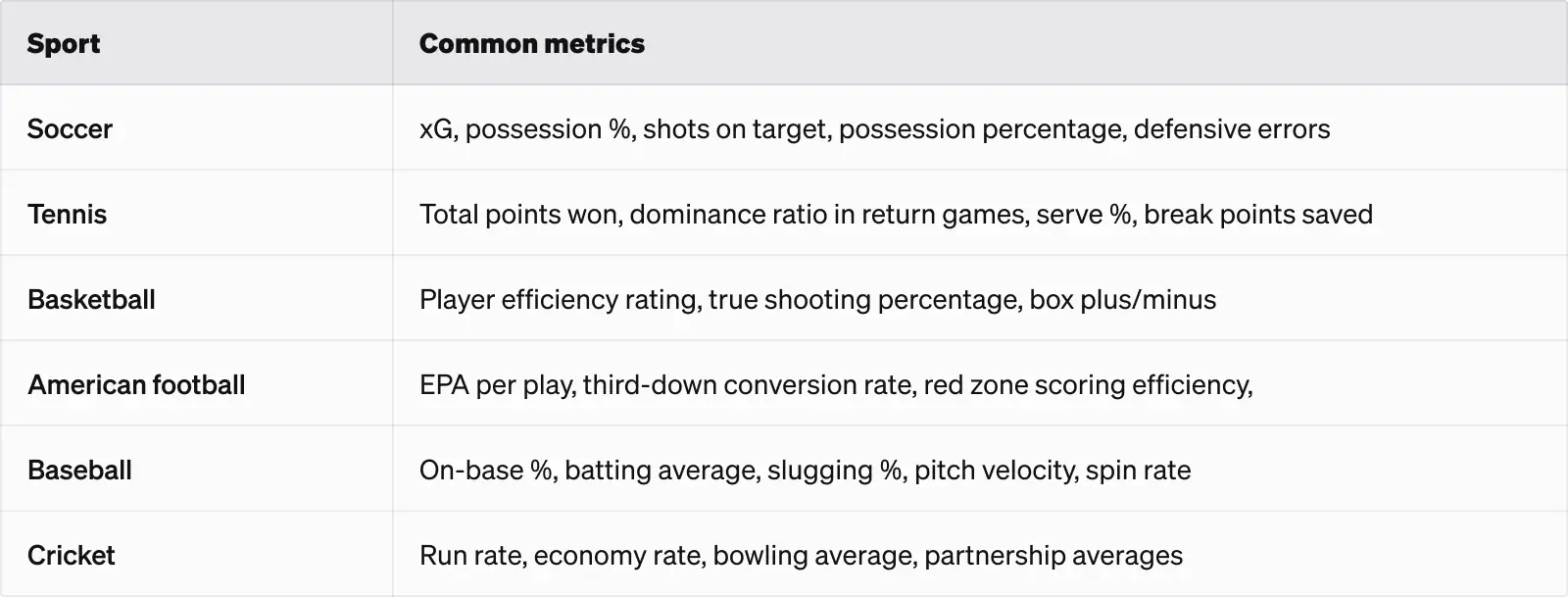
Each sport has a specific data profile. The metrics that matter, the speed at which they change, and the markets they support all differ significantly.
sport-table

A generic data feed can’t serve operators across all of these. Sport-specific granularity, delivered at the cadence the sport demands, is what enables accurate pricing and controlled exposure.

The what, when, and how of sports data analytics

The analytics pipeline for a modern sportsbook has several stages, the first being collection

Data can be captured through devices such as sensors and wearables, or through observation. For example, a ball-tracking camera captures positional data at dozens of frames per second, while a manual scout logs events as they happen.

Next, statistical models, algorithms, and machine learning (ML) models help structure raw input. ML models cross-reference player form, head-to-head records, venue trends, weather, and live match state to generate probability distributions for odds engines.

AI is a useful tool for analysis, particularly in two areas. In-play automation recalculates outcome probabilities as events occur, enabling price adjustments without manual intervention. Anomaly detection flags unusual betting patterns that signal sharp information or integrity concerns.

Finally, processed data drives live operations, such as market management or odd setting. Latency matters most here. In micro-betting markets, the gap between a real-world event and the odds reflecting it is measured in milliseconds. Operators on delayed feeds are effectively offering stale prices.

Looking ahead 

The value of the sports analytics market is projected to rise from roughly $5.3 billion in 2026 to nearly $18 billion by 2031, growing at a 27%+ annual growth rate. Such an impressive estimate results from rapid technological advancements over the last few years, which indicate a continuous trend. Here’s what we can expect to see or see more of in the near future:

  • AI-powered predictive modeling is moving from a competitive edge to table stakes. Models ingesting broader datasets alongside traditional statistics will produce more accurate pre-match and in-play probabilities.
  • Micro-betting expansion continues to push what’s tradeable. Betting on the next pitch, serve, or possession requires sub-second data feeds and near-instant settlement.
  • Personalized betting experiences are becoming a retention lever. Operators are using behavioral data to tailor market suggestions, odds boosts, and interface layouts.
  • Responsible gaming requirements are tightening across regulated markets. Behavioral monitoring models that flag at-risk patterns are becoming mandatory rather than optional.

Overall, greater speed, accuracy, personalization, and transparency are set to define the next era.

The bottom line

Sports data analytics is the operating system of a modern betting site. Pre-match pricing, in-play volatility management, bettor retention: every layer depends on data quality, speed, and breadth. Bookmakers still relying on limited coverage, delayed feeds, or manual processes risk falling behind as the market accelerates.

The right data partner makes all the difference. LSports gives operators the infrastructure to compete at the speed and scale the market demands, without the cost or complexity of building it alone.

LSports: Live sports data to power big wins

LSports is a world-leading sports data provider built to solve the modern bookmaker’s challenges. Where data monopolies create cost pressure and coverage limitations, LSports offers an independent alternative. Its AI and computer vision technology collect data from public broadcast sources, while its scouting network reports from live events, to free operators from monopoly-priced feeds.
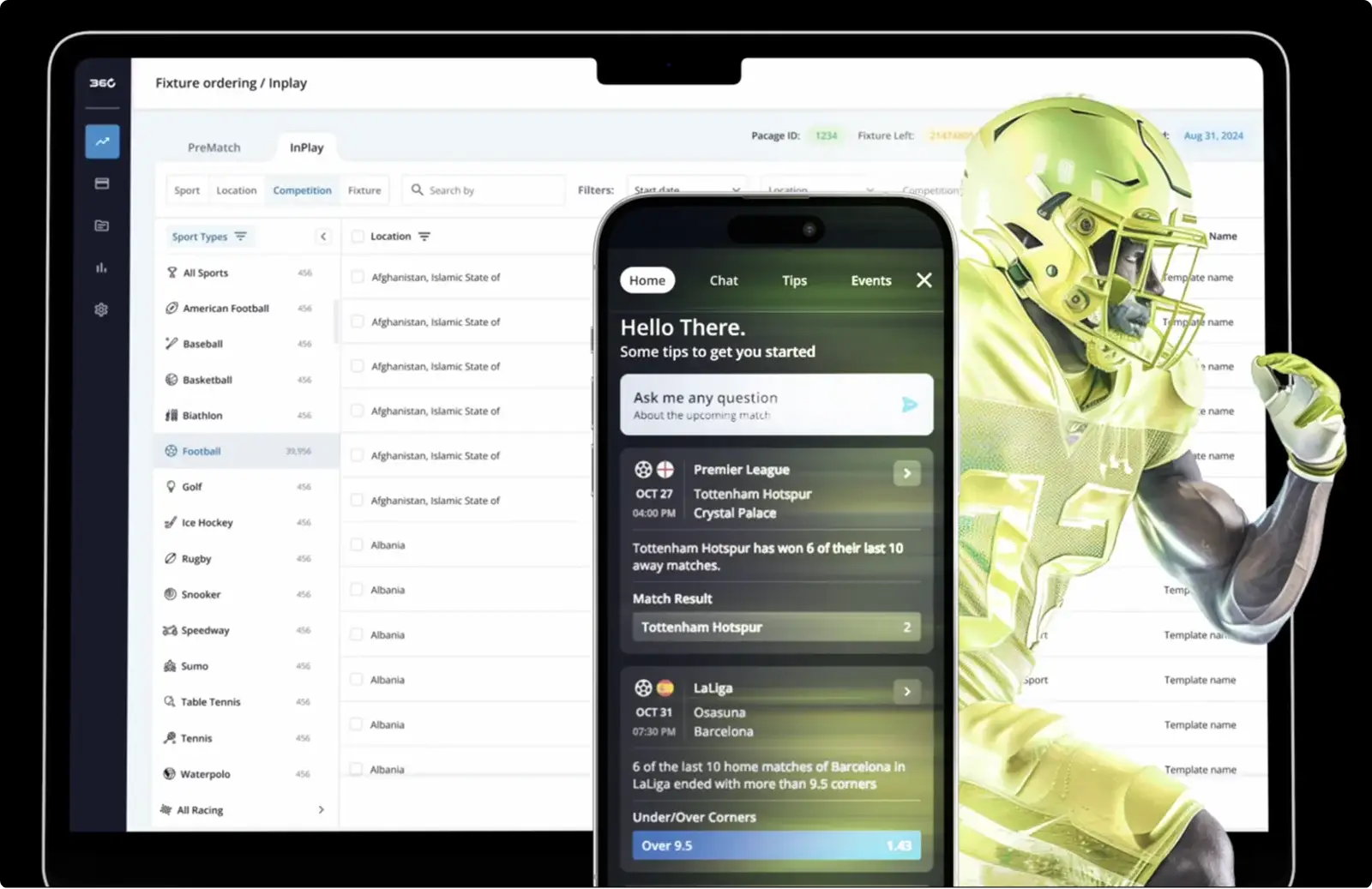
lsports-example

At the center of the offering is ARENA360, an integrated platform that consolidates trading operations into a single environment:

  • TRADE automatically generates and adjusts odds in real time. It removes manual overhead and the latency that erodes margin in fast-moving in-play markets.
  • DEFEND provides dynamic risk management with automation and manual override, so operators can control exposure without sacrificing reaction speed.
  • BOOST surfaces margin opportunities and coverage gaps through live benchmarking, replacing static reports with intelligence that drives action.
  • ENGAGE increases user retention and betting volume through personalized experiences and useful widgets.

The coverage speaks for itself: 100+ sports, 15,000+ leagues, and 2,500 markets, all delivered at close-to-zero latency from 100+ live sources. This breadth lets operators capture revenue from niche competitions that major providers ignore.

For operators who want full capability without the operational lift, LSports’ Managed Trade Service handles day-to-day management of ARENA360. Sportsbooks focus on marketing and profit, while LSports handles the rest.

Sign up for a free trial or demo and outpace the market with the industry’s most comprehensive and independent sports data ecosystem.

Frequently asked questions

What is data analytics in sports?

Sports data analytics is the practice of collecting and interpreting data from sporting events to inform decisions. For sportsbooks, it drives odds generation, in-play market management, risk control, and bettor experience optimization.

Can AI predict sports results?

AI models generate probabilistic forecasts based on historical data, current form, and contextual factors. They produce probability distributions faster and more reliably than manual assessment, which is crucial for quick in-play markets. Still, they don’t predict outcomes with certainty.

What are the best sports data companies?

The best sports data provider depends on operational needs. LSports stands out for operators who need broad coverage across 100+ sports and 15,000+ leagues, competitive pricing outside exclusive rights structures, and a full-stack platform covering trading, risk, engagement, and analytics. LSports’s AI-driven collection ensures speed and accuracy without the high price of monopoly feeds.


MORE blogs

Prediction Markets vs. Sportsbooks_ What're the Differences Cover

Prediction Markets vs. Sportsbooks: What Are the Differences?

Compare prediction market vs sportsbook options so you can understand pricing, liquidity, risk, regulation, and the...
6 Best Technologies to Use For Sports Fan Engagement in 2026 Cover

6 Best Technologies to Use for Sports Fan Engagement in 2026

Discover the best technologies to use for sports fan engagement so you can boost interaction, build...
How Do Sportsbooks Detect Arbitrage in 2026 Cover

How Do Sportsbooks Detect Arbitrage in 2026? [Guide]

Explore how sportsbooks detect arbitrage so you can identify betting patterns, reduce exposure, and protect your...

What Is Sports Betting? A Foundational Guide for Operators

Learn what sports betting is so you can understand how betting markets work, explore popular wager...
6 Risk Management Techniques for Prediction Markets Cover

6 Risk Management Techniques for Prediction Markets in 2026

Explore the risk management techniques for prediction markets so you can reduce exposure, protect profits, and...
Importance of Data Quality Management in Sports Analytics Cover

Data Quality Management in Sports Analytics: What to Know?

Discover the importance of data quality management in sports analytics so you can improve accuracy, reduce...

TRUSTED BY MAJOR SPORTSBOOKS 

HEAR IT FROM OUR PARTNERS​