
Unlike pre-match betting, live betting requires odds and markets to change continuously as the event unfolds. To keep pricing accurate, you need fast, reliable data and systems that can react within seconds.
Because markets are updated throughout the event, bettors can place wagers based on what’s happening in real time instead of making all their decisions only before kickoff.
Delayed or inaccurate data can lead to pricing mistakes, incorrect market settlements, customer complaints, and financial losses. The more quickly and accurately your platform reacts to live events, the better protected your sportsbook will be.
Every live event can affect multiple betting markets simultaneously, making automated pricing, exposure management, and scalable infrastructure essential for handling thousands of events in parallel.
LSports combines AI-powered data collection, ultra-fast live sports data, and ultra-low-latency event delivery through Hyper Feed, giving you everything you need to deliver a smooth in-play betting experience.
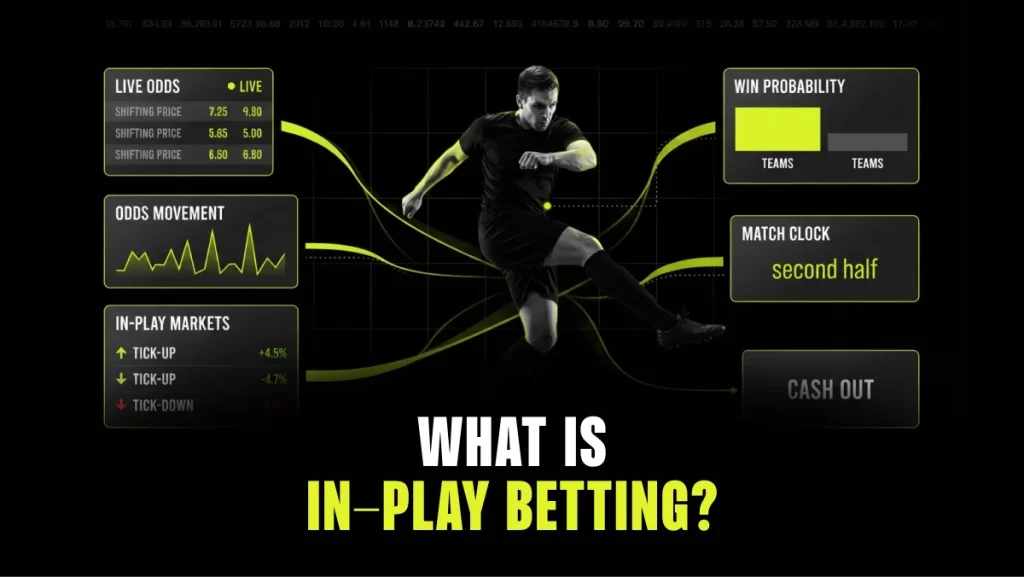
In-play betting, also known as live betting, allows users to place bets after a sporting event has started. The odds and available betting markets are continuously updated based on the score, time remaining, player performance, momentum, and other developments.

During key moments, such as a goal, penalty, red card, or video review, betting markets may be temporarily suspended before reopening with updated odds.
Here’s how pre-match and in-play betting compare across the key areas:

The live betting markets available depend on the sport, data coverage, and your sportsbook’s trading capabilities. Common in-play betting markets include:
Behind every high-quality in-play betting experience is a combination of technologies that keep odds accurate, markets responsive, and risk under control. These include:
Every time a goal is scored, a red card is shown, or the clock changes, your sportsbook needs to receive that information almost instantly so it can update the odds.
A solid live data provider should offer:
Worth knowing:
LSports uses a multi-layered approach to collect live sports data instead of relying on a single source. It combines a global network of 1,000+ trained scouts with AI and computer vision technology to capture match incidents directly from venues and low-latency TV feeds.
This helps deliver live updates with latency as low as one second without compromising data accuracy and reliability, allowing you to keep in-play markets fast and responsive.
A real-time odds and trading engine updates betting odds as a sporting event unfolds. It analyzes every live incident and instantly recalculates the probability of different outcomes so the odds remain accurate.
For example, when a goal is scored, the engine should recalculate not only the match winner market but also related markets such as:
Because a single incident can affect dozens of betting markets, these updates need to happen automatically. This becomes even more important when you manage hundreds or thousands of live events at the same time. Traders can oversee performance, adjust strategies, and intervene when needed, but manually repricing every market isn’t realistic.
In-play betting markets need to close immediately whenever a key moment could make the displayed odds inaccurate.
For example, when a penalty is awarded in a soccer match, the chances of that team scoring increase significantly. If you keep the affected markets open before updating odds, bettors can place wagers at prices that no longer reflect the true probability of the outcome.

To prevent this, the platform should automatically suspend markets during important moments or whenever there is uncertainty about the current state of play. Once the incident has been confirmed and the odds have been updated, those markets should reopen as quickly as possible.
Every bet your sportsbook accepts changes your overall exposure. During live events, those changes occur constantly, so the platform needs to monitor risk in real time rather than relying on manual oversight.
A real-time risk management system continuously tracks your liability across markets and alerts you when your exposure exceeds predefined limits. You should also be able to set stake limits, apply customer-specific controls, define market exposure thresholds, and automate risk management actions when needed.
A strong risk management system should also help identify:
Live bettors expect winning bets to be settled as soon as the outcome is known, without waiting for the entire match to end.
For example, if a customer bets that both teams will score within the first 15 minutes and that outcome is confirmed, the bet should be settled immediately so the winnings are available for the next betting opportunity. The same applies to markets such as the next goalscorer, where the ticket should be settled as soon as the goal is officially confirmed.
To deliver this experience, automate settlement wherever possible. You should also have clear processes for handling:
In-play betting can be an excellent way to increase player engagement, but it also creates new challenges, such as:
Successfully offering in-play betting depends on much more than simply displaying live odds. You need fast, accurate sports data, ultra-low-latency, automated trading, real-time risk management, and reliable settlement working together in a single ecosystem. That’s where LSports stands out.
LSports combines AI, computer vision, and a global network of more than 1,000 trained scouts to collect live sports data directly from venues and low-latency broadcasts. This multi-layered approach improves both speed and reliability, helping you keep odds synchronized with the action while minimizing data errors.
For sportsbooks that require even faster event delivery, Hyper Feed provides ultra-low-latency live data with confidence scores for every incident, allowing trading teams to react more quickly, optimize market suspensions, and make better-informed pricing decisions. Each event also includes detailed metadata and trace IDs, improving transparency and operational workflows.
Apart from data, LSports offers ARENA360, a platform that brings together the core technologies needed to operate a modern sportsbook:
Request a demo today and discover how LSports can help you deliver a faster, smarter, and more reliable in-play betting experience.
There’s no ideal number. It’s generally better to offer a smaller selection of well-managed live markets with accurate pricing and fast updates than hundreds of markets that are difficult to maintain. As your trading capabilities and data coverage grow, you can gradually expand your live betting offering.
Sports with frequent events and continuous action tend to generate the most in-play betting activity. Football, basketball, tennis, baseball, ice hockey, cricket, and esports are among the most popular because they provide numerous opportunities for odds updates and live betting markets throughout an event.
Many parts of in-play betting can be automated, including data collection, odds updates, market suspension, risk controls, and bet settlement. However, most sportsbooks still keep traders involved to supervise automated systems, manage unusual situations, and intervene during unexpected events.
No. Live betting is only available for events with sufficient real-time data coverage and trading support. Major competitions usually offer the widest range of in-play markets, while lower-tier events may have fewer options depending on the available data and pricing capabilities.