28 de octubre, 2026
How to Calculate Odds in Soccer Betting
Learn how to calculate odds in soccer betting, from decimal and fractional formats to implied probability and payouts, with simple worked examples.


En este artículo
Suscribirse
Manténgase a la vanguardia
Recibe las últimas perspectivas sobre datos deportivos, tendencias de apuestas y noticias del sector directamente en tu bandeja de entrada.
Este es un encabezado
Calculating soccer betting odds involves estimating the probability of each outcome, converting those probabilities into fair odds, and then applying your sportsbook’s margin to create the prices offered to bettors.
According to Statista, soccer is the most bet-on sport in the world, with more than $779 billion wagered globally in 2024. With so much at stake, even small pricing errors can become costly for your sportsbook, making accurate odds essential for protecting margins and managing exposure.
In this article, you’ll learn how to calculate odds in soccer betting, which factors influence your pricing, and how to manage common challenges when setting odds.
Puntos clave
- Soccer odds start with accurate probability estimates
Define exactly what you are pricing, assess team strength and scoring expectations, then convert the resulting probabilities into fair odds before applying your margin.
- Different soccer markets require different pricing logic
1X2 markets use match outcome probabilities, while player props require individual player performance estimates. Bet builders introduce additional complexity because correlated selections require joint probability calculations.
- Pricing continues after the initial odds are published
Your live odds need to adjust to goals, red cards, and other match events. At the same time, your trading team needs to monitor margins, accepted wagers, and exposure across related markets.
- Accurate soccer odds depend on reliable data and consistent pricing
Incomplete competition data, changing team strength, delayed match events, and inconsistencies between connected markets can all create pricing errors and unnecessary risk.
- LSports can support the full soccer odds workflow at scale
LSports’ Soccer API delivers data and odds across 2,000 leagues with sub-second latency, while OddService and ARENA360 provide broader odds coverage and tools to manage prices, margins, market suspensions, risk, and performance.
What is soccer betting?
Soccer betting is wagering on the outcomes of soccer matches and specific in-game events. It can include a wide range of markets, such as match winner, total goals, correct scores, corners, cards, and individual player performances.
These markets may be available through pre-match betting, where customers place bets before kick-off, and in-play betting, where they can continue betting while the match is underway. With in-play betting, odds and available markets change throughout the game as events like goals, cards, and substitutions affect likely outcomes.
What types of bets are popular in soccer betting?
Soccer supports various markets, and each creates different pricing and settlement requirements. Here are the main categories to consider when building your offering:
How to calculate odds in soccer betting
To calculate soccer betting odds, you need to estimate the likelihood of each possible outcome and convert those probabilities into prices that account for your margin. Here’s how to do it step by step:
1. Define the market before building the price
Clearly define what the wager covers, since a team’s probability of winning in 90 minutes differs from its probability of qualifying after extra time or penalties.
Specify the relevant match period, possible outcomes, refund conditions, and, for player markets, any participation requirements. By doing this, you ensure your model calculates the probability for the exact outcome your sportsbook is pricing.
2. Estimate team strength and scoring expectations
Next, use your pricing model to estimate each team's strength and expected goal output for the fixture, taking into account factors such as:
- Attacking and defensive performance
- Opponent strength
- Home advantage
- Expected lineups
- Rest periods
- Recent changes in players or tactics
Historical expected goals (xG) can help you understand the quality of chances a team typically creates and concedes. Still, don't treat past xG as a direct prediction for the next match, since expected goals also depend on the opponent and match conditions.
A simple starting point is:
Home goal expectation = league home-goal average × home attacking strength × away defensive weakness
3. Turn goal expectations into score probabilities
Once you have estimated how many goals each team is likely to score, the next step is to calculate the probability of different scorelines. A Poisson model is a common approach that uses each team’s expected goals to estimate the likelihood of scoring 0, 1, 2, 3, or more goals.
The basic formula is:
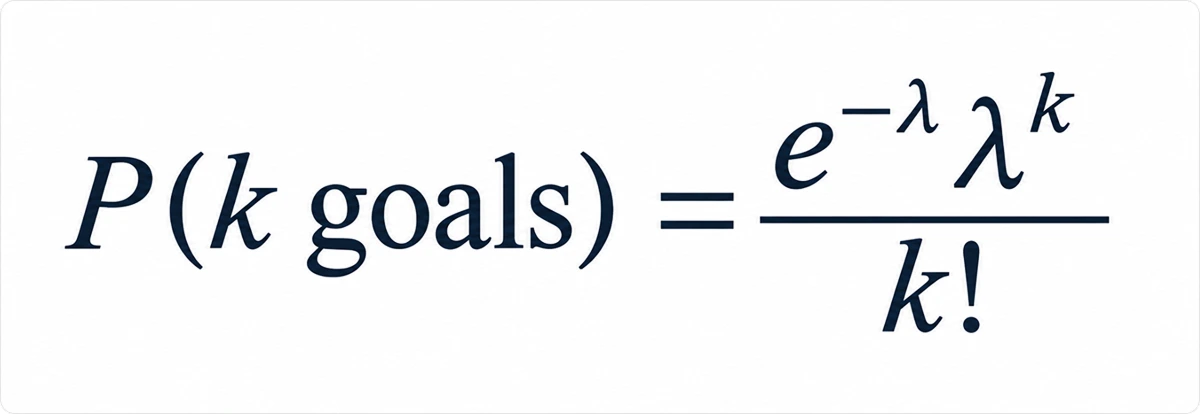
Here:
- λ (lambda): The number of goals you expect the team to score
- k: The specific number of goals you want to calculate the probability for
- P: The probability that the team scores exactly that number of goals
Multiply the two teams' goal probabilities to calculate the likelihood of each scoreline. This basic approach assumes that one team's goals don't affect the other team's scoring probability. For example, to calculate the probability of a 1–1 result, multiply the probability of the home team scoring exactly 1 goal by the probability of the away team scoring exactly 1 goal.
Repeat this calculation for each possible scoreline, then group the results based on the outcome you want to price:
- Home win: Add the probabilities of all scorelines where the home team scores more goals.
- Draw: Add the probabilities of all scorelines where both teams score the same number of goals.
- Away win: Add the probabilities of all scorelines where the away team scores more goals.
4. Convert probabilities into fair odds
Once you have estimated the probability of each outcome, you can convert those probabilities into fair decimal odds using this formula:
Fair decimal odds = 1 ÷ probability
For example, suppose your model gives a 1X2 market the following probabilities:
These are fair odds, meaning they reflect your estimated probabilities without a sportsbook margin.
5. Apply your sportsbook’s margin
To build the margin into your prices, increase the combined implied probability above 100%.
For example, if you want a 6% overround, you can multiply each fair probability by 1.06:
Adjusted probability = fair probability × 1.06
Then convert each adjusted probability back into decimal odds:
Offered decimal odds = 1 ÷ adjusted probability
Here's how the odds change after applying a 6% overround using the 50% / 28% / 22% probabilities from the previous example:
Since rounding the final odds can slightly change the margin, recalculate the overround using the prices you publish.
You do not have to apply the margin equally across every outcome. Depending on your pricing strategy and risk exposure, you may distribute more or less margin across individual selections while keeping the overall market at your desired level.
6. Calculate related markets from the same distribution
Once you have built a score probability distribution, you can use it to price related markets such as total goals and both teams to score (BTTS). Using the same distribution helps you keep prices consistent across your sportsbook.
For example, suppose your model estimates:
- Home team: 1.60 expected goals
- Away team: 1.00 expected goals
- Total: 2.60 expected goals
For over 2.5 goals, calculate the probability that the match finishes with three or more goals:
P(over 2.5) = 1 − P(0 goals) − P(1 goal) − P(2 goals)
In this example, over 2.5 goals has a probability of approximately 48.16%, which corresponds to fair decimal odds of 2.08.
You can use the same score distribution to calculate “BTTS YES”:
P(BTTS yes) = 1 − P(home scores 0) − P(away scores 0) + P(0–0)
This gives “BTTS YES” a probability of approximately 50.45% and fair decimal odds of 1.98.
Calculate these fair probabilities first, then apply your sportsbook’s chosen margin to determine the odds to offer customers.
7. Price combinations using joint probabilities
When customers combine selections from the same match, you need to account for how those outcomes are related. Multiplying their individual probabilities alone works only when one outcome does not affect the likelihood of the other.
For example, suppose you estimate:
- Home win: 50%
- Over 2.5 goals: 55%
If these outcomes were independent, you could multiply their probabilities: 0.50 × 0.55 = 27.5%
This would give you fair odds of 3.64. However, a home win and over 2.5 goals may be related, so treating them as independent can produce an inaccurate price.
If your model estimates that there is a 35% probability of both selections winning, you should price the combination using that joint probability:
1 ÷ 0.35 = 2.86
This difference matters because inaccurate combination pricing can expose your sportsbook to unnecessary risk. By accounting for the relationship between selections, you can set odds that reflect the true probability of both outcomes occurring together.
8. Update live prices and manage exposure
Once the match starts, continuously update your probabilities as new information becomes available. Your live pricing model should account for factors such as:
- Current score
- Time remaining
- Red cards
- Penalties
- Substitutions
- Changes in match tempo and performance
For example, a red card can significantly change each team’s probability of scoring or winning, so your odds need to adjust accordingly. Your model should also account for stoppage time and changes in scoring intensity, since goals aren't scored evenly throughout a match and reducing pre-match goal expectations based only on time remaining can lead to inaccurate odds.
At the same time, monitor your exposure from bets you have already accepted. For example, if you've accepted $15,000 in stakes on Team A at odds of 1.80 and $5,000 on Team B at odds of 2.20, a Team A win would result in a $7,000 net loss, while a Team B win would generate a $9,000 net profit.
Consider these potential payouts across related markets and outcomes to understand your overall exposure. Adjusting your live odds can help manage the risk created by new bets, but it does not change the payouts already agreed on for wagers you have accepted.
Challenges of calculating odds for soccer betting
- Incomplete or inconsistent data: Data quality can vary significantly between competitions, particularly between major leagues and lower-tier events. When reliable data is limited, you may need to offer fewer markets, lower betting limits, or add trader review.
- Small samples and changing team strength: Recent results can be misleading, while older results may become less relevant after transfers, injuries, or managerial changes. Your model needs to balance historical performance with changes that affect a team’s current strength.
- Delays and uncertain live events: Even a short delay in receiving a goal, red card, penalty, or VAR decision can leave outdated live odds available. You need clear rules for when to suspend, recalculate, and reopen affected markets.
- Contradictions between connected markets: Related soccer markets can produce inconsistent odds when they are priced or adjusted separately. Check connected markets and bet combinations to ensure your prices remain logically consistent.
Strengthen your soccer betting operations with LSports
Calculating and managing soccer odds at scale requires fast, reliable data and the tools to keep prices accurate as matches develop. LSports provides the data, odds, and trading infrastructure sportsbooks need to support these processes across both pre-match and in-play betting.
The LSports Football (Soccer) API collects data from 100+ live sources and covers 2,000 popular and niche leagues, delivering pre-match and real-time odds with below-one-second latency. It also provides live scores, standings, lineups, and match incidents, with betting coverage spanning:
- 550+ markets
- 45+ player prop markets
- 50 outright options
Additionally, OddService provides odds from 100+ bookmakers across 100+ sports, 2,500+ markets, and 175,000+ pre-match fixtures per month. This gives your trading team the market visibility needed to benchmark prices, identify significant movements, and keep your odds competitive.
Through ARENA360, you also get TRADE, an operations module that helps you manage odds, margins, market suspensions, and provider prices from one place, as well as:
- DEFEND: Monitors exposure and high-risk betting activity to help you manage sportsbook risk
- BOOST: Analyzes margins, market uptime, and provider performance so you can easily identify opportunities for improvement
- ENGAGE: Provides interactive tools that use live odds, statistics, and match data to help bettors follow events and discover betting opportunities
Request a demo today to see how LSports can help you improve soccer odds accuracy and expand your betting markets.
Preguntas frecuentes:
1. What is the difference between odds compilation and odds management?
Odds compilation is the process of creating prices from estimated probabilities, while odds management is the process of adjusting those prices after publication to reflect new information and exposure.
2. How often should you update soccer odds?
Update soccer odds whenever new information materially changes the probability of an outcome. Before kick-off, this can include lineup changes and team news, while in-play prices may need to react immediately to goals, cards, penalties, substitutions, and other match events.
3. What happens to soccer bets if a match is abandoned?
Your settlement rules determine what happens when a soccer match is abandoned, so they need to clearly define when bets stand and when they are voided. For example, some sportsbooks allow already-determined markets to stand while voiding markets whose outcomes were still undecided when play stopped.
4. How should VAR affect your live soccer markets?
Suspend affected markets when a VAR review could materially change the outcome, and reopen them only once the decision is known and your prices have been updated. You also need clear rules for wagers accepted during the review period and for correcting settlements when a VAR decision changes the relevant outcome.
5. What data do you need to price soccer betting markets?
You typically need historical and live data covering match results, team and player performance, lineups, and match incidents. However, the specific inputs vary, as pricing a 1X2 market requires different data than pricing player props, cards, corners, or live markets.