5 de noviembre, 2026
Push Bet Meaning Explained: Settlement Rules and Best Practices for Sportsbooks
Learn the push bet meaning, when stakes are refunded, and how sportsbooks can handle settlement rules, accumulator bets, and common exceptions.


En este artículo
Suscribirse
Manténgase a la vanguardia
Recibe las últimas perspectivas sobre datos deportivos, tendencias de apuestas y noticias del sector directamente en tu bandeja de entrada.
Este es un encabezado
A push occurs when a bet finishes exactly on the betting line. For example, an NFL team wins by seven points against a -7 spread.
Settling a pushed single bet is simple: you refund the stake. The process is more challenging with parlays and teasers because a pushed leg changes the payout for the whole ticket, and the rules vary by bet type.
In this article, we'll explain what a push means in sports betting, when it occurs, how different bets are settled, and how your sportsbook can reduce pushes and avoid settlement errors.
Puntos clave
- A push occurs when a bet is settled as neither a win nor a loss
Your sportsbook returns the customer's original stake without paying winnings. Pushes commonly occur when the final result matches a whole-number betting line exactly.
- Pushes can occur across different sports betting markets
Whole-number point spreads, totals, player props, Asian handicaps, and draw-no-bet markets can all result in pushes. Each market has specific settlement conditions that your sportsbook must apply correctly.
- Push settlement rules depend on the bet type
Single bets receive a full stake refund, while standard parlays have pushed selections removed from the payout calculation. Same-game parlays and teasers may require different settlement procedures based on your sportsbook's rules.
- You can limit pushes or account for them in pricing
Half-point lines eliminate pushes caused by results landing exactly on the betting line, while calculating the probability of specific results helps you price whole-number lines accurately.
- LSports supports accurate bet settlement
LSports provides accurate, real-time sports data and automated trading tools to help your sportsbook settle bets correctly and reduce costly payout errors.
What is a push bet?
A push is a settlement outcome in which a valid betting selection is graded as neither won nor lost under the applicable market rules.
This usually happens when the final result exactly matches the point spread or total set by your sportsbook. When a single bet ends in a push, you return the customer's original stake without paying any winnings.
When do push bets occur?
The possibility of a push depends on how your sportsbook structures its markets, particularly how it uses whole-number lines and draw-no-bet rules. Here are the most common situations:
1. Whole-number point spreads
In point spread betting, pushes are possible when your sportsbook offers whole-number handicaps, such as -3, -6, or -7.
For example, if you offer an NFL point spread of -7 and the favorite wins 24–17, both the -7 and +7 selections result in a push. Your sportsbook returns the original stakes to customers who backed either side.
The same applies to basketball. If a team has a -6 spread and wins by exactly six points, the bet ends in a push.
2. Whole-number totals
In over/under betting, pushes are possible when your sportsbook offers whole-number totals. For instance, if you set a basketball game's total at 218 points and the final score is 110–108, both over 218 and under 218 result in a push.
The same principle applies to American football, baseball, ice hockey, and soccer, where the total is based on the number of points, runs, or goals scored.
3. Whole-number player props
Player prop bets can also result in a push when your sportsbook offers over/under markets with whole-number statistical lines.
If you set a basketball player's points total at 20 and the player scores exactly 20 points, both the over and under selections push. The same applies to an NFL quarterback who records exactly 250 passing yards against a line of 250.
However, settlement depends on the market type you offer. If a player prop is listed as "20+ points," a bet on that player wins if they score exactly 20 points, because the market only requires them to reach the threshold.
Your sportsbook must also apply its player participation rules. If a player does not meet the minimum participation requirements, the bet may be voided instead of settled as a push.
4. Whole-number Asian handicaps
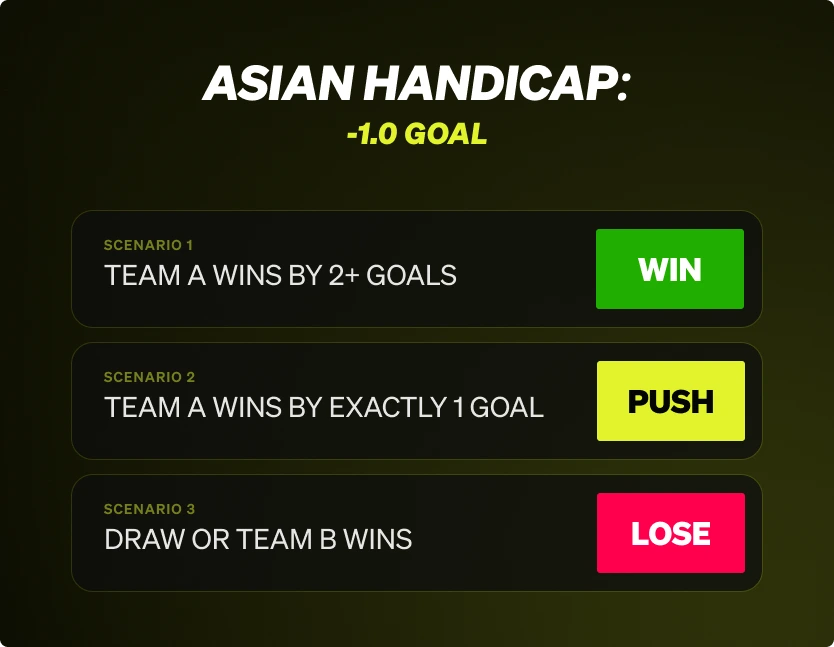
In soccer betting, whole-number Asian handicaps can result in a push when the handicap adjustment produces a draw.
Say you offer a -1 Asian handicap and the selected team wins 2–1. Subtracting one goal makes the adjusted score 1–1. The bet ends in a push, and your sportsbook returns the original stake.
Quarter-goal Asian handicaps, such as -0.25 or -0.75, work differently because the stake is split equally between two adjacent handicap lines. For example, a $100 bet on -0.75 is divided into $50 on -0.5 and $50 on -1.
If the selected team wins by exactly one goal, the -0.5 portion wins, while the -1 portion pushes. Your sportsbook pays out the winning half at the accepted odds and refunds the other $50.
5. Draw-no-bet markets
In a draw-no-bet market, customers back one team to win but receive their original stake back if the match ends in a draw.
For example, if Manchester United and Chelsea finish 1–1, draw-no-bet wagers on either team result in a push.
What happens when a bet pushes?
The optimal way to handle a push depends on the bet type. Here's how pushes affect single bets, parlays, and other betting options:
1. Single bets
When a single bet pushes, your sportsbook returns the customer's original stake and pays no winnings.
If a customer places a $100 bet at decimal odds of 1.91 and the bet pushes, they receive their $100 back. The customer makes no profit, and your sportsbook generates no gross betting revenue from that wager.
2. Standard parlays
When a selection in a standard parlay ends in a push, your sportsbook assigns that leg decimal odds of 1.00 and recalculates the potential payout using the remaining selections.
Suppose a customer places a $100 four-leg parlay, with each selection priced at decimal odds of 2.00. If all four legs win, the total return is $1,600.
However, if two legs push and the other two win, the parlay effectively becomes a two-leg bet, and the return is:
$100 × 2.00 × 2.00 × 1.00 × 1.00 = $400
If any remaining selection loses, the entire parlay loses. If all selections push, your sportsbook returns the customer's original stake under standard parlay rules.
3. Same-game parlays
Same-game parlays work differently because selections within the same match can influence each other. As a result, your sportsbook cannot always settle a pushed leg by simply assigning it odds of 1.00.
For example, a bet on a quarterback's passing yards can be related to a bet on their team's total points. If one selection pushes, your settlement rules may require you to remove it and reprice the remaining combination using the odds available when the bet was placed.
4. Teasers
Two common approaches for settling teaser bets include:
- Ties reduce: The pushed leg is removed, and the payout is recalculated based on the remaining selections. If one leg of a two-team teaser pushes, the entire ticket is typically voided, and the original stake is returned.
- Ties lose: A pushed leg counts as a losing selection, causing the entire teaser to lose.
How is a push different from a void or a dead heat?
Pushes, void bets, and dead heats can all return some or all of the stake, but they apply in different situations:
How can sportsbooks manage and minimize push bets?
While you can't eliminate every push, you can take several steps to reduce how often they occur and make sure affected bets are settled correctly:
1. Use half-point lines where they suit your pricing
Offering half-point spreads and totals prevents pushes because winning margins and combined scores are always whole numbers, so they can’t land exactly on a line ending in .5.
For example, if you set a basketball game's total at 218.5 instead of 218, the bet must either win or lose based on the final score.
However, moving a line by half a point changes each side's win probability, especially around key numbers like 3 and 7 in the NFL. You may need to adjust your odds accordingly to protect your sportsbook's margin.
2. Calculate the probability of exact results
Some winning margins occur more often than others, so a whole-number line set on one of them will push more often.
For example, according to ESPN, roughly 15% of NFL games finish with a three-point winning margin, while about 9% end with a seven-point margin. This means a -3 spread would push in about one out of every seven games, assuming the same distribution of results.
Accounting for these outcomes helps your sportsbook price whole-number lines accurately, forecast potential refunds, and manage expected revenue and exposure without removing lines customers want to bet on.
3. Verify match results before settling bets
Incorrect match results or player statistics can cause your sportsbook to settle a winning or losing bet as a push.
For example, if a basketball player's points total is incorrectly reported as 20 instead of 21, a bet on over 20 points could be settled as a push instead of a win.
To prevent this, use reliable sports data providers and confirm final scores and player statistics before settling bets, especially when a result lands exactly on the line.
4. Test how your platform handles pushes
Run your settlement system through different push scenarios before they happen in live markets.
For example, check how your system settles a parlay with multiple pushed selections or a teaser where one leg pushes. You should also test cases where only part of an Asian handicap bet is refunded.
Make sure your system doesn't refund the same bet twice if it receives duplicate results. If a match result is later corrected, your platform should also be able to update the bet's settlement and adjust the customer's balance.
Improve bet settlement accuracy with LSports
Accurate push-bet settlement requires reliable match results and a trading system that applies the right settlement rules. Incorrect scores or statistics can cause your sportsbook to refund wagers that should have won or lost, which can lead to payout disputes and financial losses.
LSports provides real-time sports data and automated trading tools that support accurate pricing and bet settlement, including:
- TRADE: Receive automatic settlement messages for bet resolution, manage pre-match and in-play odds, adjust margins, and automate market suspensions during important match incidents.
- Sports API: Access live scores and detailed match statistics collected and verified through multiple data sources. You can use this information to determine the correct outcomes for point spreads, totals, player props, and other betting markets.
- Hyper Feed: Receive fast live event updates with confidence grading and detailed metadata. Your traders can check each incident’s grade before repricing or suspending markets, so a single unconfirmed score doesn’t move your lines.
- DEFEND: Monitor betting activity and exposure in real time, set customized betting limits, and apply risk controls across your sportsbook. For example, you can track liability on spreads set at key numbers such as three and seven, where one result can decide or push a large share of bets.
Request a demo to see how LSports can help you manage complex betting settlements with greater confidence.
Preguntas frecuentes:
1. In which sports are push bets most common?
Push bets are particularly common in American football, where scoring patterns make winning margins of three and seven points frequent. They also occur in basketball markets with whole-number spreads and totals, as well as soccer markets with whole-number Asian handicaps or draw-no-bet rules.
2. What does "3-way no push" mean in sports betting?
A 3-way no push market offers three possible outcomes: a home win, an away win, or a draw. Unlike a two-way moneyline market, which refunds stakes when a match ends in a tie, a 3-way market treats a draw as a separate outcome. If the match ends in a draw, bets on either team lose, while draw bets win.
3. Can a parlay still win if one selection pushes?
Yes. Under standard parlay settlement rules, a parlay can still win if one or more selections push, provided all remaining selections win. Your sportsbook removes the pushed legs from the payout calculation and adjusts the combined odds accordingly.
4. Do push bets affect a sportsbook's hold percentage?
Yes. A pushed bet generates no gross betting revenue, so including refunded stakes in your sportsbook's betting handle lowers its realized hold percentage. If refunded stakes are excluded from the handle, pushes have no direct effect on hold.
5. What are half-point lines in sports betting?
Half-point lines are betting spreads or totals that end in .5, such as -3.5 or 218.5. Since final scores and winning margins are whole numbers, these lines eliminate the possibility of a result landing exactly on the betting line.