
In live betting and microbetting, bettors expect odds to reflect match conditions and cash to settle instantly. Data delays make these markets inoperable and frustrate users, especially during critical events.
Match trackers, heat maps, and live statistics reduce the gap between watching and wagering. A tracker out of sync with live play misleads bettors and damages the credibility of the surrounding product.
Inconsistent or delayed data results in visible failures, such as frozen bet slips, delayed settlements, and disappearing cash-outs. These erode confidence in your platform quickly and significantly.
Select a data provider that can support your betting volume and help you provide a superior experience that keeps players coming back. Verify latency, coverage breadth, and integration quality at peak load.
A live data feed is what keeps a sportsbook synchronized with events. It delivers scores, player stats, match incidents, and odds updates on a continuous basis. Every feature runs on top of this infrastructure, from cash-out to visualization widgets.
When the data is slow or inaccurate, the rest of the betting platform follows suit:
Such technical problems can be deciding factors in whether a bettor stays or leaves.
On the other hand, fast and accurate data results in a seamless user experience. Players are engaged, satisfied, and willing to return to the platform, which translates to a more sustained revenue growth for your business. iGamingFuture’s 2024 report suggests that a 5% increase in player retention can result in a whopping 25% increase in profit.
The following sections analyze specific ways real-time sports data benefits bettors and, in turn, sportsbook operators.
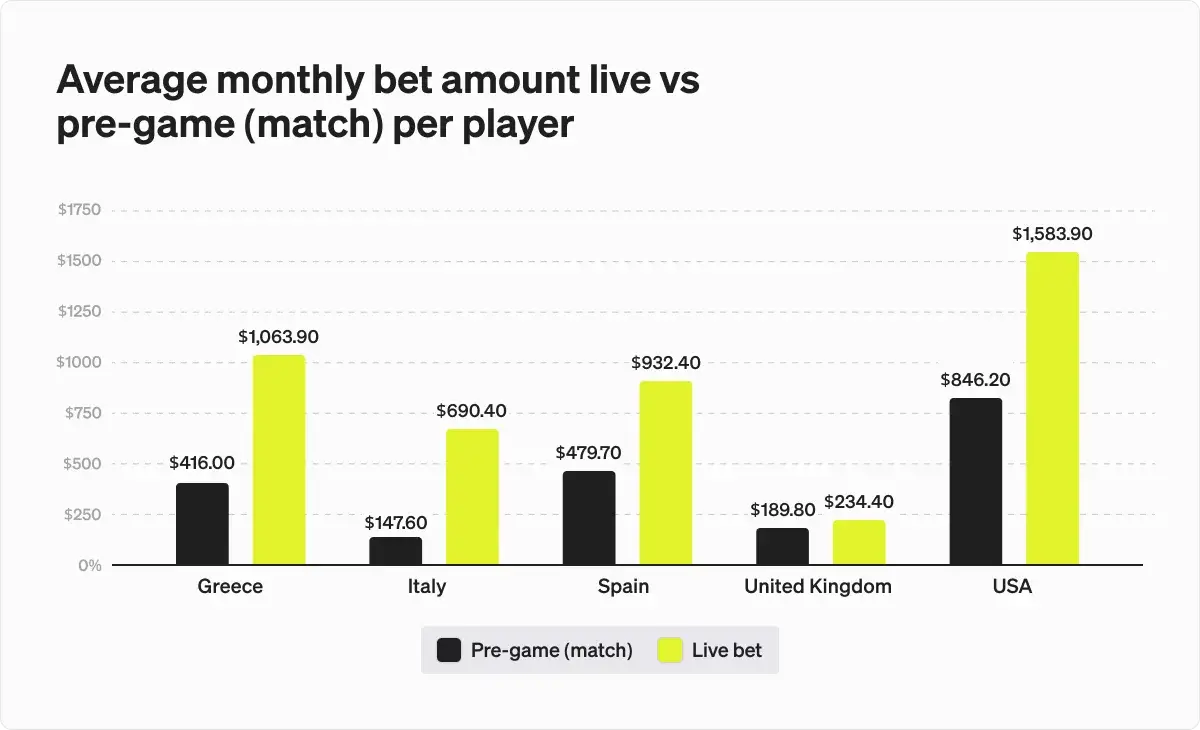
According to Optimove’s 2024 research, over 54% of players from the U.S., the U.K., and Europe bet live. In the U.S., monthly spending on live bets exceeds pre-match by 87%. The percentages are likely higher today, given the recent rise in AI-driven technology and personalized betting.
The commercial weight behind those numbers matters. Gr8 Tech reports that live betting accounts for 45–60% of sportsbooks’ revenue and increases player session time by 20–30%.
Microbetting leaves the smallest margin for data delay. A bettor wagering on the next serve, corner, or possession needs odds that reflect the current state of play, updated in near real time.
When data is delayed, bettors lose access to markets before they can act. A processing delay of even 100 milliseconds can mean the possession a bettor was wagering on is already over by the time the platform responds.
Data delays also create fairness problems. If one bettor receives updates even a second or two ahead of another, they gain an informational advantage that puts others at a disadvantage.
Cash-out prices stem from live data. The offer a bettor sees comes from current match odds, which themselves depend on the feed state at that exact moment.
A latency gap of a few seconds is manageable in a stable match. During a high-volatility event, such as a red card or a goal, the same gap can produce an offer price that no longer reflects the actual risk position. At that point, the operator either suspends cash-out entirely or accepts the pricing error.
Suspension is the safer choice, but it comes at a cost. Bettors who try to close a position at a critical moment and find the feature unavailable will be frustrated and likely to leave. This is one of the fastest trust-destroyers on any platform.
Problems with auto-settlement have a similar impact. When a condition is met, bettors expect the platform to resolve related bets within seconds. A wager that remains open after the event ends ties up funds the bettor may want to reinvest. This disrupts the rhythm of a live session and undermines the sense of control that makes in-play betting appealing in the first place.
Real-time data also feeds the visual layer that sustains bettor attention during matches and between active wagers, such as:
A bettor actively tracking live match visualization is more likely to stay on-platform and place additional in-play bets. These tools reduce the gap between watching and wagering, which directly supports betting volume.
Data quality and speed determine whether any of this works. A live tracker that updates with a five-second delay actively misleads bettors about the current state of play. When visualization tools fall out of sync with the live feed, they damage the credibility of the surrounding product, including the odds and markets the operator relies on for margin.
Most of the failures that accelerate bettor churn trace back to the same source—data that isn’t fast enough or accurate enough to support the features built on top of it.
Problems like frozen bet slips or slow-loading balances indicate that your platform can’t handle real money under pressure. When these problems are accompanied by poor communication and slow resolution, the reputational damage is often substantial. Building those perceptions back is a major challenge
With so many options on the market today, bettors can easily switch to a different platform if they experience lag or other issues.

Selecting a data provider is one of the most consequential infrastructure decisions you’ll make. Evaluating correctly upfront avoids costly mid-contract corrections.
Premium feeds update in near real time with comprehensive in-play statistics. Standard feeds are typically cheaper, but some may lag in delivery. It’s important to adopt a balanced approach to ensure effective data delivery. Additionally, having multiple independent data sources helps catch errors that single-feed models miss.
When evaluating providers, pay attention to factors such as:
A feed that performs well during a standard demo may degrade significantly during popular events, when concurrent in-play markets multiply and data volumes spike.
Before signing any long-term contracts, push for testing that mirrors real traffic patterns around a major fixture window. The key variables to measure are end-to-end latency from event to odds update, feed stability under sustained load, and recovery time after any interruption.
It’s also worth checking what happens when the feed degrades. Does the platform receive clear signals it can act on, or does data stop arriving without warning? Feeds with clear failover signalling allow trading systems to respond before the gap becomes visible to bettors.

LSports is a provider offering close-to-zero latency data through independent collection. Instead of relying solely on official rights agreements,
LSports gathers data through a live scouting network and AI and computer vision across broadcasts and public sources. This enables it to provide broad coverage at a sustainable cost. The platform covers over 100 sports, 15,000+ leagues, 2,500 markets, and 3 million fixtures.
Operators under official rights contracts typically have strong coverage of elite competitions and a solid compliance record. Outside those tiers, the gaps emerge fast.
LSports perfectly supplements primary feeds to cover regional and lower-tier markets that Tier 1 contracts don’t extend to. At the same time, it doesn’t require a separate integration or contract. Where official data compliance isn’t a regulatory requirement, LSports works as a standalone, full-coverage solution.
The data feeds sit within ARENA360, an integrated platform covering odds, trading and risk lifecycle management, and live benchmarking and margin intelligence. The platform also offers ENGAGE, a suite of features designed to keep players active:
Sign up for a free trial and find out how LSports can strengthen your in-play product and engagement offering.
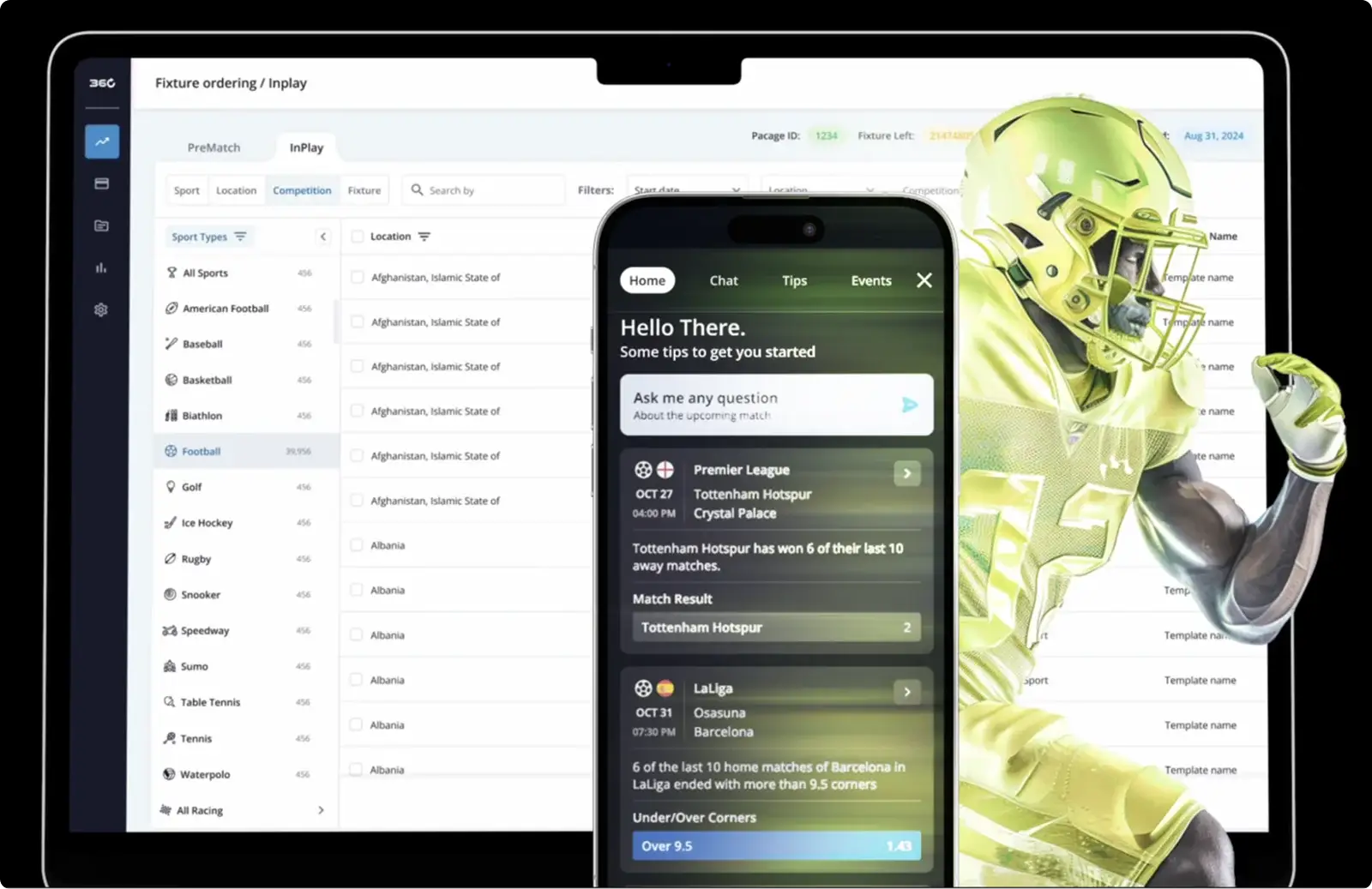
The first step is to capture the data from live sources, such as broadcasts, sensors, or on-site collection.
Next, data is processed into structured feeds, which are delivered to sportsbook platforms via application programming interfaces (APIs). They update live scores, odds, statistics, and market states in milliseconds as events unfold. The speed and reliability of the capture and delivery chain determine how competitive the resulting in-play product can be.
Three common issues include:
The most effective way to avoid them is to choose a reliable, high-coverage data provider. Test them under realistic peak-load conditions before committing and evaluate API quality and documentation early in the selection process. Additionally, verify that the provider’s coverage footprint matches the markets you actually plan to offer, and not only the major leagues.