
Define the sports, markets, data types, latency needs, and platform goals upfront. This prevents overpaying for unnecessary feeds and helps you choose an API partner that actually fits your product and scale.
Successful sports data API integration goes beyond connecting endpoints. Strong backend logic, caching, real-time delivery methods, secure authentication, and staged deployment are what make feeds perform reliably under live betting conditions.
Low latency, load testing, caching strategies, and monitoring are critical, especially during traffic spikes around major events. Building for speed and resilience early helps avoid outages, cost overruns, and poor user experiences later.
Common integration challenges include inaccurate feeds, rate limits, stitching multiple data sources together, and handling provider inconsistencies. Choosing providers with strong uptime, documentation, and support can significantly reduce these risks.
Instead of piecing together multiple vendors, solutions like LSports offer a unified ecosystem for real-time data, odds, trading tools, risk management, and engagement features. For sportsbooks looking to scale faster with less integration complexity, this kind of all-in-one solution can be a major advantage.
A sports data API (Application Programming Interface) lets sportsbooks and other applications connect directly to a data provider and receive real-time, structured sports information through simple requests and responses. Instead of scraping websites or building complex data pipelines, sportsbooks can use an API to instantly access schedules, scores, player stats, odds, and other real-time sports data delivered in a structured, reliable format.

This infrastructure powers core sportsbook features, including live odds, in-play betting markets, leaderboards, and real-time game updates.
Sports data APIs provide a wide range of information, from real-time game action to deep statistical analysis and betting-related data. Here are some of the most common types of data available:
Integrating a sports data API into a betting platform requires thoughtful planning, choosing the right vendor, rigorous performance testing, and ongoing optimization. Here is how the process works:
Start by clearly outlining the scope of your platform and the data it requires. Focus on:
Defining these requirements early helps avoid paying for unnecessary data and ensures you choose a provider that fits both your business needs and your technical infrastructure.
When evaluating potential providers, focus on the factors that will impact performance, scalability, and long-term reliability. In the table below, you will find key criteria for evaluating a sports data API provider:
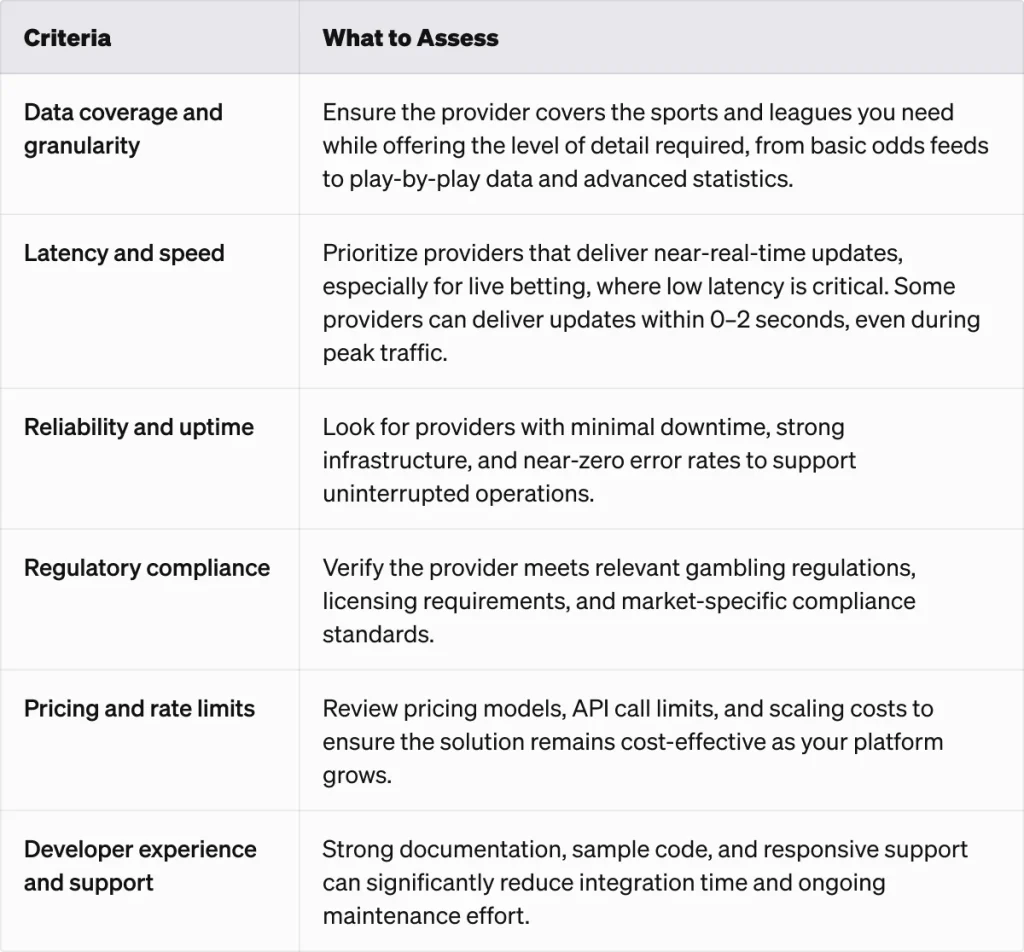
Criteria Table
Once you’ve narrowed down your options, validate your shortlist by testing performance, reviewing compliance standards, and confirming reliability commitments. After selecting a provider, set up your account, obtain your API credentials, and review usage limits and licensing terms before moving into integration.
You can also check out our article, “Key metrics sportsbooks should consider when choosing a sports data API provider,” to learn more.
Before writing any code, take time to thoroughly review the API documentation. Every provider structures its APIs differently, so understanding how a specific API works upfront will save time and prevent integration issues later. Focus on these key areas:
Set up a sandbox or test environment to safely explore the API before moving into production. Many providers, such as LSports, offer free trials, allowing you to test endpoints, explore available data, and evaluate how the API fits your needs before committing.
Begin with simple endpoints, such as schedules or team lists, to get familiar with the data structure and response formats. Once you have a solid understanding of the basics, you can move on to more complex data, such as live game feeds or odds.
Avoid hard-coding API keys in client-side code, where they can be exposed and misused. Instead, store keys securely on your server or within a protected gateway layer, where requests can be authenticated before being sent to the provider.
It’s also important to follow strong key management practices. Rotate API keys regularly, limit access by IP address or environment when possible, and use permission controls to reduce risk.
Once your endpoints and authentication are in place, the next step is building the backend services that fetch, process, and deliver data to your application. This layer acts as the bridge between external APIs and your front end, ensuring the data is reliable, structured, and fast to access. Here’s what you need to do:
After your backend can fetch and store data, focus on creating a front-end that presents odds, live scores, and betting slips in real time with a smooth, intuitive user experience. Use reactive frameworks, so updates appear instantly for users, keeping the interface fast and responsive. Build modular components such as event cards, odds tables, and bet slips to improve consistency and make them easy to reuse across different sports and markets.
Test both functionality and performance to make sure your system works reliably under pressure. Simulate peak traffic, sudden spikes during major game moments, thousands of concurrent users, and temporary upstream API outages. Also, check how your app recovers from dropped WebSocket connections, rate limit errors, and malformed data.
During testing, you’ll likely find that repeatedly calling the API for unchanged data is inefficient and can slow down your application. Implementing an intelligent caching strategy helps store frequently accessed data closer to users, reducing latency, cutting down API requests, lowering costs, and improving reliability at scale. A strong caching strategy should include:
Roll out integrations gradually to reduce risk and avoid service disruptions. Start with a limited set of sports or markets, then expand once stability is confirmed. After launch, continuously monitor key metrics, including latency, uptime, error rates, and call volumes. Use automated alerts to detect issues early, and perform regular updates as provider endpoints evolve.
While sports data APIs enable powerful features, integrating them comes with technical and operational challenges. Some of the most common challenges include:
Effective Sports Data API Integration requires more than a fast data feed. It also depends on reliable infrastructure, broad coverage, and tools that support trading, risk management, and user engagement.
This is where LSports can help you!

LSports homepage
LSports is a global sports data solutions provider delivering real-time feeds, trading intelligence, and operational tools through its Sports API and the broader ARENA360 platform. Its Sports API provides continuously updated, verified data across 30+ sports and up to 40,000 monthly events, while its wider data infrastructure covers:
For odds and trading, OddService supplies raw bookmaker lines from over 100 operators, while TRADE adds customized average odds, built-in margin control, automated suspensions, settlement tools, and 0–1 second latency for in-play events. Beyond pricing feeds, ARENA360 extends into sportsbook operations through DEFEND for risk management, BOOST for live benchmarking and trading intelligence, and ENGAGE for front-end tools such as live scoreframes, match trackers, and AI-powered betting assistance.
What makes LSports a strong solution for modern sportsbooks is its ability to combine real-time sports data, trading tools, risk controls, and engagement features within a single ecosystem. Rather than relying on separate vendors for data, pricing, and operational support, you can access a unified platform designed for scalability, performance, and competitive growth.
Start your free trial today and see how LSports can support your sportsbook with reliable real-time data.
Sports data API integration costs vary based on provider pricing, data volume, sports coverage, and whether you need live odds, historical data, or premium feeds. Beyond API fees, costs can also include development, infrastructure, caching, monitoring, and ongoing maintenance.
Using a single provider can simplify integration and reduce costs, while using multiple providers can improve coverage, redundancy, and data reliability. The right choice depends on your scale, technical resources, and whether you need backup feeds or specialized data sources.