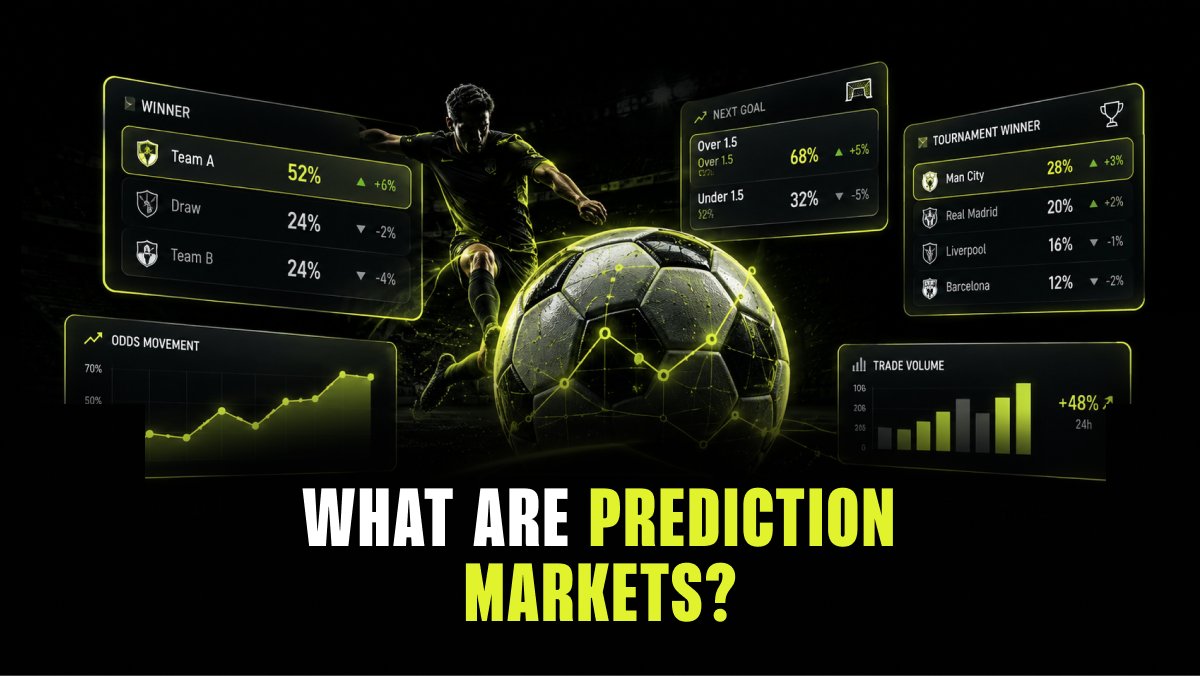

From sports and elections to financial markets and entertainment, prediction markets allow customers to trade on any event with a clear, independently verifiable outcome.
Higher liquidity lets customers trade more easily, reduces large price swings, and helps market prices reflect an event’s likelihood more accurately.
They expand your product portfolio beyond traditional betting, encourage customers to stay active throughout an event, and create additional revenue opportunities through trading fees, commissions, or market-maker spreads.
Rather than depending on operator-set odds, prices are driven by customer trading activity. Participants can buy, sell, and manage positions throughout the life of the market, which ensures a more flexible and interactive experience than traditional fixed-odds betting.
With the unified Prediction Markets Feed, LSports provides the technology needed to integrate live market prices, futures contracts, settlement rules, and automated settlement data with your sportsbook.
Prediction markets are platforms where people buy and sell contracts based on the outcome of future events, such as elections, sporting events, or economic trends. The price of each contract changes as participants trade, reflecting the market’s collective expectations about how likely an outcome is.

Instead of depending on fixed odds set by an operator, prices are continuously shaped by market activity and new information. This creates dynamic markets that can adapt quickly to changing events while giving participants an opportunity to profit from accurate predictions.
A prediction market can theoretically be created for almost any event with a clear, independently verifiable outcome. Common prediction market categories include:
Every prediction market follows a structured process that takes an event from market creation through trading and final settlement. The process typically looks like this:
For example, a market may ask “Will Person A win the election?” If a Yes contract is trading at $0.64, the market is effectively estimating that Person A has a 64% chance of winning. A customer who purchases the contract for $0.64 will receive $1 if Person A wins, earning a $0.36 gross profit per contract (the payout minus the purchase price, before any platform fees).
However, the customer does not have to wait until the match ends. If Person A takes an early lead and the contract price rises to $0.82, the customer can sell the contract before the final whistle and secure a $0.18 gross profit per contract, regardless of the eventual result.
Prediction market prices are often used as estimates of how likely an event is to occur, but they aren’t perfect. They can also be affected by factors such as:
In large, active markets, prices tend to be more accurate because traders quickly buy or sell contracts they believe are mispriced. In smaller markets with fewer participants, even a single large trade can move the price significantly.
For sportsbook operators, liquidity is one of the most important factors in a prediction market’s success. Higher liquidity allows customers to trade larger positions with minimal price movement, creating a smoother trading experience. It also enables market prices to reflect the likelihood of an event more accurately.
Prediction markets can use several contract structures. The right format depends on the event, customer experience, available data, and regulatory requirements.
Binary markets are the simplest type of prediction market you can offer. Customers answer a question with only two possible outcomes: Yes or No. For example, “Will the Federal Reserve raise interest rates this month?“, “Will a Category 5 hurricane make landfall this season?“, or “Will Company X release its new product before December 31?“

Because there are only two possible outcomes, binary markets are easy for customers to understand and simpler for your platform to price, manage, and settle.
Multiple-outcome markets let customers choose between three or more possible results. For example, they can predict which country will host the next Olympic Games, which company will become the world’s most valuable by year-end, or which artist will win Album of the Year.

These markets give you more flexibility to cover different event categories, but they also require accurate pricing and clear settlement rules for situations such as withdrawals, disqualifications, or other changes to the original field.
Range markets let your customers predict which range a numerical result will fall into. For example, they might predict whether annual inflation will be 2–3%, 3–4%, or above 4%, or whether global electric vehicle sales will reach 10–12 million, 12–14 million, or more than 14 million.

Range markets can increase the variety of markets you offer, but the ranges and settlement rules should be clearly defined to avoid customer disputes.
Scalar markets are based on the final value of a measurable outcome. For example, your customers could predict the total rainfall in a city during a month, the number of satellites launched this year, or the closing value of a major stock index.

These markets allow you to cover a wide range of measurable events, but they are generally more complex to price and settle than binary or multiple-outcome markets.
Conditional markets are based on one event depending on another. For example, a market may predict whether a central bank will cut interest rates if inflation falls below a certain level, or whether a company will complete an acquisition if regulators approve the deal. These markets also require carefully written rules due to their complexity.
Both prediction markets and traditional sportsbooks allow customers to take positions on uncertain outcomes. However, they differ in several important ways:

Prediction markets can complement a sportsbook’s existing pre-match and live betting products. When implemented properly, they give customers more control over how they express their opinions and how long they keep a position open. Key benefits of adding prediction markets include:
To launch prediction markets, you need accurate market data, real-time price updates, automated settlement, and technology that integrates reliably with your existing sportsbook infrastructure.
LSports is a sports data solution that provides the technology you need to launch prediction markets without the operational and risk management complexity. Through its Prediction Markets Feed, LSports aggregates real-time data from leading market exchanges into a single, unified feed. This simplifies integration while giving you access to continuously updated market content.
The feed delivers everything needed to power a complete prediction market experience, including:
Coverage extends well beyond traditional sports, allowing you to offer markets across a wide range of categories, including:
Request a demo today and discover how LSports can help you launch, scale, and manage prediction markets.
The legality of prediction markets depends on the jurisdiction in which you operate. Some regulators treat them as betting products, while others classify them as financial or event contracts. Before offering prediction markets, you should ensure your product complies with local licensing and regulatory requirements.
Yes. Many prediction market providers offer APIs and data feeds that integrate with existing sportsbook platforms. This allows you to add prediction markets without replacing your current betting infrastructure, reducing development time and operational complexity.
When choosing a prediction market provider, look for reliable real-time data, broad market coverage, low-latency updates, clear contract and settlement rules, automated settlement, API integration, and scalable infrastructure. These capabilities help deliver a smooth customer experience while reducing operational overhead.