2026년 10월 28일
티저 베팅이란 무엇인가? 스포츠북을 위한 종합 가이드
명확한 예시를 통해 티저 베팅이 무엇인지, 포인트 조정과 배당률 산정 방식이 어떻게 이루어지는지, 그리고 스포츠북이 티저 베팅의 위험과 마진을 어떻게 관리하는지 알아보세요.

이 기사에서
구독하기
항상 한 발 앞서 나가세요
스포츠 데이터, 베팅 동향, 업계 뉴스에 대한 최신 정보를 이메일로 바로 받아보세요.
이것은 제목입니다
A teaser bet is a multi-leg wager where customers receive more favorable point spreads or totals on their selections in exchange for a lower potential payout.
Unlike standard parlays, teasers change the underlying lines, so when setting your odds, you need to consider how each adjustment affects the ticket’s chance of winning.
In this article, you’ll learn what a teaser bet is, how it works, and how you can price and offer it to your customers.
주요 내용
- Teaser bets give customers better lines in exchange for lower payouts
Customers can move spreads or totals in their favor by a set number of points, but every required leg generally needs to win for the teaser to pay out.
- The same point adjustment does not have the same value on every line
Moving a spread across important scoring margins can increase a leg’s win probability much more than an identical adjustment elsewhere, so you need to price the new line based on its actual probability.
- Correlated selections and stale lines can increase your exposure
Related outcomes can make a teaser more likely to win than expected, while delayed updates can allow customers to place teaser bets using outdated lines that are more favorable than the current market.
- Accurate teaser pricing starts with clear rules and probability-based calculations
Define eligible markets, point adjustments, settlement rules, and limits first. Then estimate each adjusted leg’s probability, calculate the ticket’s overall probability, and apply your target margin.
- LSports can provide the data, odds, and trading tools needed to support teaser markets
With real-time sports data and odds, TRADE for pricing and trading controls, and OddService for comparing odds from 100+ bookmakers, LSports can help you keep teaser lines up to date and respond quickly to market movements.
What is a teaser bet?
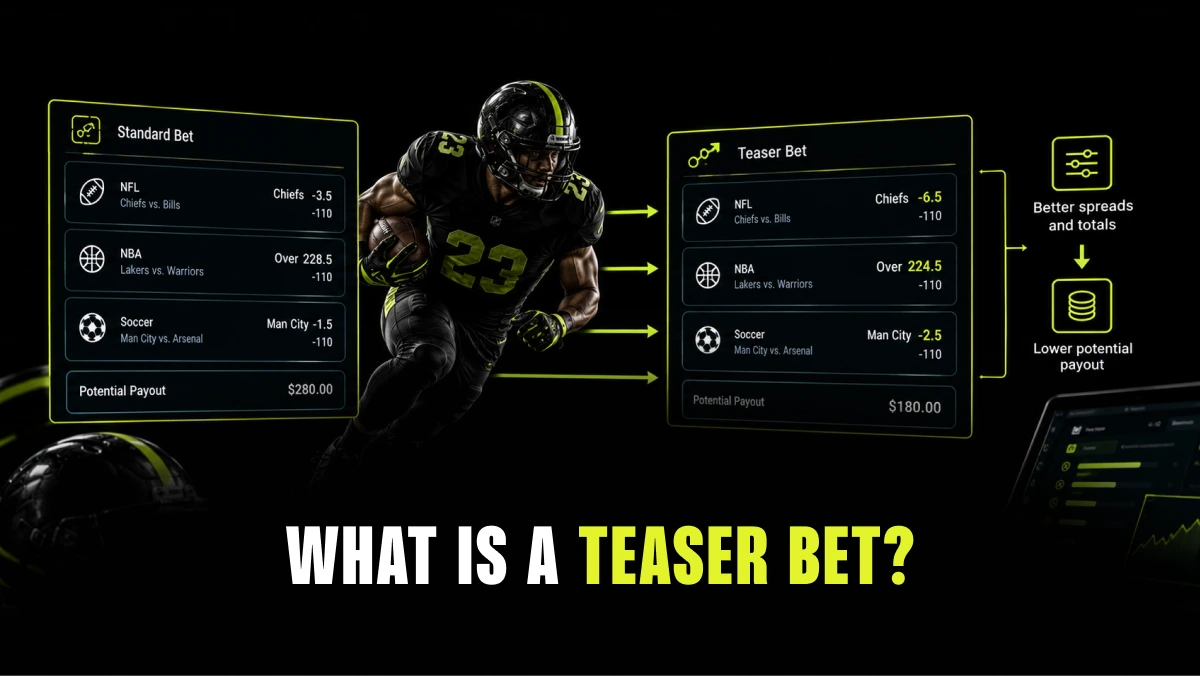
A teaser bet is a type of bet that combines multiple selections into a single wager and lets the customer move the point spread or total in their favor by a set number of points. It’s particularly common in basketball and American football.
Because the adjusted lines give each selection a better chance of winning, a teaser pays less than a standard parlay with the same legs.
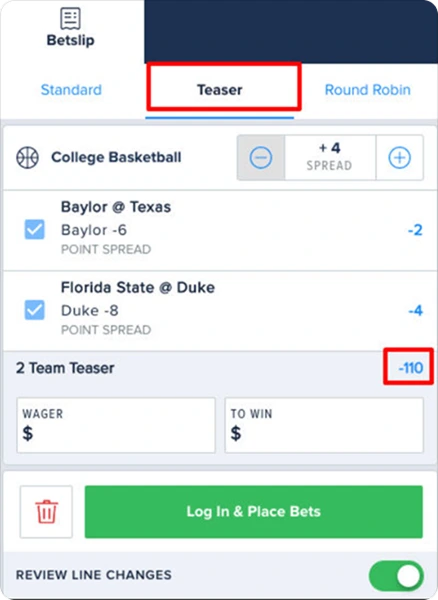
For example, if a basketball team is priced at -8.5, a 3-point teaser could move the spread to -5.5. Instead of requiring the team to win by nine or more points, the bettor would only need it to win by six or more for that selection to cover the adjusted spread.
How does a teaser bet work?
1. The customer selects eligible markets
The customer chooses two or more eligible markets to include in the teaser, such as basketball or football point spreads and totals. The system then combines these selections into a single teaser bet with multiple legs.
2. You adjust the lines
Once your customer has chosen their selections, they pick the number of teaser points from the options you offer. Your system then moves each line by that amount and prices the complete teaser based on the number of legs and the size of the adjustment. Generally, more teaser points mean shorter odds because each adjusted selection becomes easier to win.
For example, suppose a customer selects two football teams at -8.5 and +2.5. With a 6-point teaser, those lines improve to -2.5 and +8.5. Because the customer receives more favorable lines on both selections, you offer a lower payout than they would receive by combining the original -8.5 and +2.5 spreads in a standard parlay.
Here is how a 6-point teaser can change different lines:
Favorite spread
- Original line: Team A -8.5
- Adjusted line: Team A -2.5
- Winning condition: Team A must win by at least 3 points.
Underdog spread
- Original line: Team B +2.5
- Adjusted line: Team B +8.5
- Winning condition: Team B can win or lose by up to 8 points.
Over
- Original line: Over 44.5
- Adjusted line: Over 38.5
- Winning condition: The teams must score at least 39 points combined.
Under
- Original line: Under 44.5
- Adjusted line: Under 50.5
- Winning condition: The teams must score 50 or fewer points combined.
3. You settle the teaser
Every leg generally needs to win for the teaser to pay out, but your rules decide what happens when a leg pushes or is voided.
For example, if an adjusted spread is Team A -3 and Team A wins by exactly three points, that selection is a push. In that case, you may remove the pushed leg and settle the teaser based on the remaining selections, refund the ticket, or treat the push as a loss, depending on the rules you have set for that teaser.
Challenges of offering teaser bets
Teaser bets are harder to price than standard spreads or totals because you need to account for the value of multiple adjusted lines within the same ticket. Here are some of the key challenges when pricing teaser bets:
1. Point adjustments have unequal value
Not every 6-point adjustment gives the customer the same advantage. In the NFL, moving a favorite from -8.5 to -2.5 crosses 3 and 7, the two most common winning margins according to a GamblingSite analysis.
A teaser that crosses both numbers can therefore noticeably raise the leg’s chance of winning. Moving a favorite from -14.5 to -8.5 gives the same 6 points, but none of the margins it crosses come up as often, so the adjustment is worth less.
This creates a pricing challenge for your sportsbook. If both adjustments are available at the same teaser price, customers can choose the combinations where the extra points provide the greatest advantage, potentially reducing your margin.
2. Related selections can affect the price
Some teaser selections are correlated. For example, a customer combines Team A +7.5 with under 48.5 points from the same game. Low-scoring games tend to stay closer, so if the game goes under the total, the underdog is also more likely to cover.
If your sportsbook prices these legs as completely separate, it may miscalculate the true chance of both winning together. You therefore need to account for these relationships when pricing teasers or restrict certain same-game combinations.
3. Line changes can leave outdated teaser prices available
Teaser lines are based on your main market, so they need to update whenever the original spread changes.
For example, if a favorite moves from -8.5 to -10.5, a six-point teaser should move from -2.5 to -4.5. If your system updates the main spread but the teaser market lags behind and still accepts bets at -2.5, customers receive an outdated, more favorable line.
4. Small pricing errors can grow across multiple legs
A small probability error may look minor on a single leg, but it compounds when the same error repeats across every leg of the ticket.
For example, suppose you estimate that each leg has a 72% chance of winning, when the real probability is 74%. For a two-leg teaser, you would estimate a 51.8% chance of the entire ticket winning, while the actual chance is about 54.8%. With three or more legs, the difference becomes even larger.
This matters because teaser payouts are often based on the number of legs. If you consistently underestimate how likely each leg is to win, you may offer payouts that are too high for the actual risk your sportsbook is taking.
How to price teaser bets
1. Define the teaser rules before pricing it
Before setting teaser odds, decide exactly which selections customers can combine and how you’ll settle those bets. These rules directly affect the probability of a winning ticket and, therefore, the odds you can offer.
For example, determine:
- Which sports, leagues, and pre-match markets are eligible
- How many points customers can add or subtract from a spread or total
- How many legs a teaser can contain
- Whether selections from different games or market types can be combined
- Which same-event or correlated selections are restricted
- How pushes, voids, postponements, and reduced tickets are settled
- What stake and maximum payout limits apply
2. Price each adjusted line based on its probability
Calculate the probability of each adjusted line directly. Adding a fixed percentage to the original spread’s probability won’t work, because the same adjustment can be worth different amounts. Use historical game results, current odds, and matchup data from the specific sport and competition you are pricing.
3. Calculate the probability of the complete ticket
Once you have estimated the win probability of each adjusted leg, calculate how likely all legs in the teaser are to win. For example, suppose a two-leg teaser contains two independent selections, and each has a 74% chance of winning. Assuming there are no pushes or voids, the probability of both winning is:
- 0.74 × 0.74 = 0.5476, or 54.76%
You can then convert that probability into fair decimal odds:
- 1 ÷ 0.5476 = 1.826
In other words, odds of approximately 1.83 would represent the fair price before your sportsbook adds its margin. If the selections are correlated, you need to calculate their combined probability differently or restrict that combination.
4. Add your sportsbook margin
Once you know the estimated probability of the complete teaser winning, adjust the fair odds to include your sportsbook’s margin.
Using the previous example, the teaser has an estimated 54.76% chance of winning, with fair decimal odds of approximately 1.83. Suppose you want to price the ticket for a theoretical 5% hold. You can calculate the offered odds as:
- (1 − 0.05) ÷ 0.5476 = 1.73
You could therefore offer decimal odds of approximately 1.73 instead of the fair price of 1.83. Under these assumptions, customers would receive an expected return of about 95% of the amount wagered, leaving a theoretical 5% margin for your sportsbook.
How can LSports help you offer teaser bets?
To price teaser legs accurately, your trading team needs current odds, scores, statistics, and market information for the underlying spreads and totals, so adjusted lines move as soon as the main market does.
LSports provides real-time sports data and odds across 100+ sports, 15,000+ leagues, 2,500+ markets, and 3 million fixtures annually. Its coverage includes both basketball and American football, two of the main sports where teaser bets are offered.
With TRADE, you can control margins, minimum and maximum odds, and line types, which helps you apply your target hold to teaser prices and keep adjusted lines within your limits. It comes with pre-match and in-play odds, live scores, statistics, and settlements.
You can also use OddService to access and compare odds from 100+ bookmakers in real time. This gives your trading team additional market information to monitor price movements and evaluate the underlying lines used to create your teaser markets.
Request a demo today to see how LSports can keep your teaser lines accurate and up to date.
자주 묻는 질문:
1. What is the difference between a teaser and a parlay?
A parlay combines multiple selections at their standard lines, and each leg generally needs to win for the ticket to pay out. A teaser is a type of multi-leg bet that lets customers adjust eligible point spreads or totals in their favor in exchange for a lower potential payout.
2. What sports are best suited for teaser bets?
Teasers are most common in American football and basketball, where point spreads and totals provide clear opportunities for line adjustments. The right markets to offer depend on your coverage, pricing models, and ability to manage the additional exposure.
3. How many selections should a teaser bet include?
Teasers typically contain two or more selections, but the maximum number of legs depends on the format and rules you set. Adding more legs reduces the probability of the entire ticket winning, so the payout needs to reflect the number of selections included.
4. Should sportsbooks offer cash out on teaser bets?
Cash out gives customers more control over an open teaser, but it also adds a pricing requirement for your sportsbook. The offer needs to reflect settled legs, the current probability of the remaining selections, and your outstanding exposure.
5. Can teaser bets include selections from the same game?
Yes, but same-game selections require particular attention because the outcomes may be correlated. If your pricing does not account for that relationship, the teaser could give customers more value than the displayed odds justify.