2026年4月23日
2026年体育数据的成本是多少?[完整指南]
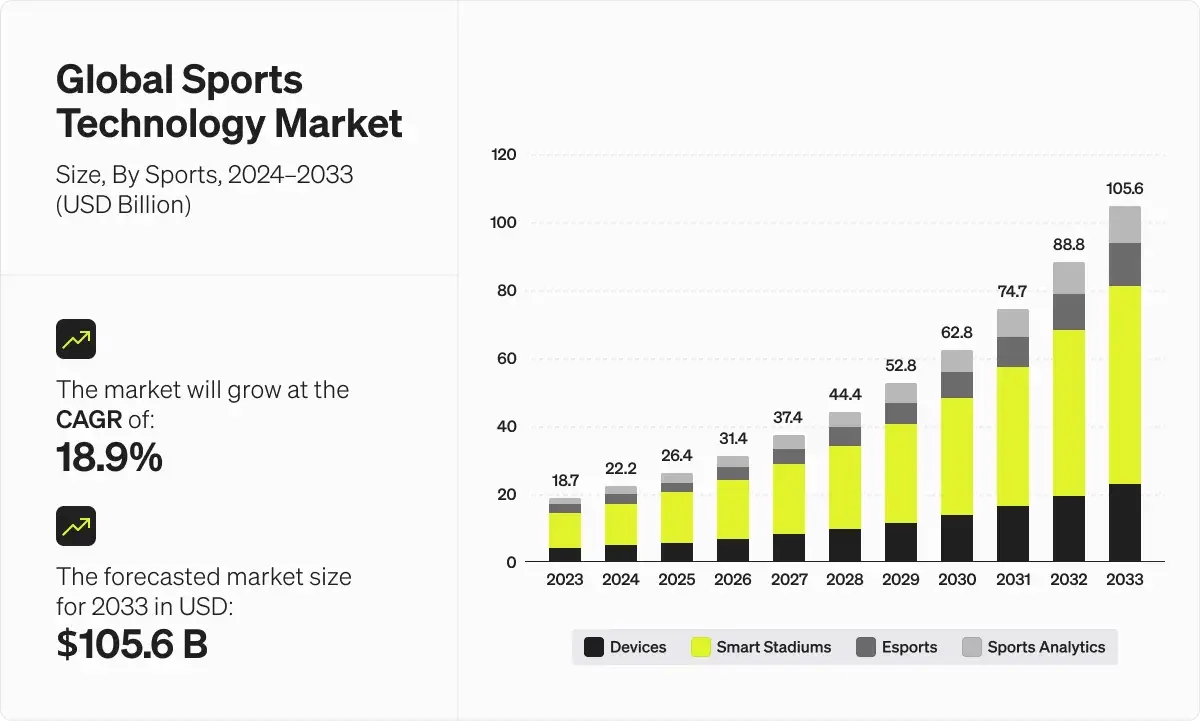
2025年,全球体育数据分析市场规模达57亿美元,预计到2033年将突破230亿美元。体育数据需求激增,价格也随之水涨船高。尽管博彩公司依赖数据,但要明确其实际成本究竟是多少,仍是该行业最令人头疼的问题之一。 定价信息极少公开,合同结构千差万别,而总拥有成本远不止标价那么简单。本指南将详细解析2026年体育数据成本的现有信息,以及供应商很少提醒您的那些隐性费用。

在本文中
订阅
保持领先地位
获取有关体育数据、博彩趋势和行业新闻的最新见解——直接发送到您的收件箱。
这是一个标题
要点总结
- Custom pricing dominates the market.
Most providers negotiate fees based on data volume, sport selection, and operational scale. Public pricing exists mainly among smaller, developer-focused APIs.
- Tier 1 sports data costs significantly more.
Sportradar and Genius Sports command premium rates driven by exclusive league agreements. Lower-cost alternatives trade off coverage depth or in-play reliability.
- The real cost extends beyond subscription fees.
Integration effort, manual operations, risk tooling, and provider switching costs can match or exceed the base subscription.
- Preparation is key to landing fair contract prices.
Select your provider carefully, define your needs before the sales call, and account for the operational costs. Opt for all-in-one providers that collect data independently.
- All-in-one platforms reduce the total cost of ownership.
A platform like LSports bundles trading, risk, analytics, and user retention tools into one ecosystem, eliminating the integration tax of managing multiple vendors.
Sports data cost in 2026: Custom pricing is the norm
If you’ve tried to compare data providers, you know that most of them, including giants like Sportradar and smaller outfits like OddsMatrix, don’t display their pricing publicly. They require you to contact the sales team or complete an online form, and then calculate a custom quote.
Usually, the end figure depends on factors like:
- The volume and granularity of data you need
- The sports and leagues you require
- How you plan to use the feed (display, trading, or settlement)
- The size of your operation
For example, a regional sportsbook covering three sports will receive a very different quote than a multi-market operator with 50+ sports.
Pricing varies greatly
The more advanced the technology powering the feed, the higher the price point tends to land. Artificial intelligence, predictive engines, and sub-second delivery infrastructure are expensive to build and maintain, and feed prices reflect this.
Tier 1 providers like Sportradar and Genius Sports command premium pricing, reflecting exclusive league data rights, regulatory trust, and enterprise-grade infrastructure.
Providers like FeedConstruct, OddsMatrix, and OpticOdds offer more accessible rates, particularly for regional operators or niche sports. Their lower costs reflect faster onboarding and leaner infrastructure, with trade-offs in in-play reliability or coverage at scale. Such providers are the usual choice for early-stage operators or those testing new markets, as they offer a practical starting point without the financial commitment of an enterprise contract.
Below is a breakdown of the available pricing information for some providers:
Providers:
Odds-API – £99–£229/month (~$132–$399) + Enterprise plan
Sportmonks (Football) – From €34/month (~$39) with yearly billing + Enterprise plan
The Odds API – $30–$249/month + high usage plans
Sports Game Odds API – $99–$299/month with yearly billing + custom plan
Sportradar (API) – From $1,250/month
*Please visit the official websites or contact providers directly for the most accurate pricing information.
Many providers also let you get started for free. For example, LSports offers a free trial, while The Odds API features a freemium tier with 500 monthly credits. These are useful for testing the data and platform before committing.
Subscription vs. pay-per-use
Pricing models also vary across providers, with two common options being subscriptions and pay-as-you-go.
Subscriptions provide predictable monthly costs regardless of call volume, which suits operators with steady, high-volume usage and makes budgeting straightforward.
Pay-per-use charges per API request, offering savings during early-stage testing or low-volume periods. Still, costs can spike unpredictably during peak events if you don’t monitor usage carefully. Understanding your usage patterns before choosing a model is important because switching mid-contract isn’t always possible.
Exclusive rights drive high prices
Much of the cost pressure stems from exclusive data rights. Major leagues sell their official data to a small number of providers—sometimes only one—and prices reflect the absence of competition.
This creates a dependency loop for sportsbooks. If an operator needs a specific league’s data for settlement and compliance, but only one provider carries it, their negotiation leverage is minimal.
Contract renewals often include above-inflation price increases. For instance, in its terms of service, Sportradar reserves the right to adjust pricing for official services on a season-by-season basis.
Mid-sized operators feel the consequences most acutely. They need the same data as the largest books to stay competitive, but lack the transaction volume to absorb premium pricing comfortably. The result is a market where data costs consume a disproportionate share of revenue for the operators who can least afford it.
Independent data providers offer an alternative by collecting through AI and computer vision from publicly available broadcasts, avoiding the exclusive rights bottleneck entirely.
The hidden cost of working with sports data
The subscription fees are not the only spending sportsbooks have to deal with. The real financial exposure lies in the operational costs that accumulate quietly over time:
- Technical debt: Every new provider means a new API to integrate, new data formats to normalize, and ongoing maintenance. Developer hours spent on integration are developer hours not spent on product improvement.
- Operational overhead: Managing odds, risk exposure, and settlements manually is expensive in headcount and error rate. Operators without automated workflows often employ large trading teams to compensate.
- Slow or inaccurate data: Delayed feeds create arbitrage risk and damage user trust. Bettors who see stale odds leave for competitors with faster updates, and that churn is difficult to reverse. As microbetting becomes more prevalent, even a one-second delay can cost real money.
- Lack of differentiation: When every sportsbook uses the same data from the same provider, the result is identical odds, markets, and experiences. Growth stalls because there’s nothing to compete on beyond marketing spend.
- Regulatory risks: Licensing delays, data integrity issues, or settlement disputes can result in fines that dwarf the annual data subscription. Choosing a provider that lacks proper compliance infrastructure turns a cost-saving decision into a liability.
- Wrong provider selection: Selecting a provider that doesn’t scale with your operation forces a painful migration later. The costs of reintegration, retraining staff, and renegotiating contracts can be substantial.
How to keep costs low without compromising on quality
Cost control starts well before the first provider conversation. The first step is to define your requirements precisely, such as the sports, data types, and latency. Arriving at the sales call with a detailed spec will help prevent overbuying or underbuying.
Your choice of provider will also have a major impact on the final cost. Don’t consider only what providers charge, but also what they eliminate from your cost structure, such as headcount and integration hours. A lower monthly fee means nothing if the provider lacks coverage that forces you to add a second feed, or if manual operations consume margin because the platform doesn’t automate key workflows.
All-in-one solutions that combine data, trading, risk management, and engagement reduce integration overhead and vendor complexity. Fewer moving parts means fewer failure points.
Finally, test before committing. Use free tiers and sandbox environments to evaluate accuracy, latency under real conditions, and support quality during integration. A provider that responds slowly during a trial will only get slower under a contract.
LSports: Enterprise-grade data without the monopoly tax
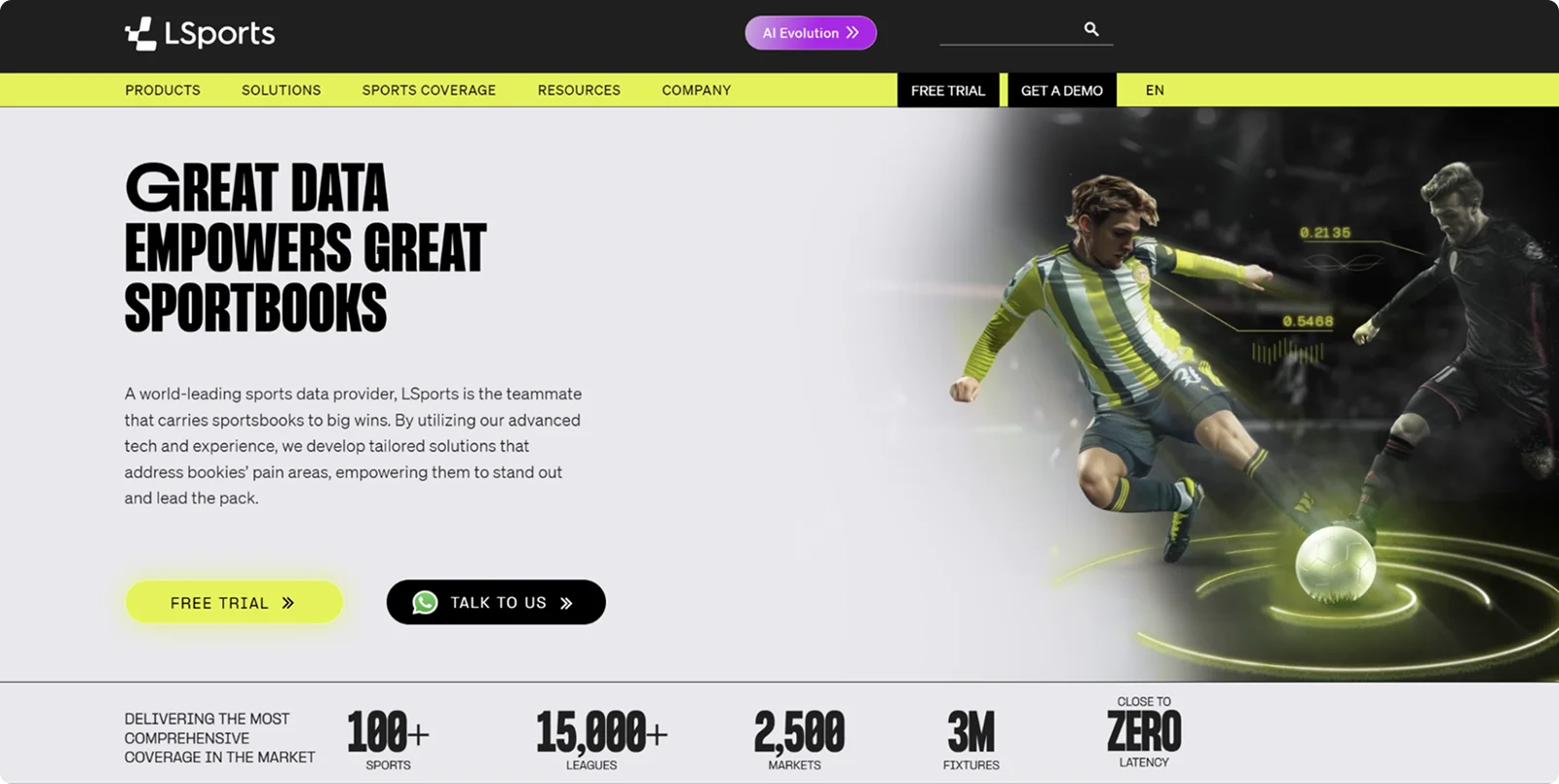
LSports was built on a straightforward premise: sportsbooks shouldn’t have to choose between data quality and financial sustainability.
An independent provider, LSports uses web scouting, AI, and computer vision to collect real-time data from over 100 live sources, bypassing exclusive rights and delivering accuracy without the markup. The result is coverage of 100+ sports, 15,000+ leagues, 2,500 markets, and 3 million+ annual fixtures, with close-to-zero latency.
Another way LSports contributes to cost efficiency is through ARENA360, an all-in-one platform that consolidates trading, risk, analytics, and user engagement into a single ecosystem:
- TRADE: Pre-match and in-play odds, live scores, statistics, and automated settlements with configurable margins and suspension logic
- DEFEND: Automated risk management with granular exposure controls by sport, competition, fixture, or player
- BOOST: Real-time performance analytics that surface coverage gaps and margin inefficiencies
- ENGAGE: Player retention tools, including an AI-powered betting chat and live visualizations, without rights-driven frontend costs
This architecture eliminates the vendor sprawl and ensures every module works together without friction. LSports complements Tier 1 feeds rather than replacing them, adding depth and tooling where official providers leave gaps or move too slowly.
Don’t let rising data costs or fragmented tooling hold your sportsbook back. Sign up for a free trial with LSports and experience the perks first-hand.
Frequently asked questions
Why are sports data costs difficult to find online?
Enterprise needs tend to vary, so providing ready-made tiers is not practical. To ensure the right fit, providers negotiate pricing individually based on data volume, sport selection, intended use, and operational scale. Usually, only smaller API providers publish fixed rate cards.
Why is real-time sports data usually expensive?
Sub-second delivery requires distributed server infrastructure, redundant connections, AI processing pipelines, and 24/7 monitoring. Official data also carries rights fees that get passed through to clients. The combination of technical overhead and licensing is what pushes real-time feeds well above delayed data products.
Is there a free sports data API?
Yes, many providers offer free tiers. However, these plans usually come with strict rate limits and limited coverage, which makes them unsuitable for production sportsbook environments.