
The table below summarizes our top picks’ offerings along with the sports they cover:


LSports is a provider that combines a comprehensive odds API with a full operational platform, called ARENA360. While most competitors either sell raw odds feeds or complete turnkey sportsbooks, LSports’s modular platform covers every layer of sportsbook operations.
At the data level, LSports independently collects information from over 100 live sources using AI-powered computer vision and web scouting. This means operators can access feeds covering 100+ sports, 15,000+ leagues, 2,500 markets, and over 175,000 pre-match events per month without monopoly-level prices.
The odds API itself comes in two forms. OddService delivers raw bookmaker lines from 100+ global operators, giving trading teams full transparency into market-wide pricing. TRADE goes further and generates customized average odds based on operator-defined preferences. It offers built-in margin control, automated suspensions triggered by real-time conditions, and settlement, all in a single feed with 0–1 second latency for in-play events.
Other ARENA360 modules support your entire sportsbook operation:
If you want even less operational burden, LSports offers a Managed Trade Service that handles day-to-day trading on your behalf, freeing you to focus on marketing and player acquisition.
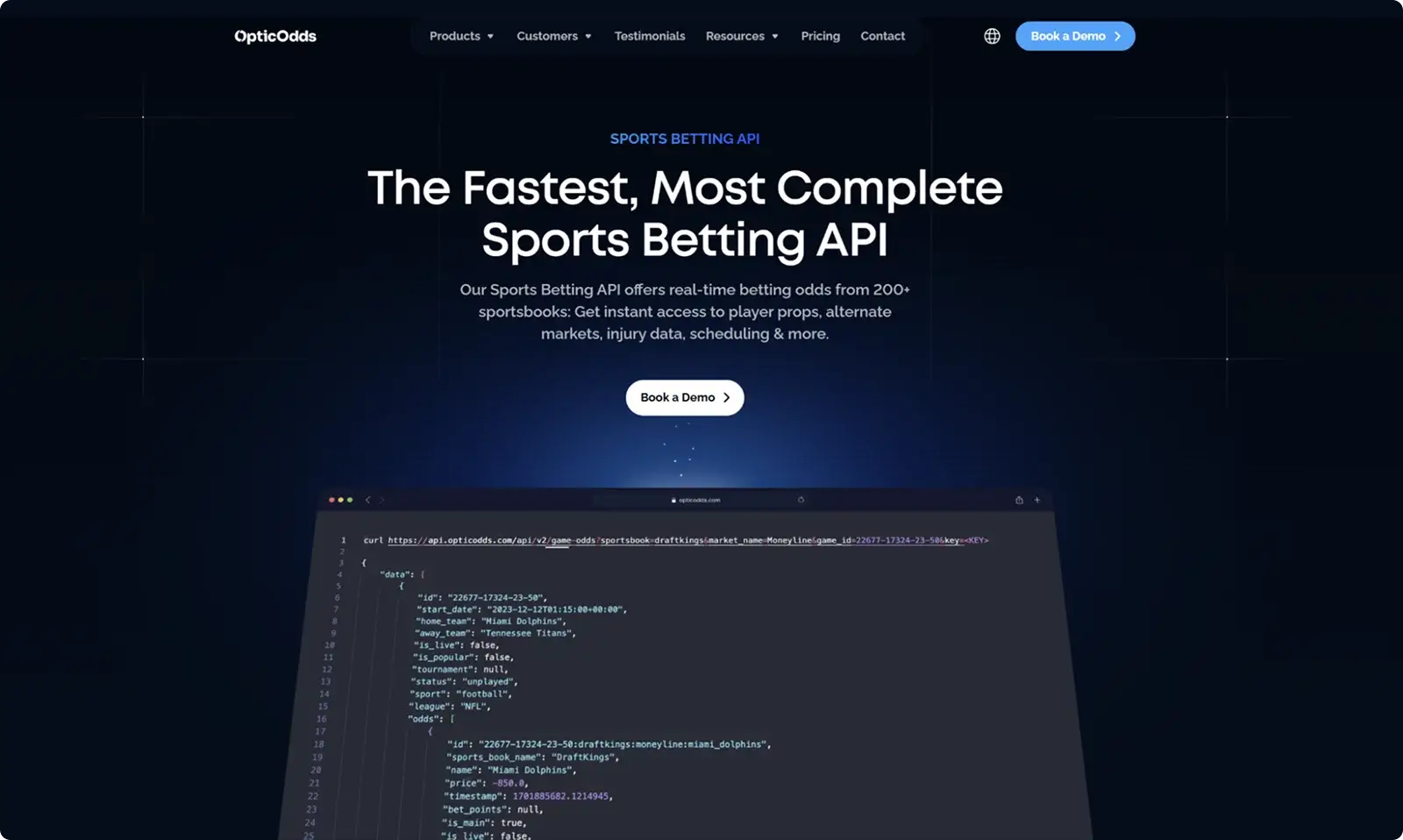
OpticOdds has built its reputation on aggregation speed. The platform pulls real-time odds from over 200 sportsbooks globally and standardizes them into a single unified feed.
The feed covers main lines, alternate spreads, player props, outrights, and futures. It was built by former traders and quants, and that background shows in the product’s focus on low latency and trading-oriented tools, such as:
The main limitation is scope. OpticOdds is primarily an odds infrastructure provider. Operators seeking risk management and engagement tools will need separate solutions. Additionally, since OpticOdds aggregates rather than independently collects data, feed quality depends on the underlying sources it pulls from.
OddsMatrix, powered by EveryMatrix, provides pre-live and live odds feeds designed to plug directly into sportsbook platforms.
Coverage spans over 75 traditional sports and 23 esports titles, with more than 150,000 pre-live and 170,000 live matches processed monthly. Odds accuracy is cross-checked against 92 pre-live providers, 43 live odds sources, and 39 score providers.
The product lineup extends beyond basic odds. OddsMatrix offers a Market Data Feed for odds comparison and affiliate sites, Historical Odds archives spanning multiple years, and frontend Data Widgets for live match tracking. The back-office provides tools to manage payouts and adjust odds, with automated settlement covering roughly 99% of markets.
OddsMatrix serves around 40 B2C and B2B companies, which is a small client base compared to leading providers. Additionally, the total operational costs could pose a challenge for growing books. The sticker price may be competitive, but internal workarounds, manual fixes, and support overhead tend to accumulate.

Sportmonks specializes in three sports:
Still, its football offering is the most comprehensive, covering 2,500+ leagues worldwide with tiered plans from a 27-league European package to full enterprise access. Data spans live scores, match events, standings, player stats, expected goals, and predictions.
Sportmonks manages data through an in-house scouting platform with dedicated scout teams worldwide. Additionally, the Premium Odds Feed, built with TXOdds, gives operators sharp bookmaker pricing for proprietary trading models. Developer experience is another strong point. Sportmonks offers a clean, well-documented REST API that allows integration within days.
However, Sportmonks is best suited as a supplementary feed for football-oriented operators. Others will likely find Sportmonks limiting, as it covers only three sports and offers few features beyond the data feed.

Unlike Sportmonks, Kambi is a full sportsbook technology company that also offers standalone odds feeds. Odds Feed+ is a product designed for operators who want Kambi’s pricing quality without adopting the complete turnkey sportsbook.
The key differentiator for Kambi is liquidity-backed pricing. Kambi’s odds are shaped by billions of bets placed across six million active players on its turnkey platform, which creates a feedback loop that sharpens accuracy over time.
The feed covers 100+ sports with over one million pre-match and 450,000 live markets annually. The platform also includes AI-driven pricing, an integrated Bet Builder, and cash-out functionality as standard.
On the downside, Kambi is a publicly listed enterprise provider, and its pricing reflects that positioning. Smaller or mid-market operators may find the cost difficult to justify, especially when bundled pricing limits the ability to optimize individual data stack components. The tightly integrated ecosystem may constrain expansion.

Sportradar is the largest sports data company in the market. The company holds official data partnerships with giants like the NBA, NHL, UEFA, and UFC, which give it exclusive access to venue-level data for many top-tier competitions. Its odds products span live odds, pre-game odds, and player markets, as well as:
In heavily regulated markets requiring official data sources, Sportradar is often the default choice. It has enterprise-grade infrastructure, compiles and trades odds in-house, and integrates fraud detection into the pricing layer.
The downside is cost structure and rigidity. Official data rights entail high costs. Also, bundled pricing makes it hard to optimize spend on specific sports or markets, while expansion into out-of-network lower-tier leagues and regions tends to be slow and expensive.
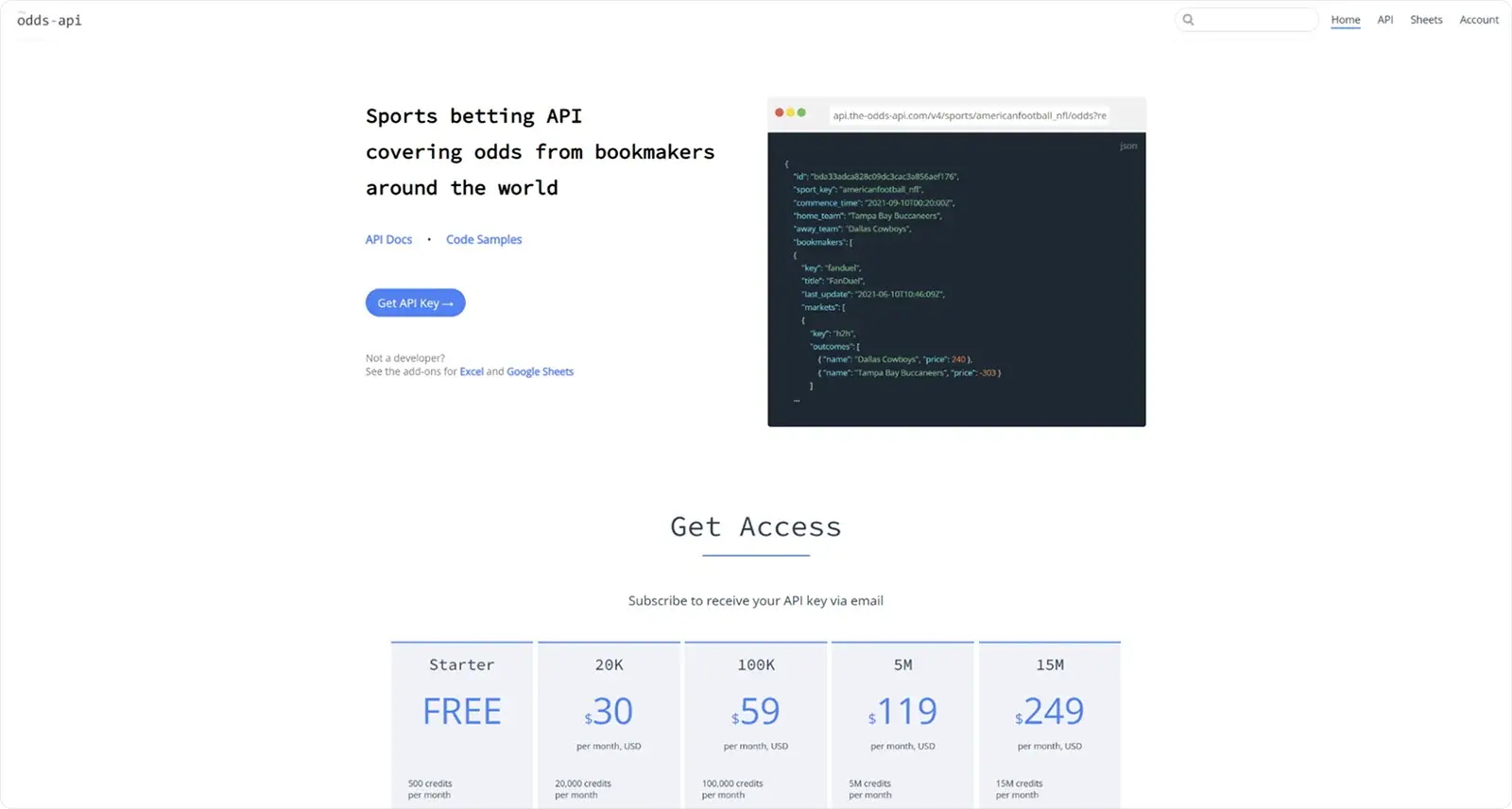
The Odds API is a lightweight, developer-friendly solution that aggregates odds from 40+ global bookmakers across 70+ sports. It covers head-to-head, point spreads, totals, outrights, and an expanding set of player props and alternate markets.
The platform delivers data in JSON format, with Google Sheets and Excel add-ons available for non-technical users. Documentation is clean, integration typically takes days instead of weeks, and pricing scales affordably. For startups building odds comparison tools, affiliate platforms, or lightweight betting apps, it provides a solid foundation with low overhead.
That said, the caveats become clear for bookmakers running a real trading desk. There is no trading engine, risk management layer, or settlement automation. Also, latency may not meet the sub-second requirements of serious in-play trading.
Consider your priorities to select the best odds feed provider for your operations. For example, Sportradar remains the default in heavily regulated environments mandating official data, but the price can be overwhelming. In contrast, the Odds API and OddsMatrix are more affordable and better-suited for lighter-weight or content-diversification use cases.
For operators looking to balance speed, coverage, cost efficiency, and feature range, LSports is the all-around best sports betting API.
Its independent data collection model frees sportsbooks from monopoly pricing, while ARENA360 eliminates the need to stitch together separate vendors for odds, risk, intelligence, and engagement. This consolidated approach reduces both cost and complexity, enabling smoother scaling.
Sign up for a free trial and see how integrating with LSports can simplify your data stack and sharpen your competitive edge.
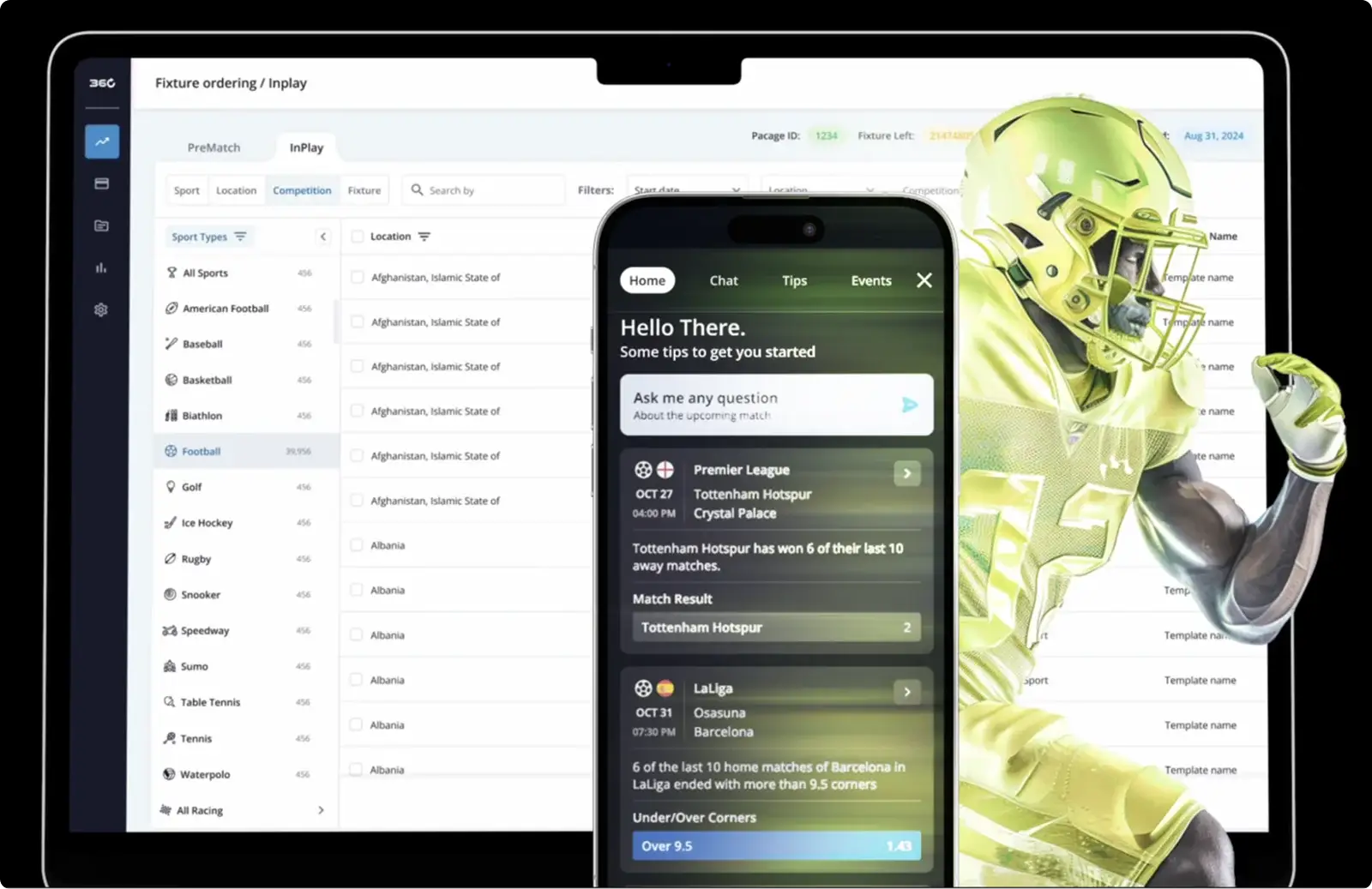
A sports betting API is a data interface that delivers live scores, odds, statistics, fixtures, and settlement information directly to a sportsbook platform. It connects the provider’s data infrastructure to the operator’s front end and trading systems. The API handles the constant flow of real-time updates that power pre-match and in-play markets, calculate odds movement, and settle bets after events conclude.
Yes: some providers offer free tiers and trials. For instance, The Odds API features a tier with 500 monthly credits, covering basic moneyline, spread, and totals markets. While these options work for prototyping and small-scale comparison tools, they’re limited in terms of coverage and speed, so they’re not suitable for high-volume sportsbooks.
Account for these factors when choosing your provider: