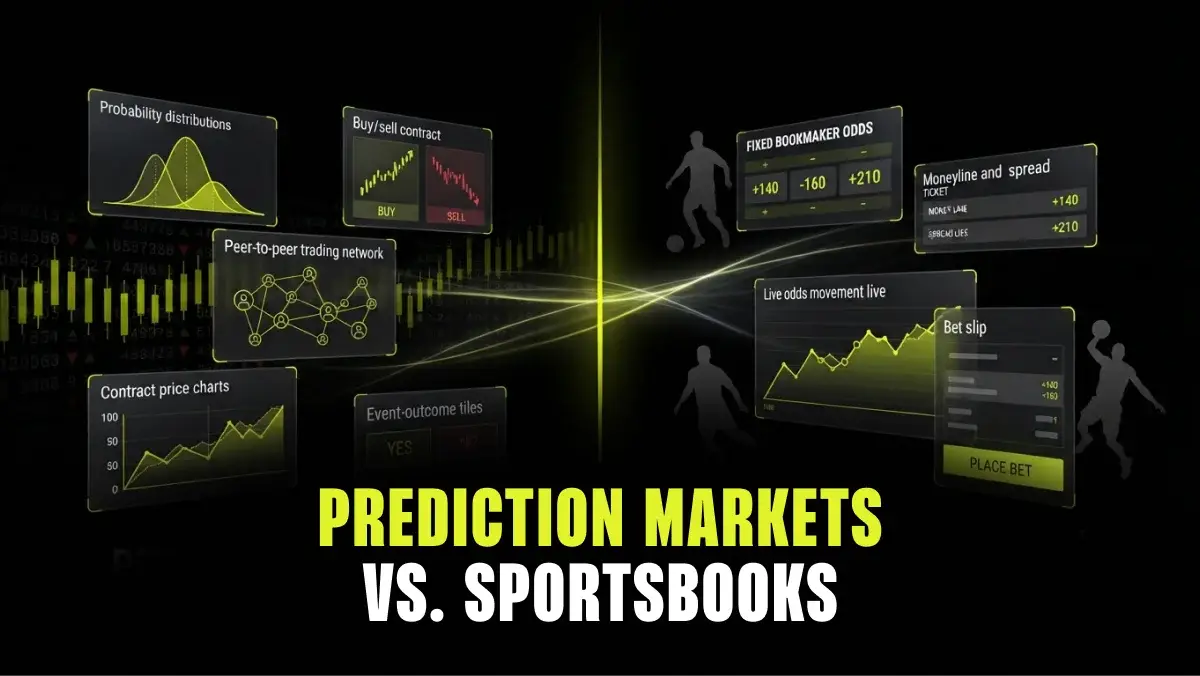

Sportsbooks offer fixed-odds betting against the house, while prediction markets let users trade contracts with each other based on the likelihood of future events.
By adding prediction markets to your sportsbook, you give users more reasons to stay active on your platform even when there are fewer sporting events.
Look for a solution that provides reliable APIs, real-time data, regulatory support, scalable infrastructure, and enough liquidity to deliver a smooth user experience.
Regulatory compliance, market liquidity, and a user-friendly platform design all play a major role in driving adoption and long-term success.
With a single integration, LSports provides the sportsbook technology, real-time data, and prediction market infrastructure needed to expand your offering without the operational complexity.
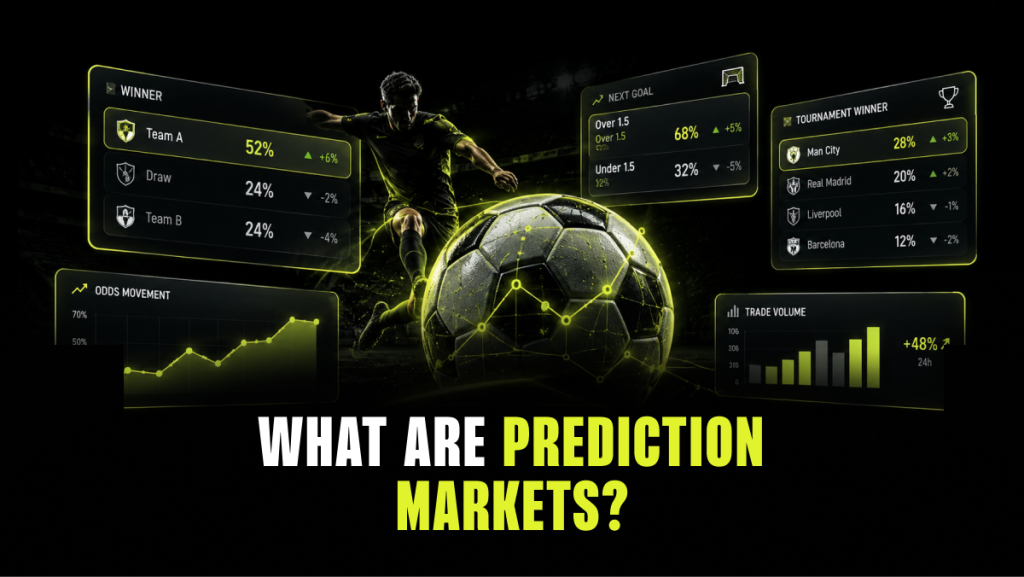
Prediction markets are exchange-based platforms where users buy and sell contracts tied to the outcome of future events, such as:

Instead of betting against a bookmaker, participants trade with one another, and contract prices fluctuate based on supply and demand, reflecting the market’s estimate of how likely an event is to happen. If the event happens, the contract is worth its full value. If not, it expires with no value. Participants can also trade their contracts at any time before the event is settled.
Sportsbooks are platforms where users place bets on the outcome of sporting events. Bettors wager directly against the sportsbook, which sets the odds, manages the risk, and pays out winning bets while building a margin into its pricing.

Sportsbooks operate under local gambling regulations in the markets where they are licensed and offer a wide variety of betting options, including:
At first glance, prediction markets and sportsbooks may appear similar because both let users profit from correctly predicting outcomes, but they operate under very different models. Here are the key differences:
Prediction markets rely on market-based pricing rather than bookmaker-set odds. Every contract has a value between $0 and $1 that directly represents the market’s estimated probability of an outcome. That price changes continuously as traders buy and sell based on new information.
Because participants trade against one another instead of the platform, prices are shaped by collective market sentiment, with traders paying only transaction fees rather than a built-in house margin.
Sportsbooks create and manage their own odds using statistical models, historical data, trader expertise, and customer betting behavior. These odds are intentionally priced with a margin (vig) to guarantee long-term profitability and are adjusted whenever new information emerges or betting liability becomes unbalanced.
Prediction markets are not limited to sports and can offer markets on almost any real-world event. This flexibility allows platforms to attract a wider pool of users and generate engagement even when the sports calendar is quiet.
Sportsbooks are built primarily around sporting events, offering extensive coverage through markets such as:
Although some sportsbook operators introduce novelty markets around elections, award ceremonies, or major cultural events, these are typically available only in certain jurisdictions due to regulatory constraints.
In the United States, regulated prediction markets are generally overseen at the federal level because their contracts are classified as financial derivatives. In theory, this allows approved operators to offer markets nationwide under a single regulatory framework focused on transparency, fair settlement, and market integrity.
However, a majority of states argue that certain prediction market contracts function as sports betting and should instead fall under state gambling laws, making the legal landscape an ongoing subject of litigation.
Crypto-based prediction markets generally face even greater legal uncertainty, as many operate outside established regulatory frameworks and many jurisdictions have yet to develop clear rules for them.
Sportsbooks are regulated under gambling laws at the state or national level. Every jurisdiction has its own:
This means sportsbook operators must obtain separate gambling licenses to operate in each jurisdiction and comply with different regulations in every market they enter. This makes expansion more complex than for federally regulated prediction market platforms.
Prediction markets resemble trading platforms more than betting apps. Users can enter and exit positions before an event is settled, trade with other participants, and take advantage of changing market sentiment over time.
However, liquidity depends on how many traders are active in a particular market, so niche events may have wider spreads and fewer trading opportunities.
Sportsbooks are built around a faster, more streamlined betting experience, allowing users to place wagers with just a few clicks. Major sporting events typically attract enough betting volume to support high liquidity and larger stake limits, creating a smooth experience for most bettors.
Prediction markets can match or even exceed that liquidity for popular events, but activity is generally less consistent across smaller or more specialized markets.
Prediction markets generally do not assume financial exposure to the outcome of an event. This makes risk management less about balancing liability and more about maintaining market integrity, ensuring sufficient liquidity, and settling contracts accurately.
Sportsbooks are directly exposed to customer betting activity and must actively manage their liability. To reduce risk, operators continuously monitor betting activity and adjust odds to balance liability across different outcomes. They may also set maximum stake limits or temporarily suspend betting when breaking news or unusual wagering patterns create excessive financial risk.
As customer expectations evolve and new markets gain traction, adding prediction market functionality can help you:
Building a prediction market from scratch requires exchange technology, order matching, settlement systems, liquidity management, and ongoing maintenance. That’s why integrating an existing prediction market solution is a faster and more cost-effective option.
Look for providers that offer:
However, before selecting a solution, there are several important factors to evaluate:

Choosing a technology partner that supports both your existing sportsbook products and your prediction market offering simplifies integration and eliminates the need to manage multiple vendors. This is exactly what LSports offers.
LSports is a global leader in sports data solutions, helping you increase profitability, improve player engagement, and stay competitive through high-quality data and advanced betting technology. Its data is aggregated from more than 100 live feeds and delivered with near-zero latency, ensuring reliable, real-time performance even during the busiest live events.
LSports provides extensive coverage of lower-tier and regional leagues, allowing you to expand your betting offering and keep users engaged across more events. Its coverage includes 100+ sports, 15,000+ leagues, 2,500 betting markets, and 3 million fixtures annually.
To support sportsbook operations, LSports offers ARENA360, an all-in-one platform with four integrated modules:
Beyond traditional sports betting, LSports also enables you to expand into prediction markets via the same integration. You gain access to everything needed to launch and manage these markets, including live odds, futures contracts, contract rules, and automated settlement data.
You can offer prediction markets across a wide range of categories, including:
Start your free trial today and explore how LSports can power both your sportsbook and prediction market offering through a single integration.
Prediction markets can complement virtually any sport, including favorites like soccer, basketball, and tennis, as well as esports and niche competitions.
Unlikely. Most bettors still prefer the simplicity and familiarity of fixed-odds betting, while prediction markets appeal to users who enjoy trading and forecasting. For many operators, the biggest opportunity lies in offering both rather than choosing one over the other.
It depends on the jurisdiction. Prediction markets may be subject to different regulations than traditional sports betting, so you should carefully review local licensing requirements and compliance obligations before adding them to your platform.
Liquidity determines how easily users can buy or sell contracts at competitive prices. Markets with higher liquidity generally offer tighter spreads, faster trade execution, and a smoother trading experience, while low-liquidity markets can make trading more difficult.
Not necessarily. Many technology providers allow you to integrate prediction markets into your existing platform through a single API, reducing development time and operational complexity.