11月9 ,2026
Tennis Betting Risk Management Strategies for Sportsbooks
Explore tennis betting risk management strategies for sportsbooks, from setting limits and monitoring exposure to adjusting live odds and suspending markets.


在本文中
订阅
保持领先地位
获取有关体育数据、博彩趋势和行业新闻的最新见解——直接发送到您的收件箱。
这是一个标题
Tennis betting risk management is the process of identifying, monitoring, and controlling the financial, pricing, integrity, and operational risks your sportsbook faces when offering tennis markets.
Tennis odds can change after almost every point, and your sportsbook needs to manage thousands of pre-match and in-play markets across different tournaments. Without effective risk controls, delayed data updates and inaccurate odds can increase your exposure to financial losses.
In this article, you’ll discover six tennis betting risk management strategies that can help you spot potential threats earlier, protect your margins, and manage your tennis markets more effectively.
要点总结
- Tennis pricing needs more than rankings and recent results
Consider surface performance, opponent strength, playing conditions, matchup styles, match format, workload, and injury history when setting your markets.
- Fast, reliable live data is critical for limiting courtsiding risk
Because every point can immediately change a market, low-latency feeds, bet revalidation, acceptance delays, and automatic suspensions can help prevent wagers from being placed against stale odds.
- Risk should be managed across markets, customers, and entire match outcomes
Monitor suspicious betting patterns and related accounts, measure combined exposure across correlated markets, and use correlation-aware pricing for same-match bet combinations.
- Your sportsbook needs safeguards for injuries, retirements, and data failures
Clear settlement rules, reliable match-status updates, automatic market suspensions, and a tested backup feed can help you respond when a match or your underlying data becomes uncertain.
- LSports combines tennis data and risk controls in one ecosystem
LSports’ Tennis Data API provides 125,000 annual fixtures, 150+ unique markets, and 2,000+ tournaments, while DEFEND helps you monitor exposure, customize limits, apply granular controls, and automate risk management across your sportsbook.
What is tennis betting?
Tennis betting is wagering on the outcome of tennis matches and tournaments, as well as on events within a match, such as sets, games, and points. It’s one of the fastest-paced forms of live betting, with odds changing after every point. You can offer a wide range of pre-match and live markets, including match winners, set winners, total games, and individual game winners.
What types of bets can you offer in tennis?
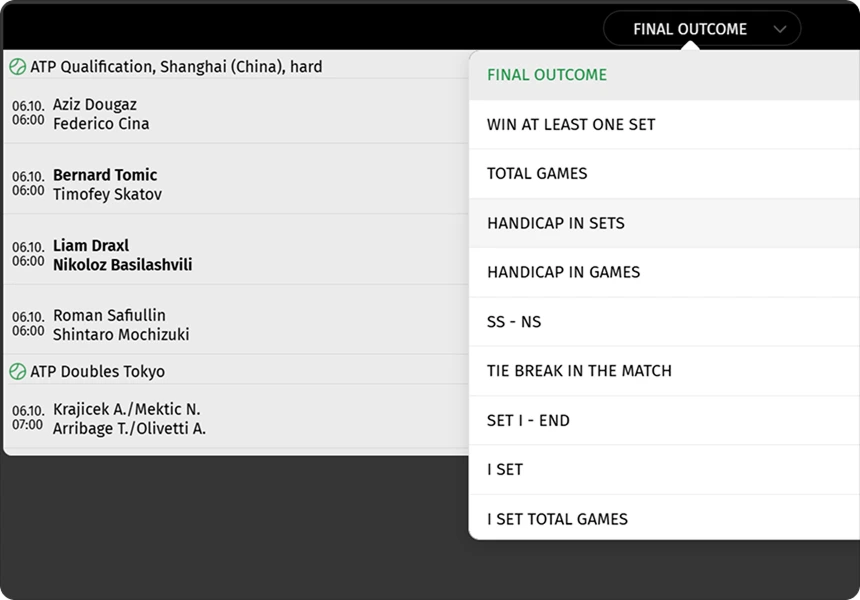
Here are some of the most popular tennis bets you should offer to your customers:
- Match winner: Customers bet on which player or doubles team will win.
- Set winner and correct set score: Set-winner bets predict who will win a particular set, while correct set score bets predict the final set score, such as 2–0 or 2–1.
- Game and set handicaps: A handicap gives one player a virtual advantage or disadvantage, such as -3.5 games, meaning they must finish at least four games ahead for the bet to win.
- Total games and total sets: Bettors predict whether the total number of games or sets will be over or under a line set by your sportsbook.
- Game winner and point markets: These live bets focus on what happens next in a match, such as who will win the next point, game, or tie-break.
- Player statistics and specials: These bets focus on player statistics or specific match events, including aces, double faults, breaks of serve, and tie-breaks.
- Tournament outrights: Instead of a single match, customers predict a tournament outcome, such as who will win or how far a player will progress.
- Multiples and same-match combinations: These bets combine multiple selections from different tennis matches or several outcomes from the same match.
Types of risks in tennis betting and how to manage them
Tennis betting presents several risks that can affect pricing accuracy, market integrity, and overall exposure. Here are some of the main challenges and the best tennis betting risk management strategies to help you address them:
1. Inaccurate pricing and incomplete player information
Rankings and recent results show a player’s general level, but they don’t capture the conditions of a specific match, which can lead to inaccurate prices. Court surface is a great example. A player with a powerful serve may have an advantage on faster grass courts but struggle to achieve the same results on slower clay courts.
To price tennis markets accurately, combine rankings and recent form with matchup-specific factors:
- Compare surface-specific performance: Assess each player's results on the surface being used, especially when enough historical data exists for a reliable comparison.
- Evaluate the strength of recent opponents: Weigh the level of competition a player has faced rather than treating all recent wins and losses equally.
- Consider playing conditions: Adjust for altitude, indoor vs. outdoor play, court speed, and the type of balls used at a particular tournament.
- Assess head-to-head and style matchups: Consider how the players' styles interact, especially in matchups such as a left-handed player facing a right-handed opponent or a big server facing a strong returner.
- Account for the match format: Best-of-five matches can reduce the likelihood of an upset compared with best-of-three matches because the stronger player has more sets to recover from a poor start.
- Factor in workload and time away: Track recent match volume, long matches, injuries, and extended periods away from competition.
- Use lower limits when data is limited: Reduce your exposure when you don't have enough reliable information to price a player or matchup confidently.
2. Live data latency and courtsiding
Courtsiding occurs when someone at a tennis venue uses information about a point's outcome to place a bet before your sportsbook receives the latest score update. Because the bettor already knows the result, these wagers carry little risk for them and are almost certain losses for your sportsbook.
In sports such as soccer, your trading team can suspend a market when a dangerous situation develops, such as a player going one-on-one with the goalkeeper or a penalty being awarded. Tennis is unique because points can end within seconds, and each can change the probability of either player winning the game, set, or match.
To manage this risk, your controls need to reduce the time between what happens on court and when your markets respond:
- Choose a low-latency data provider: Use a provider that can deliver live point and score updates quickly and consistently from the court to your sportsbook.
- Apply bet acceptance delays: Add short delays to fast-moving in-play markets to reduce the advantage of customers receiving information directly from the venue.
- Revalidate bets before acceptance: Check that the score, odds, and market status are still current before confirming a wager.
- Suspend markets during data delays: Stop accepting bets when your feed is delayed, interrupted, or showing an uncertain match state.
- Monitor bet timing: Flag accounts that repeatedly place wagers immediately before score or price updates for further review.
3. Injuries, retirements, and walkovers
Tennis matches can be physically demanding, with best-of-five matches sometimes lasting four or five hours. Fatigue and injuries can significantly affect a player's performance and quickly make your live odds inaccurate.
If a player eventually retires, you also need to determine how different bets should be settled, which can create disputes if your retirement and walkover rules are unclear.
To manage this risk, you need to:
- Set clear retirement and walkover rules: Define in advance how match-winner, set, game, handicap, total, and other markets will be settled when a player retires, is disqualified, or withdraws before the match.
- Use reliable match-status data: Make sure your data provider quickly reports medical timeouts, retirements, walkovers, and other status changes that could affect your markets.
- Suspend markets when an injury creates uncertainty: Temporarily stop accepting bets when a medical timeout or visible physical problem makes your current prices unreliable.
- Adjust exposure when uncertainty remains: Reduce limits or restrict affected markets when there are credible injury concerns but not enough information to justify repricing confidently.
4. Suspicious betting and match integrity
Lower-ranked players earn less prize money while still covering travel and coaching costs, which is one reason lower-tier events carry higher integrity risk for your sportsbook.
In 2025, the International Tennis Integrity Agency (ITIA) received 68 match alerts from the regulated betting industry, including 28 from lower-level men's M15 and M25 tournaments. However, the ITIA stresses that a betting alert does not itself prove that a match was fixed.
Tennis also allows a player to manipulate a single set or game without losing the match, so set, game, and point markets need closer monitoring than the match-winner market.
To manage this risk, you should:
- Monitor unusual betting patterns: Flag sudden increases in stakes, unusual interest in low-profile matches, or concentrated betting on specific sets and games.
- Monitor related accounts: Look for multiple accounts placing similar bets or sharing devices, payment methods, or IP addresses.
- Set appropriate limits: Use lower limits for competitions and markets where available information, liquidity, or integrity risk makes larger exposure difficult to justify.
- Keep detailed records: Preserve bets, timestamps, odds movements, account activity, and other relevant information so you can investigate suspicious activity.
5. Correlated markets and combination pricing
Many tennis markets are closely connected. For example, if a strong favorite dominates a match, they may win the match, cover a -5.5 game handicap, and win 2–0 in sets. These outcomes are more likely to happen together, so treating each bet as an independent risk can underestimate how much your sportsbook could lose on a single match result.
The same problem applies to same-match bet builders. Combining the odds of related selections alone can produce an inaccurate price because one selection can make another more likely.
To manage this risk, you need to:
- Identify correlated markets: Track markets that are likely to win together, such as match winner, set score, game handicaps, and total games.
- Measure combined exposure: Assess how much your sportsbook could lose across all related markets if a particular match result occurs.
- Use correlation-aware pricing: Price same-match combinations based on how each selection affects the probability of the others rather than treating every leg independently.
- Restrict unsupported combinations: Block selections that your system cannot reliably price together or that create excessive correlation.
6. Feed outages and platform failures
Your live tennis markets depend on a continuous flow of scores and other match data. If your data provider experiences an outage or your own system stops processing updates, your markets may continue displaying odds based on an old score.
This is particularly problematic in tennis because a few points can quickly change the probability of winning a game, set, or match.
To manage this risk, you should:
- Automatically suspend stale markets: Configure your system to stop accepting bets when live data hasn’t updated within a set period.
- Monitor your entire data flow: Track the provider connection, internal processing, and odds publication so you can identify where delays or failures occur.
- Use a backup data provider: Maintain a secondary feed that can take over when your primary source becomes unavailable.
- Test your backup feed in advance: Make sure player names, events, markets, scores, and other data are mapped correctly before you need to switch providers.
- Verify data before reopening markets: Confirm the latest score and match status, and review pending wagers before betting resumes.
How LSports can help you manage tennis betting risk
Managing tennis betting risk requires reliable data to keep your markets accurate and the right controls to manage exposure as betting activity changes.
LSports brings you both.
Its Tennis Data API is a leading tennis data solution trusted by 220+ sportsbooks worldwide. You get access to 125,000 annual fixtures, 150+ unique markets, and 2,000+ tournaments, including Grand Slams and ATP, WTA, Challenger, and ITF events, with independent and official feeds available through a single integration.
LSports’ AI and computer vision technology collect data from broadcast and web sources, while its scouting network reports directly from venues. Cross-checking these sources helps you confirm live scores and keep in-play markets current.
As part of its ARENA360 ecosystem, LSports also offers DEFEND, a risk management system that helps you:
- Monitor exposure and betting activity as it develops across your sportsbook
- Set customizable bet limits based on the level of risk you are willing to accept
- Apply granular controls by sport, competition, fixture, or customer betting behavior
- Automate risk controls while maintaining manual oversight for higher-risk bets
Request a demo today and see how LSports can help you deliver faster, more accurate tennis markets while protecting your sportsbook from costly data delays and betting risks.
常见问题解答:
1. Which tennis markets are the riskiest for sportsbooks?
Fast-moving in-play markets, such as next-point and next-game betting, generally carry greater latency risk because prices can become outdated within seconds.
2. How do sportsbooks set betting limits for tennis?
Sportsbooks typically set tennis betting limits based on factors such as the competition, market type, available data, expected liquidity, and customer risk profile. Limits can also change throughout a match as exposure grows or the level of uncertainty changes.
3. How does tennis betting risk differ from other sports?
Tennis creates unusually frequent pricing changes because every point can affect the probability of winning a game, set, and match. It also has no fixed match duration, includes thousands of events across different competition levels, and offers granular in-play markets, making real-time risk management especially important.
4. How can sportsbooks manage risk on lower-level tennis tournaments?
Lower-level events may have less available player information, lower liquidity, and greater integrity concerns than major tournaments. Sportsbooks can respond with lower limits, fewer markets, tighter monitoring, and stricter requirements for the quality and speed of the data used to price them.