
HOME / BLOG

What is In-Play Betting? Everything You Need to Know

What is In-Play Betting_ Everything You Need to Know Cover

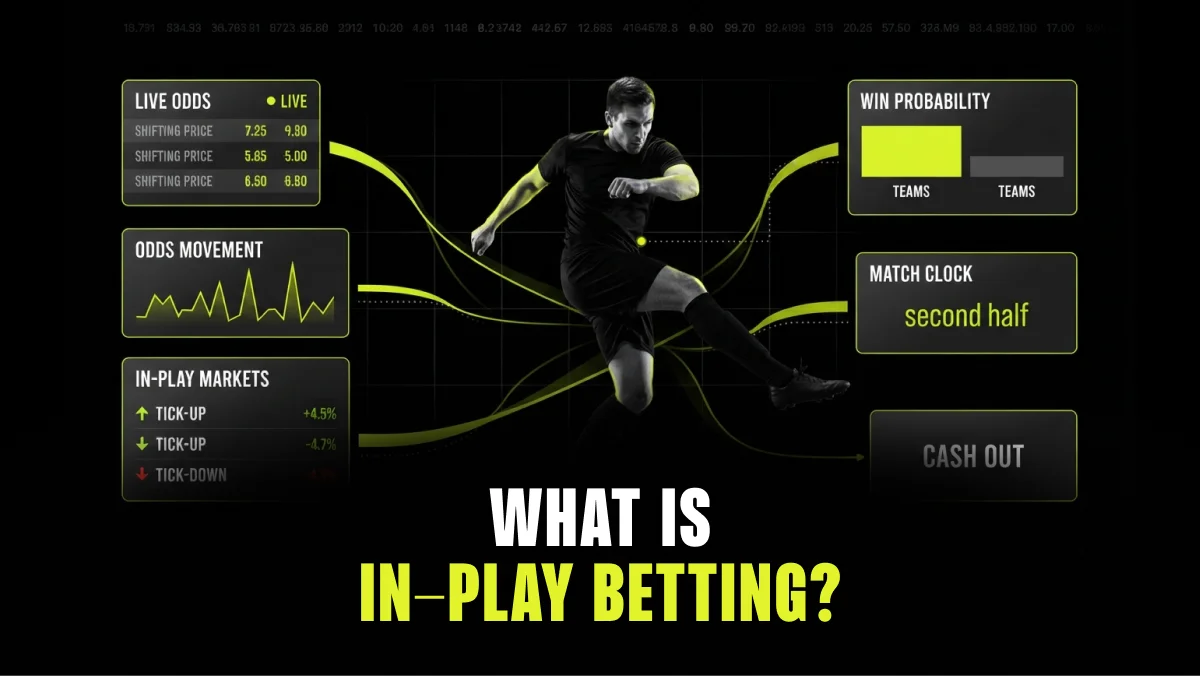
In-play betting allows users to place wagers while a sporting event is underway, with odds and betting markets updating continuously as the action unfolds.

According to an IBIA report based on H2 Gambling Capital data, in-play betting is forecast to generate $47 billion in gross gaming revenue by 2028, accounting for 51% of global online sports betting revenue. For sportsbooks, this means more opportunities to offer bets, increase betting activity, and generate value from matches.

In this article, you’ll learn what in-play betting is and how to implement it successfully.

Yoav ziv 
Subscribe To Our Blog

Key takeaways

  • In-play betting relies on real-time updates

Unlike pre-match betting, live betting requires odds and markets to change continuously as the event unfolds. To keep pricing accurate, you need fast, reliable data and systems that can react within seconds.

  • Live betting creates more betting opportunities

Because markets are updated throughout the event, bettors can place wagers based on what’s happening in real time instead of making all their decisions only before kickoff.

  • Speed and accuracy directly affect profitability

Delayed or inaccurate data can lead to pricing mistakes, incorrect market settlements, customer complaints, and financial losses. The more quickly and accurately your platform reacts to live events, the better protected your sportsbook will be.

  • Managing live betting is more complex than pre-match betting

Every live event can affect multiple betting markets simultaneously, making automated pricing, exposure management, and scalable infrastructure essential for handling thousands of events in parallel.

  • LSports provides the technology needed to power in-play betting

LSports combines AI-powered data collection, ultra-fast live sports data, and ultra-low-latency event delivery through Hyper Feed, giving you everything you need to deliver a smooth in-play betting experience.

What is in-play betting?

In-play betting, also known as live betting, allows users to place bets after a sporting event has started. The odds and available betting markets are continuously updated based on the score, time remaining, player performance, momentum, and other developments.

In-play betting

During key moments, such as a goal, penalty, red card, or video review, betting markets may be temporarily suspended before reopening with updated odds.

In-play betting vs. pre-match betting

Here’s how pre-match and in-play betting compare across the key areas:

Area table

Types of bets available in in-play betting

The live betting markets available depend on the sport, data coverage, and your sportsbook’s trading capabilities. Common in-play betting markets include:

  • Live match winner: Betting on which team or player will win the event
  • Live totals (Over/Under): Betting on whether the total number of goals, points, corners, cards, or another statistic will finish over or under the live line
  • Live spreads and handicaps: Betting on a team or player with a live handicap applied
  • Next scoring event: Betting on which team or player will score the next goal, point, basket, touchdown, or other scoring event
  • Period markets: Betting on the outcome of a specific quarter, half, set, inning, period, round, or map
  • Player props: Betting on individual player statistics, such as goals, assists, points, rebounds, shots, strikeouts, or kills
  • Correct score: Betting on the exact final score of the event
  • Winning margin: Betting on the margin by which a team or player will win
  • Team totals: Betting on whether one team will finish over or under a live total for goals, points, corners, cards, or another statistic
  • Time-based markets: Betting on whether a specific event will occur within a set period, such as the next 10 minutes
  • Microbetting: Betting on the next immediate action, such as the next tennis point, baseball pitch, or football play
  • Esports live markets: Betting on markets such as the match winner, map winner, round winner, kills, objectives, or other game-specific outcomes

What you need to offer in-play betting

Behind every high-quality in-play betting experience is a combination of technologies that keep odds accurate, markets responsive, and risk under control. These include:

1. Fast and reliable live sports data

Every time a goal is scored, a red card is shown, or the clock changes, your sportsbook needs to receive that information almost instantly so it can update the odds.

A solid live data provider should offer:

  • Fast updates so your odds stay in sync with what’s happening in the game
  • Accurate scores and match events to avoid pricing mistakes
  • Reliable data with as few errors or duplicate incidents as possible
  • Redundant data collection so it can continue delivering reliable data if one collection method is interrupted
  • Clear timestamps and data quality checks so your trading team can trust the information

Worth knowing:

LSports uses a multi-layered approach to collect live sports data instead of relying on a single source. It combines a global network of 1,000+ trained scouts with AI and computer vision technology to capture match incidents directly from venues and low-latency TV feeds.

This helps deliver live updates with latency as low as one second without compromising data accuracy and reliability, allowing you to keep in-play markets fast and responsive.

2. A real-time odds and trading engine

A real-time odds and trading engine updates betting odds as a sporting event unfolds. It analyzes every live incident and instantly recalculates the probability of different outcomes so the odds remain accurate.

For example, when a goal is scored, the engine should recalculate not only the match winner market but also related markets such as:

  • Totals
  • Handicaps
  • Correct score
  • Next scorer
  • Team totals

Because a single incident can affect dozens of betting markets, these updates need to happen automatically. This becomes even more important when you manage hundreds or thousands of live events at the same time. Traders can oversee performance, adjust strategies, and intervene when needed, but manually repricing every market isn’t realistic.

3. Automated market suspension and reopening

In-play betting markets need to close immediately whenever a key moment could make the displayed odds inaccurate.

For example, when a penalty is awarded in a soccer match, the chances of that team scoring increase significantly. If you keep the affected markets open before updating odds, bettors can place wagers at prices that no longer reflect the true probability of the outcome.

Market suspension and reopening

To prevent this, the platform should automatically suspend markets during important moments or whenever there is uncertainty about the current state of play. Once the incident has been confirmed and the odds have been updated, those markets should reopen as quickly as possible.

4. Real-time risk and liability management

Every bet your sportsbook accepts changes your overall exposure. During live events, those changes occur constantly, so the platform needs to monitor risk in real time rather than relying on manual oversight.

A real-time risk management system continuously tracks your liability across markets and alerts you when your exposure exceeds predefined limits. You should also be able to set stake limits, apply customer-specific controls, define market exposure thresholds, and automate risk management actions when needed.

A strong risk management system should also help identify:

  • Correlated betting positions
  • Bets placed at outdated odds
  • Unusually large stakes
  • Sudden changes in betting patterns
  • Customers using faster event information
  • High exposure across related markets

5. Fast and accurate bet settlement

Live bettors expect winning bets to be settled as soon as the outcome is known, without waiting for the entire match to end.

For example, if a customer bets that both teams will score within the first 15 minutes and that outcome is confirmed, the bet should be settled immediately so the winnings are available for the next betting opportunity. The same applies to markets such as the next goalscorer, where the ticket should be settled as soon as the goal is officially confirmed.

To deliver this experience, automate settlement wherever possible. You should also have clear processes for handling:

  • Official confirmation of results before settling a market
  • Video reviews (VAR) and other decisions that may temporarily change an outcome
  • Corrected statistics from the data provider
  • Abandoned or postponed events
  • Player retirements and interrupted matches
  • Reversed decisions that affect previously settled markets
  • Data feed errors and settlement corrections

Challenges of offering in-play betting

In-play betting can be an excellent way to increase player engagement, but it also creates new challenges, such as:

  • Data accuracy: If your live data is wrong, your odds will be too. Incorrect scores, player information, or match events can lead to pricing errors, market suspensions, customer complaints, and financial losses.
  • Balancing uptime with protection: Keeping markets open gives bettors more opportunities to wager, but some moments require temporary suspensions to protect your sportsbook. Closing markets too often hurts the user experience, while reopening them too soon increases risk.
  • Latency exploitation and courtsiding: Some bettors may receive information faster than your sportsbook, whether through lower-latency broadcasts or by being inside the venue. They can use that advantage to place bets before your odds have been updated.
  • Managing correlated exposure: Many live markets are linked together. A single match event can affect multiple bets at the same time, so you need to monitor your overall exposure rather than each market individually.
  • Scaling during demand peaks: Traffic can spike during major matches or key moments. Your platform needs to keep updating odds, accepting bets, processing bet slips, and settling markets without slowing down or going offline.
  • Market complexity: Every live market you offer needs its own pricing logic, suspension rules, settlement process, and ongoing maintenance. As your sportsbook expands into more sports and bet types, managing everything becomes much more complex.

Build a better in-play betting experience with LSports

Successfully offering in-play betting depends on much more than simply displaying live odds. You need fast, accurate sports data, ultra-low-latency, automated trading, real-time risk management, and reliable settlement working together in a single ecosystem. That’s where LSports stands out.

LSports combines AI, computer vision, and a global network of more than 1,000 trained scouts to collect live sports data directly from venues and low-latency broadcasts. This multi-layered approach improves both speed and reliability, helping you keep odds synchronized with the action while minimizing data errors.

For sportsbooks that require even faster event delivery, Hyper Feed provides ultra-low-latency live data with confidence scores for every incident, allowing trading teams to react more quickly, optimize market suspensions, and make better-informed pricing decisions. Each event also includes detailed metadata and trace IDs, improving transparency and operational workflows.

Apart from data, LSports offers ARENA360, a platform that brings together the core technologies needed to operate a modern sportsbook:

  • TRADE automates pre-match and in-play trading with real-time odds, sports data, settlement services, and trading tools.
  • DEFEND helps monitor betting activity, manage exposure, and detect suspicious betting patterns through configurable risk controls.
  • BOOST provides real-time analytics on sportsbook performance, market uptime, margins, and data quality, helping operators make faster business decisions.
  • ENGAGE uses AI-powered widgets, visualizations, personalized content, and other interactive features to create richer betting experiences and increase engagement.

Request a demo today and discover how LSports can help you deliver a faster, smarter, and more reliable in-play betting experience.

FAQ:

1. How many live betting markets should a sportsbook offer?

There’s no ideal number. It’s generally better to offer a smaller selection of well-managed live markets with accurate pricing and fast updates than hundreds of markets that are difficult to maintain. As your trading capabilities and data coverage grow, you can gradually expand your live betting offering.

2. Which sports are best suited for in-play betting?

Sports with frequent events and continuous action tend to generate the most in-play betting activity. Football, basketball, tennis, baseball, ice hockey, cricket, and esports are among the most popular because they provide numerous opportunities for odds updates and live betting markets throughout an event.

3. Can in-play betting be fully automated?

Many parts of in-play betting can be automated, including data collection, odds updates, market suspension, risk controls, and bet settlement. However, most sportsbooks still keep traders involved to supervise automated systems, manage unusual situations, and intervene during unexpected events.

4. Does every sporting event support in-play betting?

No. Live betting is only available for events with sufficient real-time data coverage and trading support. Major competitions usually offer the widest range of in-play markets, while lower-tier events may have fewer options depending on the available data and pricing capabilities.
MORE blogs

What is In-Play Betting_ Everything You Need to Know Cover

What is In-Play Betting? Everything You Need to Know

Discover what in-play betting is, how live markets work, and how you can improve odds accuracy,...
How Accurate Are Prediction Markets in 2026 Cover

How Accurate Are Prediction Markets in 2026? [Insights]

Learn how accurate prediction markets are so you can evaluate forecasting reliability, compare market performance, and...
Sportsbook vs. Fantasy_ What Is the Difference Cover

Sportsbook vs. Fantasy: What Is the Difference? [Explained]

Compare sportsbook vs fantasy so you can understand key differences, explore formats, improve engagement & choose...
8 Best OpticOdds Alternatives for Sports Data APIs in 2026 Cover

8 Best OpticOdds Alternatives for Sports Data APIs in 2026

Explore the best OpticOdds alternatives so you can compare sports data APIs, streamline integration, and support...
Sports Data Management_ Definition, Importance, and Best Practices Cover

Sports Data Management: Definition, Importance & Practices

Learn everything about sports data management so you can improve data accuracy, streamline operations, and deliver...
Sportsbook Technology Cover

Sportsbook Technology Explained: 8 Must-Haves for 2026

Explore sportsbook technologies so you can improve operations, strengthen security, enhance player experiences, and build a...

TRUSTED BY MAJOR SPORTSBOOKS 

HEAR IT FROM OUR PARTNERS​