Prediction markets are online platforms where people trade contracts based on the outcomes of future events, such as:
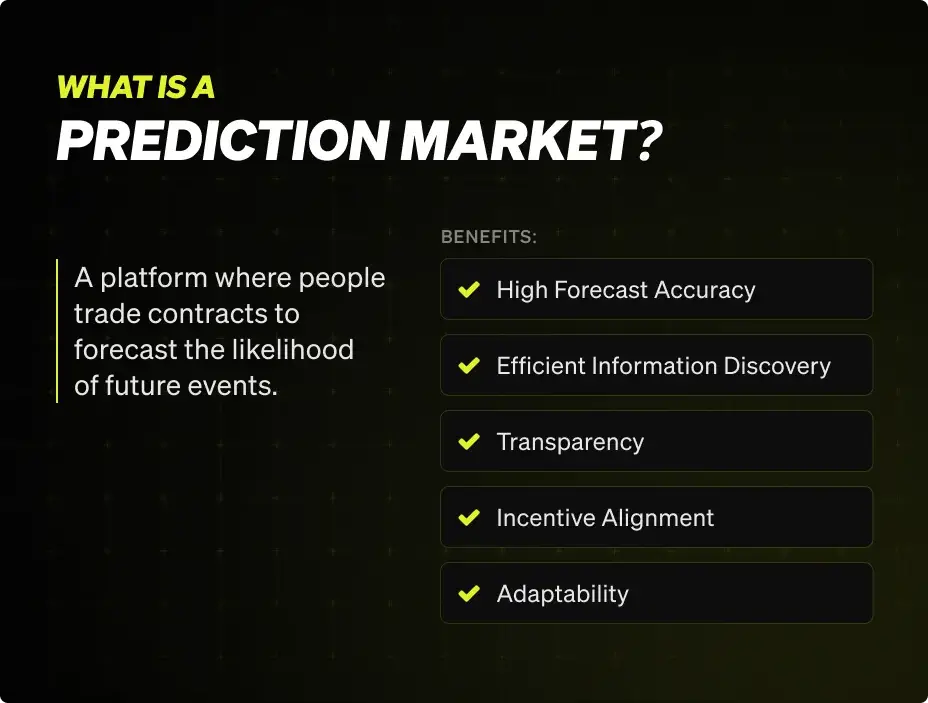
Each contract pays a fixed amount if the event happens, and its price reflects how likely traders think that outcome is, effectively turning crowd opinion into a real-time probability. As more people participate and new information emerges, prices adjust continuously, often leading to highly accurate forecasts.
Unlike stocks or commodity futures, prediction market contracts don’t represent ownership in an asset. Their value comes entirely from the outcome of an event, meaning participants are simply taking a position on whether it will happen.
Sports betting is the process of predicting the outcome of sporting events and placing wagers through a licensed sportsbook or betting platform. Operators set the odds for each market and accept bets upfront, providing users with a structured, regulated environment in which to participate.
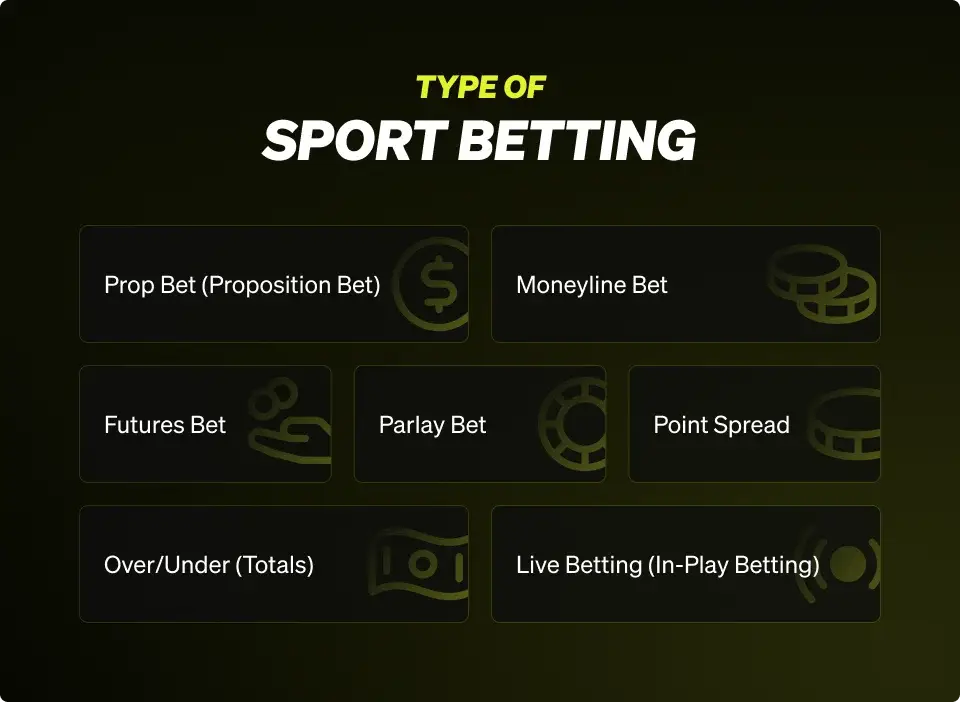
Sports betting spans a wide range of sports and wager types, including:
While both models revolve around backing outcomes, their structures and monetization set them apart. To make those differences clear, we’ll compare them across several key categories:
Prediction markets function like peer-to-peer exchanges. Traders buy and sell contracts directly with each other. The platform itself doesn’t take a position; it simply facilitates trades and earns a fee, much like a stock exchange.
Sports betting works differently. It follows a “house” model, where bettors wager against the bookmaker. The bookmaker sets the odds and effectively takes the opposite side of each bet, aiming to balance action on both sides so it can reliably profit from the built-in margin (the vig).
In prediction markets, prices double as probabilities. If a contract is trading at $0.60, the market is effectively saying there’s a 60% chance the event will happen. These prices update constantly as traders react to new information, making them dynamic and information-driven.
In sports betting, odds are set by the bookmaker and include a built-in margin (known as the vig). Because of this, odds don’t translate directly into true probabilities. They reflect both the likelihood of an outcome and the bookmaker’s profit margin. For instance, American odds of −110 correspond to an implied probability of about 52.4% after accounting for the vig.
Sports betting is widely classified as gambling in most jurisdictions. As a result, operators must obtain gambling licenses and comply with strict requirements, including:
In the United States, sports betting is regulated at the state level, so legality and requirements can vary significantly by state.
Prediction markets, on the other hand, are typically treated as financial instruments, often categorized as derivatives or event contracts. This places them under financial regulatory frameworks rather than gambling laws. In the US, oversight falls under the Commodity Futures Trading Commission (CFTC). Because of this federal regulatory structure, prediction markets can, in some cases, operate across multiple states, even where traditional sports betting remains restricted or illegal.
Sports betting platforms center their offerings around athletic events and competitions. Their main products include wagers on:
While some sportsbooks may also offer occasional novelty bets, such as predictions on end-of-season awards (like MVP or top scorer) or special events, their primary focus remains firmly on sports.
Prediction markets, by contrast, span a much wider range of topics. In addition to sports, they can cover areas such as:
For example, LSports offers a prediction market feed that aggregates markets across categories like elections, entertainment, and economic indicators.
In prediction markets, liquidity comes directly from participants trading with one another. As new information becomes available, traders adjust their positions, which leads to continuous price updates. This creates real-time price discovery, where market prices reflect the collective judgment and sentiment of all participants.
In sports betting, odds are set by bookmakers rather than through direct participant trading. However, with the rise of live betting and micro-betting, odds now update rapidly in response to game events and new information. These adjustments are driven by a combination of statistical models, real-time data, and betting activity.
Prediction markets are designed to reward accuracy. Traders can profit by correctly forecasting outcomes, encouraging them to seek reliable information and act on well-informed beliefs rather than on emotion or bias. Because prices represent probabilities, any mispricing tends to be quickly corrected as other participants step in to take advantage of it.
In sports betting, user behavior is often driven by entertainment and personal preference. Many bettors place wagers based on team loyalty, intuition, or excitement, even though some do rely on data and analysis.
Prediction market operators take on very little direct risk. Since they don’t bet on outcomes themselves, their role is limited to facilitating trades between participants. This means their exposure is minimal, and their revenue depends primarily on platform activity rather than event results.
Sportsbooks, on the other hand, carry significant market risk. Because they take the opposite side of bets, they can lose money if a large number of bettors win. To manage this exposure, bookmakers actively adjust odds, balance action across both sides, and may limit bet sizes or restrict certain players.
Prediction markets and sports betting may differ in structure, but they aren’t entirely separate. There’s meaningful overlap between the two, and in many cases, they can complement each other, particularly from a business standpoint.
Prediction markets are increasingly offering contracts tied to sports outcomes, such as predicting a Super Bowl winner or the number of goals in a match, with over $1 billion in trading volume recorded during the 2026 Super Bowl alone.
For users in states where sports betting isn’t legal, these contracts offer a federally regulated way to engage with sports results. However, regulators are still debating whether these products qualify as gambling, so operators need to closely monitor ongoing legal developments.
Sportsbooks depend on precise data and pricing, and prediction markets can enhance this by providing real-time probability signals. By converting live information into actionable insights, they enable operators to adjust odds more dynamically and manage risk more effectively.
Prediction markets help maintain engagement during slower sports periods by offering opportunities across areas like politics, finance, and culture. For sportsbook operators, integrating them through solutions like LSports’ premium prediction market feed extends their offering beyond traditional sports and attracts a broader audience. The feed spans topics like crypto, climate, and health, giving operators a simple way to add meaningful non-sports content.
Sportsbooks can promote prediction markets to users who enjoy analyzing data, making forecasts, and thinking strategically, similar to trading. At the same time, prediction market platforms can introduce traditional sports bettors to a wider range of event-based contracts.
By cross-promoting these offerings, operators can keep users more engaged and encourage them to explore new features, thereby improving long-term retention.
For operators exploring prediction markets or integrating data feeds, there are several important factors to consider:
As prediction markets expand and reshape user engagement with real-world events, they offer sportsbooks a clear path beyond traditional betting models. However, successfully integrating these markets requires more than just access. It demands reliable data, scalable infrastructure, and intelligent risk management tools.
This is where LSports can help you.

LSports is a world-leading sports data solutions provider that equips sportsbooks with the data, automation, and insights needed to maximize profitability and stay competitive. By tracking games, markets, and real-time events at scale, LSports enables operators to deliver accurate odds, improve decision-making, and enhance player engagement.
At the core of its offering is ARENA360, an all-in-one platform designed to manage the entire sportsbook operation through four key components:
LSports also enables sportsbooks to expand beyond traditional betting through its Prediction Markets Feed. The feed aggregates real-time data from leading exchanges, allowing operators to offer markets across areas such as politics, cryptocurrency, and global events. This extends the sportsbook offering beyond the constraints of the sports calendar, creating continuous engagement driven by real-world developments.
For sportsbooks, this means:
Start with LSports today and unlock new revenue streams by seamlessly integrating prediction markets alongside your sportsbook offering.
Prediction markets can improve sportsbook profitability by providing real-time probability signals that help operators refine odds and reduce exposure to sharp bettors. When used alongside traditional pricing models, they enhance risk management and enable more efficient margin control.
Key challenges include ensuring low-latency data delivery, normalizing data from multiple sources, maintaining system scalability during high-volume events, and aligning prediction market pricing with existing sportsbook models without causing inconsistencies in the user experience.
As AI and advanced analytics continue to develop, prediction markets are likely to become even more accurate and responsive. Automated trading strategies, sentiment analysis, and machine learning models could further improve price discovery, making these markets an increasingly powerful tool for both forecasting and sportsbook optimization.